News by Topic: Multimessenger Astronomy
-
January 27, 2023
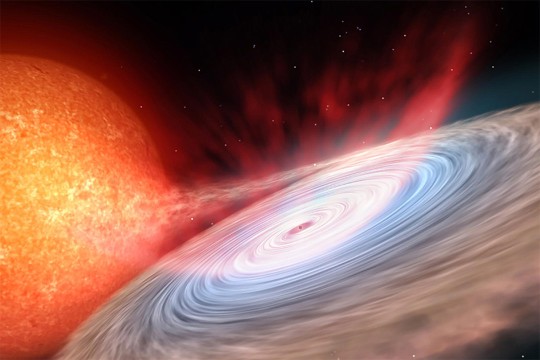
RIT scientists reach a milestone in the search for continuous gravitational waves
Scientists on the hunt for a previously undetected type of gravitational waves believe they are getting close and have refined techniques to use in upcoming observational runs. Researchers from the LIGO-Virgo-KAGRA Collaboration outlined the most sensitive search to date for continuous gravitational waves from a promising source in a paper recently published in the Astrophysical Journal Letters.
-
January 24, 2023

The latest from...space!
WXXI’s “Connections” program features Professor Emeritus Roger Dube.
-
January 10, 2023
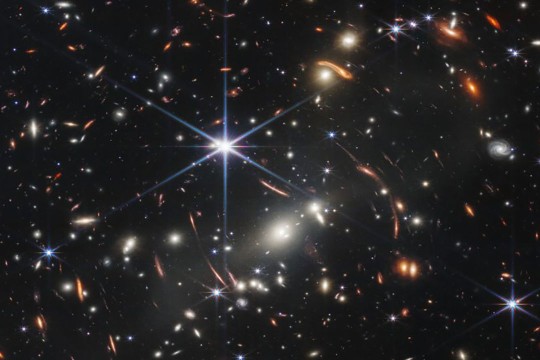
Early James Webb Space Telescope findings take center stage at key astronomy conference
Space.com talks to Jeyhan Kartaltepe, associate professor in the School of Physics and Astronomy, about early galaxies detected by the James Webb Space Telescope.
-
November 21, 2022

Dozens of RIT researchers included on Stanford University’s list of the world’s top 2% of scientists
Numerous Rochester Institute of Technology faculty, professors emeriti, and postdoctoral researchers were recognized as top-cited scientists in their fields, according to a Stanford University study published by Elsevier.
-
May 23, 2022

RIT student Olivia Young receives prestigious NSF Graduate Research Fellowship
Astrophysical sciences and technology Ph.D. student Olivia Young earned a competitive fellowship from the National Science Foundation to develop machine learning algorithms that will help scientists use radio telescopes to study transient objects such as pulsars and fast radio bursts.
-
May 15, 2022
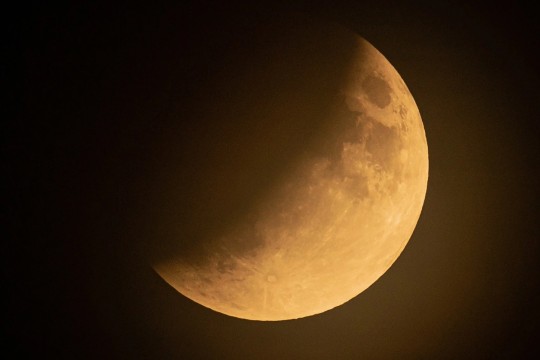
A total lunar eclipse may be visible in Rochester this weekend
WROC-TV interviews Michael Richmond, a professor in RIT's School of Physics and Astronomy, about the total lunar eclipse on May 15-16.
-
March 22, 2022

The universe’s background starlight is twice as bright as expected
ScienceNews talks to Michael Zemcov, associate professor in the School of Physics and Astronomy, about discrepancies in extragalactic background light.
-
February 25, 2022

RIT astrophysicist awarded research leave to study gravitational waves as a Simons Fellow
Richard O’Shaughnessy, an associate professor in RIT’s School of Mathematical Sciences, was awarded a prestigious fellowship to spend the next year preparing for an “onslaught” of gravitational wave discoveries. He is one of 10 faculty worldwide named 2022 Simons Fellows in Theoretical Physics and is the first RIT faculty member to receive the award.
-
January 20, 2022
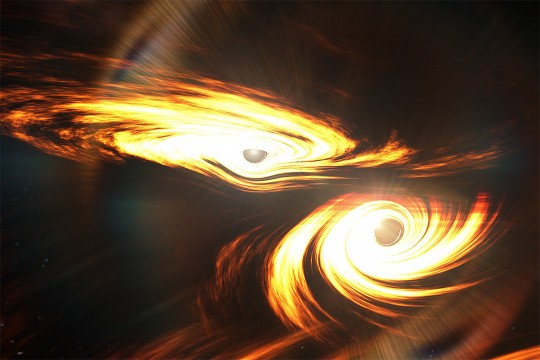
RIT scientists confirm a highly eccentric black hole merger for the first time
For the first time, scientists believe they have detected a merger of two black holes with eccentric orbits. According to a paper published in Nature Astronomy by researchers from RIT and the University of Florida, this can help explain how some of the previous black hole mergers are much heavier than previously thought possible.
-
December 6, 2021
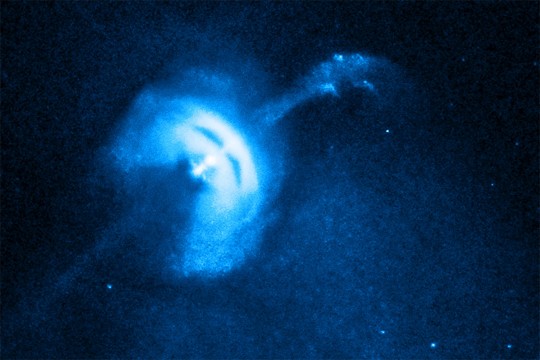
RIT scientists develop machine learning techniques to shed new light on pulsars
New machine learning techniques developed by scientists at Rochester Institute of Technology are revealing important information about how pulsars—rapidly rotating neutron stars—behave. In a new study published by Monthly Notices of the Royal Astronomical Society, the researchers outlined their new techniques and how they applied to study Vela, the brightest radio pulsar in the sky.
-
November 16, 2021

RIT astrophysics graduate students conduct experiment at White Sands Missile Range
Serena Tramm and Mike Ortiz are pursuing their studies in astrophysics and have been working alongside Michael Zemcov, assistant professor in RIT’s School of Physics and Astronomy. Together, the team conducted an experiment that resulted in traveling to New Mexico’s White Sands Missile Range for the first CIBER-2 launch earlier this year.
-
November 8, 2021

LIGO-Virgo-KAGRA Collaboration announces 90 gravitational wave discoveries to date
The LIGO-Virgo-KAGRA Collaboration unveiled several studies that shed important new light on the nature of gravitational waves. They include a “census” of gravitational wave events to date and a new catalog of results from the second half of its third observing run.