Rochester Institute of Technology News
Microsystems Engineering Ph.D.
-
March 30, 2022

RIT researchers contribute integrated photonics technology to develop new point-of-care system for diagnosing coronavirus
RIT’s team will develop the technology needed for a point-of-care diagnostics system built on integrated photonics. Capable of accurate detection of SARS-CoV-2 antibodies, the new system could reduce the need for expensive equipment and specialized expertise to better inform care decisions in underserved, resource-limited communities.
-
March 2, 2022
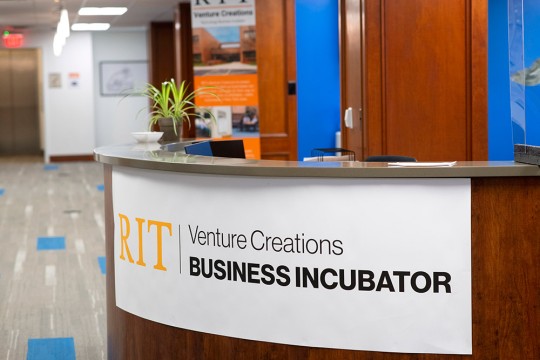
RIT Venture Creations member companies secure $45 million in investment funding
Two member companies at RIT’s Venture Creations business incubator are continuing their upward trajectory with the help of two multimillion-dollar investments: Casana, a healthcare technology firm that is reinventing in-home health monitoring, and Owl Autonomous Imaging (Owl AI), which is developing monocular 3D thermal imaging and ranging solutions for automotive active safety systems.
-
February 3, 2022

Semiconductors at RIT: What they are, how their lab makes them, and how they teach them
WROC-TV talks to Sean Rommel, professor and director of the microelectronic engineering program, and Michael Jackson, associate professor in the Department of Electrical and Microelectronic Engineering, about semiconductors.
-
January 31, 2022

RIT expands Ph.D. portfolio
RIT’s strategic plan calls for adding six to 12 new Ph.D. programs and conferring 50 doctoral degrees every year by 2025. The university already reached the latter goal with 51 Ph.D. degrees conferred in the 2020-2021 academic year.
-
October 11, 2021

RIT receives $1 million grant to upgrade and expand its cleanroom facility
The Kate Gleason College of Engineering was awarded a $1 million Higher Education Capital Matching Grant (HECAP) from New York state. The award will be used to upgrade and expand the college’s cleanroom facility to accommodate the growth of research in biomedical technologies such as drug delivery and lab-on-chip devices.
-
October 8, 2021
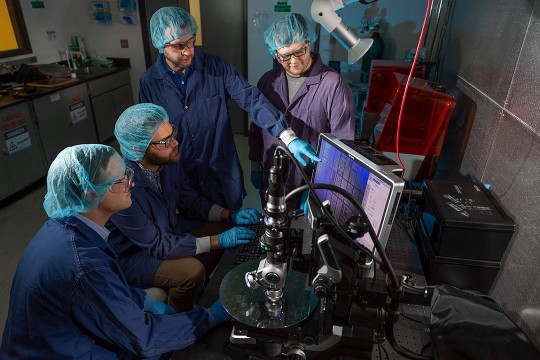
RIT, photonic company build quantum chip prototype to bridge quantum and traditional network bands
Researchers from RIT and national photonic device company, AdvR Inc., built a quantum chip prototype that is bridging today’s traditional fiber optic networks with the future—quantum computing networks.
-
August 30, 2021

Engineering faculty member receives NIH grant to develop biotechnology to better detect sepsis
As one of the leading causes of death in hospitals, sepsis becomes more complicated with the rise in bacteria most resistant to some of today’s antibiotics. If physicians can detect onset earlier, treatments could begin sooner. Ke Du, a mechanical engineering faculty-researcher, will be developing a microfluidic device to improve detection of drug resistant bacteria in blood.
-
June 2, 2021

RIT and SPIE partner on 2021 Photonics for Quantum event
SPIE, the international society for optics and photonics, and RIT will present the 2021 Photonics for Quantum Digital Forum July 16-20. Previously an RIT initiative, this year marks a new iteration of this event in the form of a partnership between RIT and SPIE.
-
May 20, 2021
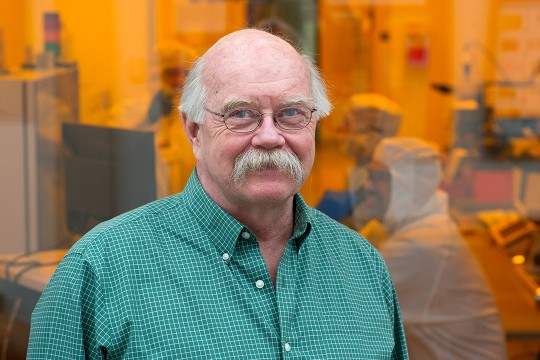
Microelectronic engineering program founder retires from Kate Gleason College of Engineering
President Joe Biden recently called for more resources to bolster the computer chip industry to meet consumer and commercial demands. Lynn Fuller has done more than his share to provide assets for this important industry. Fuller established the first microelectronic engineering program in the country in 1982 at RIT, and today many program graduates lead efforts at the top microchip firms advising the president.
-
May 11, 2021

Ph.D. students take different career paths
More than 50 students are expected to earn their Ph.D. degrees by the end of June. The hooding ceremony, which will also include Ph.D. recipients in the class of 2020, is May 15.
-
April 28, 2021

Alumni join forces to market smart toilet seat
Alumnus Nick Conn’s vision for a one-of-a-kind smart toilet seat that will improve the health of people around the world has made giant leaps toward becoming a reality with the help of one of RIT’s most generous patrons, Austin McChord.
-
April 28, 2021

Ph.D. students complement academic research with internships and co-ops
Undergraduates aren’t the only students taking advantage of RIT’s co-op and internship program. Across the university, Ph.D. students are securing prestigious work experiences to provide important gateways to careers in industry, foundations, and government.