Dual-degree RIT student finds his niche internship with the Smithsonian
Provided
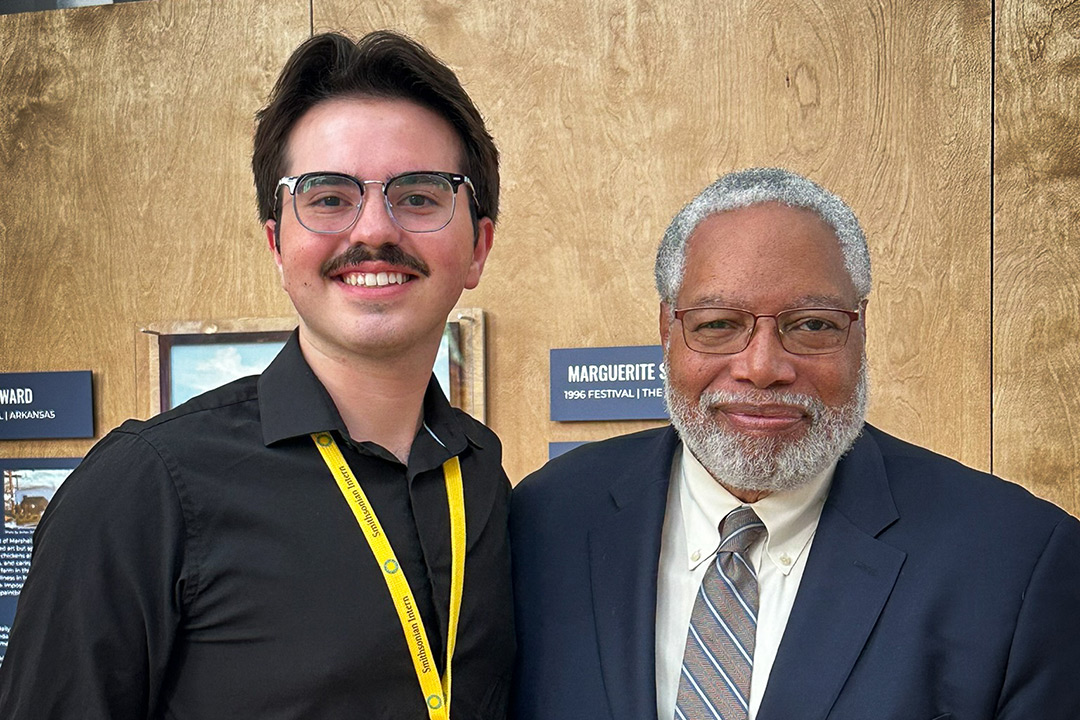
Third-year RIT student Nathaniel Bartsch, left, is completing an internship with the Smithsonian Center for Folklife and Cultural Heritage Storytellers Workshop. He said one of his internship highlights has been conducting a video interview with Secretary of the Smithsonian Lonnie G. Bunch, right.
Creating documentaries for an institution like the Smithsonian Center for Folklife and Cultural Heritage is one of Nathaniel Bartsch’s dream jobs. An internship gave him a chance to see if his dream job could become a reality.
Bartsch, a third-year dual-degree student studying history and film production at Rochester Institute of Technology, is working as a video lead intern for the Smithsonian Center’s Storytellers Workshop. He spent much of his summer documenting cultural festivals from across the nation, and he’ll continue to work with the Smithsonian remotely during the fall semester.
This internship opportunity is the perfect blend of Bartsch’s degrees and allows him to flex his unique expertise in history and film production and prepares him for career success. Experiential learning opportunities are a staple at RIT, which is ranked fifth among co-op/internship programs by U.S. News & World Report.
Spending the summer away from his home in Buffalo, N.Y., to work in Washington, D.C., was made possible through support from the Ruth M. and Brackett H. Clark Internship Support Fund.
How did you find an internship with the Smithsonian, and what was the application process like?
The Center for Folklife and Cultural Heritage is one of the sections of the Smithsonian dedicated to preserving people's voices. I always wanted to try to work there, so when I saw the posting online, I had to apply even though it felt like a longshot. This internship was perfect for me because I was looking for a position at the intersection of my two degrees.
I had to submit a write up describing why I wanted to work there when I applied, and then I gathered recommendations from Professor Tamar Carroll and Associate Professor Michael Brown. All my history and film professors were supportive through the application process. It took a few weeks before I got the e-mail saying that they were very interested in me, but the interview was amazing. I felt like it was the place where I was meant to be.
What kind of work do you do as a video lead?
The Smithsonian usually hosts a Folklife Festival on the National Mall every year. In the past, a person in my role would document that festival, but this year they decided to host a Festival of Festivals aimed at highlighting different cultural events across our nation. So, my work was focused on documenting several festivals over the summer. I couldn’t travel to all of them, but there were several I was able to attend and record footage, like Anacostia’s Juneteenth festival. For festivals out of my reach, I received the content from another videographer.
We’re capturing these videos for social media and for archival purposes. After I film or receive the content, I log the unedited footage and send it to the archive to be filed away. For social media, I'm editing footage and producing videos ranging from 60 to 90 seconds per reel, but it can range to five or six minutes depending on the story we’re trying to tell.
What skills or experiences did you have at RIT that helped you get this internship?
I think the major skill advantage is my pursuit of two degrees in two different disciplines. My split focus on the humanities and film offered the best of both worlds for a documentary videographer role like this. I also already had experience working with oral histories through a project called Remembering the Lambda Network at Kodak, led by Professor Carroll.
I’d say my ability to lead also set me apart. I’m the president of the Phi Kappa Psi fraternity this year, and I’ve held other leadership positions in the fraternity in previous years. I also helped found the RIT chapter of the Phi Alpha Theta history fraternity in Spring of 2026. All those experiences, paired with my past work experience, made me a well-rounded candidate.
How did this internship help you grow, and how will the experience help you in the future?
This internship has given me the real experience of what it means to work on a creative team and to work on projects that are larger than yourself. I've learned how to deal with the stress of tight deadlines, and how to collaborate and communicate with a team that's full of creative people who have different ways of communicating and expressing ideas.
I think that going back to RIT this semester, I’ll have a different perspective in how I approach leadership in my fraternity and clubs. In my film program I can bring a better understanding of how documentation works, and in my history program I can bring a better understanding of oral histories and research methods. I think this internship has prepared me well to start my third year, and, eventually, my career.