Illustration student learns from a pro through annual workshop
Maya Rao, a fourth-year student, relishes the opportunity to learn from artist Kris Starlein
Provided
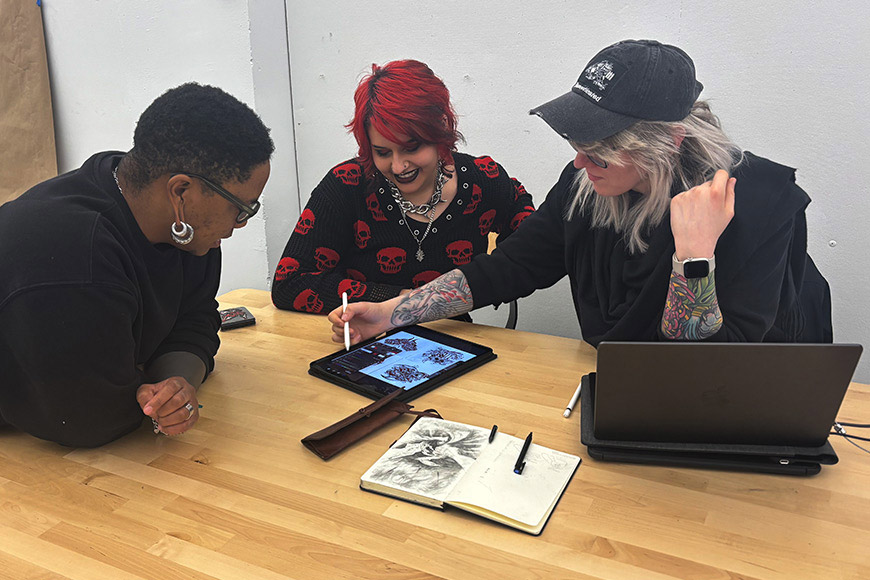
Students in the Presto workshop received direct feedback on their illustrations from Kris Starlein, a self-proclaimed “dark arts” illustrator with over 10 years of experience in licensed merchandising. From left: Assistant Professor Alesha Williams, Maya Rao, and Kris Starlein.
Observing the work of other artists is one of the many ways an illustrator can grow and hone their own skills. Presto, an annual workshop series offered by RIT’s illustration program, aims to facilitate this type of peer-to-peer learning.
During the three-day workshop, participating students are given a prompt to spark their creativity. Students benefit from art demonstrations, open studio time, and educational presentations that dig deeper into the partnering artists’ creative process, and the workshop culminates in a project critique given by the artist.
Provided
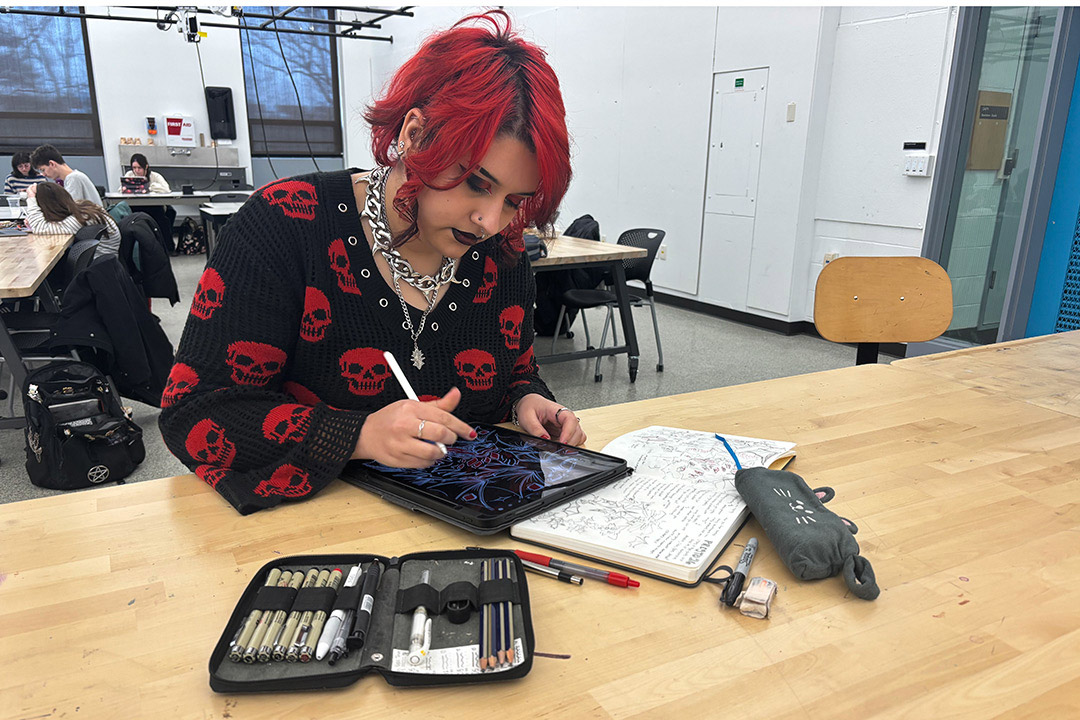
Maya Rao first discovered Starlein’s work as a high school student. They said her art has long been an inspiration for their own work.
This year, illustration students of all year levels are learning from Kris Starlein. A self-described “dark arts illustrator,” Starlein worked for Licensed Merchandising for 10 years and currently works at an independent artist selling her own original works at conventions and online. Starlein has created products, designs, and collections for brands such as Pokémon, Nintendo, Bethesda, and Funimation, and her work can be seen on the shelf at stores like Hot Topic, Spencer’s, Target, and GameStop.
Illustration-centric opportunities like Presto are why Maya Rao, from Cincinnati, chose to come to RIT. The fourth-year illustration and biotechnology and molecular bioscience double major, and RIT Honors Program student, has participated in the workshop in previous years. They said the experiences have helped them grow as an artist by forcing them to stop and observe the art being created around them.
Why did you want to participate in Presto this year?
It's exciting to hear an artist who's working in the field speak about their craft and experience. I think our professors have done a great job finding a variety of artists in very different areas that can give us diverse perspectives to learn from. As an artist, it is always valuable to look at art, even if you don't like it. It can help you learn what you want to do with your own work, and it teaches you how to apply new skills. You never know what might be useful for you in the future. I think making connections and learning about the people in our community is really important.
I’m also very familiar with Kris Starlein’s work. I actually met them at a local convention, Anime Ohio, while I was a high school student. They've been a huge inspiration for me throughout my time as an illustrator.
Why is it valuable to have your work critiqued by a wide array of audiences?
When you have a small faculty cohort that you become familiar with, they also become familiar with you and your work. I think that combination of knowing someone as a person and their artwork can almost make your eyes glaze over during critique. Having a fresh set of eyes from someone who's never seen your work before and doesn't know who you are can really allow them to give a more constructive and critical critique.
What are your biggest highlights from participating in Presto?
The most exciting part is always seeing what my peers produce. Having such a short amount of time to try to make something great with this prompt we’ve been given unleashes a type of creativity that you don't really see at any other time. You feel like you're working together with your entire program toward this collective goal. I think that is something so rare, and that's really the gift of Presto.
I also really enjoyed the artist’s demo because, for the longest time, I have always wondered about Kris’s process and how they design their work. There's a natural flow to their forms, and the way that they use line weight and texture is stunning to me. I was really interested to see how their designs came to be because their artwork has this chaos to it, and yet it feels organized and intentional. To be able to make something that feels abstract, but also has a distinct form, takes a unique skill set.