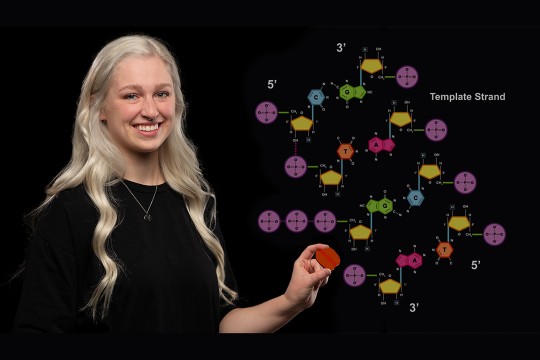
McCarthy develops groundbreaking mammography tool
RIT medical illustration alumna Erica McCarthy is president of Bloom Medical Simulation
Traci Westcott/RIT
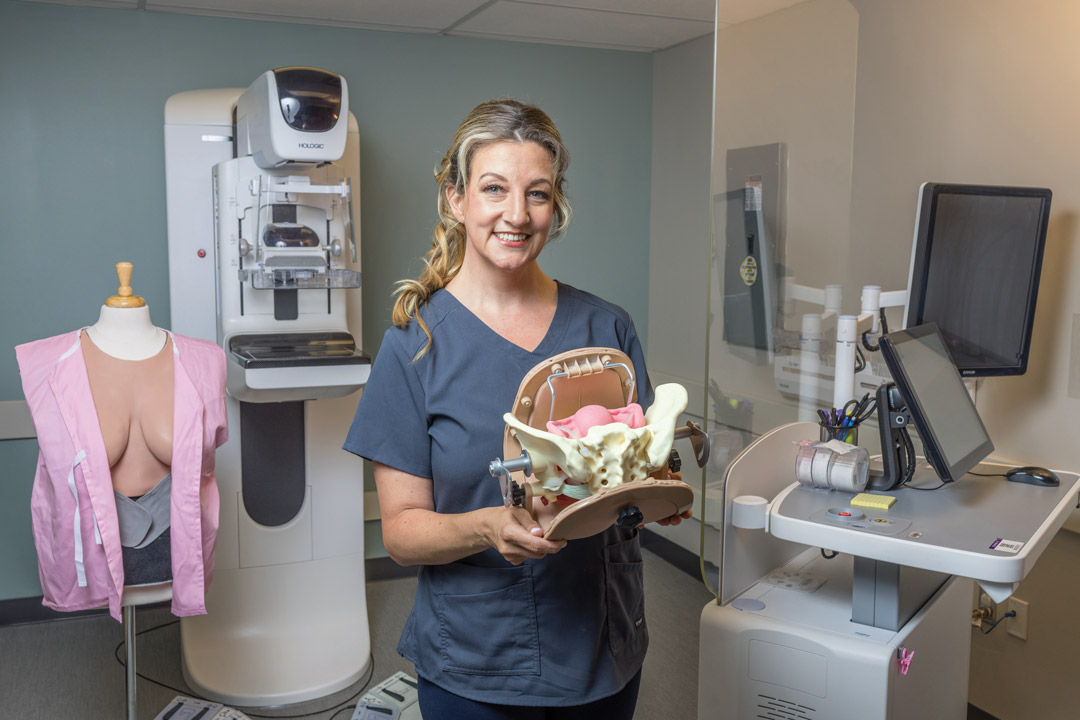
Erica McCarthy ’03 found her niche designing medical simulation tools to support women’s healthcare. Here, she poses with the Miya Model Pelvic Surgery Training Model.
Mammography screening for breast cancer is recommended for all women over 40 years old in the United States, which is roughly 25 percent of the population. But, when it comes to learning the procedure, there is a lack of simulation tools to help train practitioners.
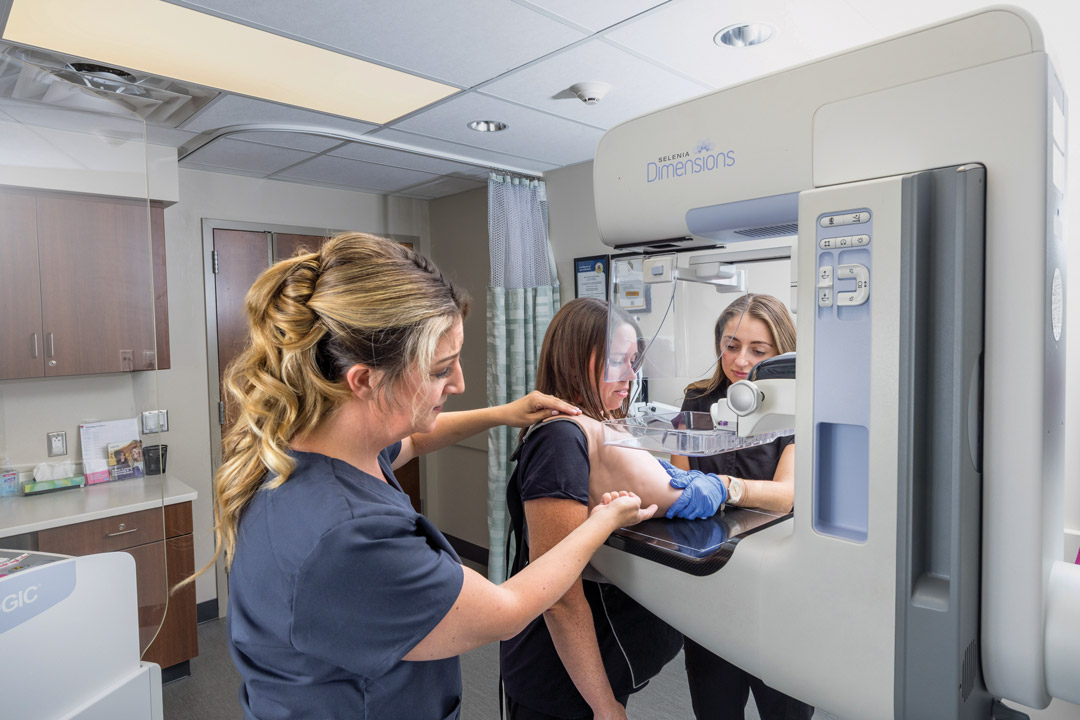
Erica (Neadom) McCarthy ’03 (medical illustration), president of Bloom Medical Simulation, aims to meet this need. Bloom’s flagship product, MammoVest, is the first and only anatomically correct training tool for breast positioning in mammography, providing access to hands-on training without using a real patient.
“Research shows that 10 to 30 percent of breast cancers can be missed by mammography due to positioning errors,” said McCarthy. “A tool like MammoVest can help save the lives of women around the world.”
Bloom is a division of One World Design and Manufacturing Group (OW DMG), which offers advanced educational products and simulations of complex drug delivery systems and human anatomy models. Founded in 2025, McCarthy’s division finds gaps in medical education tools, with a focus on women’s healthcare, and creates high-fidelity medical simulators and task trainers.
“The work we do gives practitioners a chance to physically walk through the steps, gain muscle memory, and ask questions along the way—a chance to learn and make mistakes,” said McCarthy.
Traci Westcott/RIT
McCarthy demonstrates MammoVest for practitioners
McCarthy was hired at OW DMG as a medical illustrator and quickly grew with the company. This growth was made possible through years of studying human anatomy, performing cadaver dissections, and observing and illustrating surgeries as a student at RIT. McCarthy added that woodworking, sculpting, and 3D-modeling classes also aided her success.
“The education I received at RIT was so varied. It really built up my confidence to go out and innovate,” she said.
Prior to MammoVest, McCarthy designed simulation tools like the PELVIC Mentor for Surgical Science, the Bladder Catheterization Simulator for Erler-Zimmer, and the Miya Model Pelvic Surgery Training Model for Miyazaki Enterprises.
MammoVest was originally concepted for Hologic, one of the world’s largest manufacturers of mammography equipment. To avoid using a real person to market their new compression paddle at an industry convention, Hologic asked McCarthy to design a demonstration model.
“The attention the MammoVest prototype got in that booth was incredible. Mammography technologists told us that they were looking for a tool like this their entire lives,” said McCarthy.
In response to demand, Bloom began a pilot program for MammoVest and sold 29 prototype units in seven countries. In 2020, McCarthy received a National Institutes of Health Small Business Innovation Research grant to fully develop the tool. Now, it continues to be employed worldwide.
McCarthy’s passion is to explore solutions that enhance the delivery of women’s healthcare. Another simulator in development, EpisioPants, will help practitioners gain more experience performing and repairing episiotomy, a procedure only conducted in emergency childbirth situations.
“Practitioners learn these procedures in school, but they don’t get much of a chance to practice,” she said. “Our goal is to contribute to this sphere in a very focused way.”