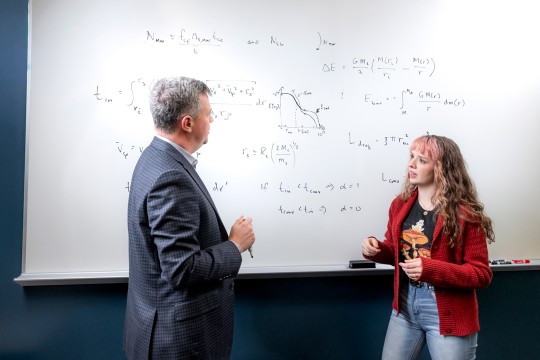
New research confirms an RIT astrophysicist’s theory about the end of a star’s life
Jason Nordhaus’s hypothesis gains validation in ‘Nature,’ leading scientists one step closer to understanding the aftermath of stellar mergers
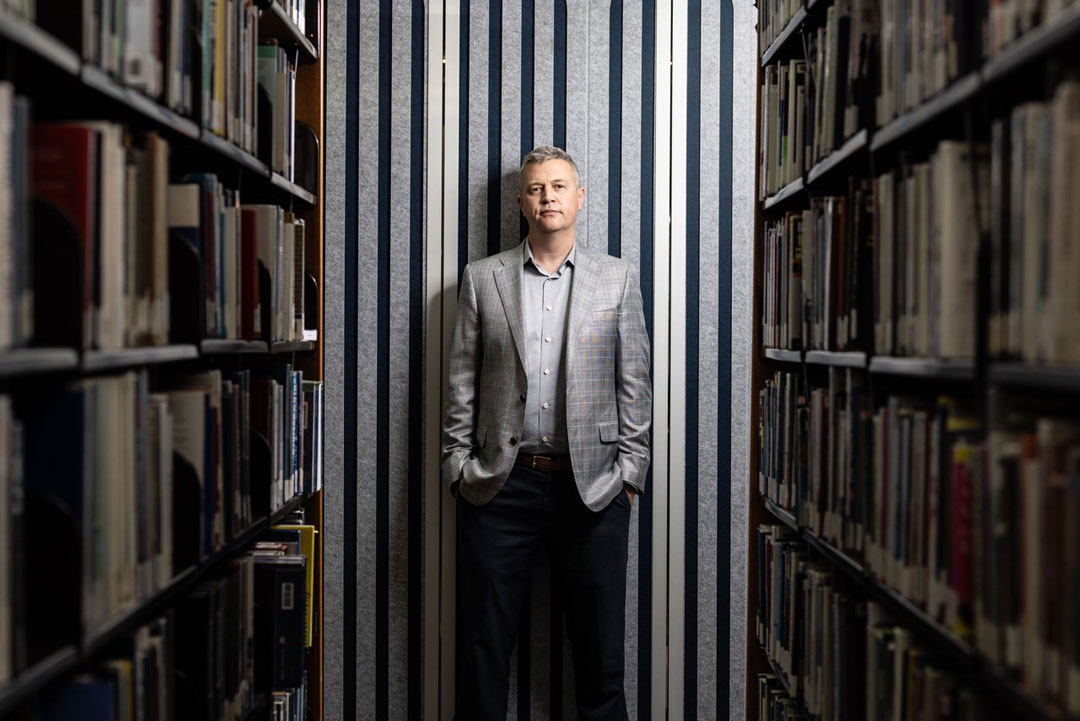
Scott Hamilton/RIT
Jason Nordhaus, professor of physics at RIT’s National Technical Institute for the Deaf, predicted how stars merge and die and has had his theory validated in 'Nature.'
An astrophysicist at Rochester Institute of Technology who predicted what happens when a star nears the end of its life has had his theory confirmed after researchers witnessed, for the first time, a star orbiting inside another star. This phenomenon will move astrophysicists and researchers significantly closer to understanding stellar mergers and “seeing” the internal structure of giant stars.
Jason Nordhaus, professor of physics at RIT’s National Technical Institute for the Deaf, hypothesized what happens when a star nears the end of its life, growing hundreds of times larger than its original size. If another star is close by when this happens, it can be engulfed by the giant star and orbit within it. Nordhaus’s hypothesis was validated Nov. 18 in Nature.
“The way this came about is going to shock a lot of people because it’s so rare. It has never been seen before,” said Nordhaus, who made the initial prediction with his research team in 2019. “It’s extraordinarily different from what most people thought happens, but this is exactly what my team and I predicted. And, in addition to the amazing discovery, I’m proud that we remained committed, and we pursued and defended this work despite skepticism from many in this field. That’s a lesson that, as an instructor, is vital to pass along to our students.”
How do scientists know when stars are merging?
When two stars merge, the smaller star loses energy and sinks into a spiral pattern toward the center of the giant star. This event happens relatively quickly, astronomically speaking, over several years. The energy transfer results in the giant star blowing up with only its core remaining, and the smaller star circling in a tight orbit.
“Because red giants are short lived and the shrinking of the orbit is fast, at any given time this is a very rare event,” explained Nordhaus. “There might only be one or two stars in this phase in the entire Milky Way Galaxy at any given moment, making them very hard to find. However, this is the main way the universe produces tight binaries, such as binary black holes, neutron stars, or white dwarfs. It’s a never-before-seen phase of stellar evolution.”
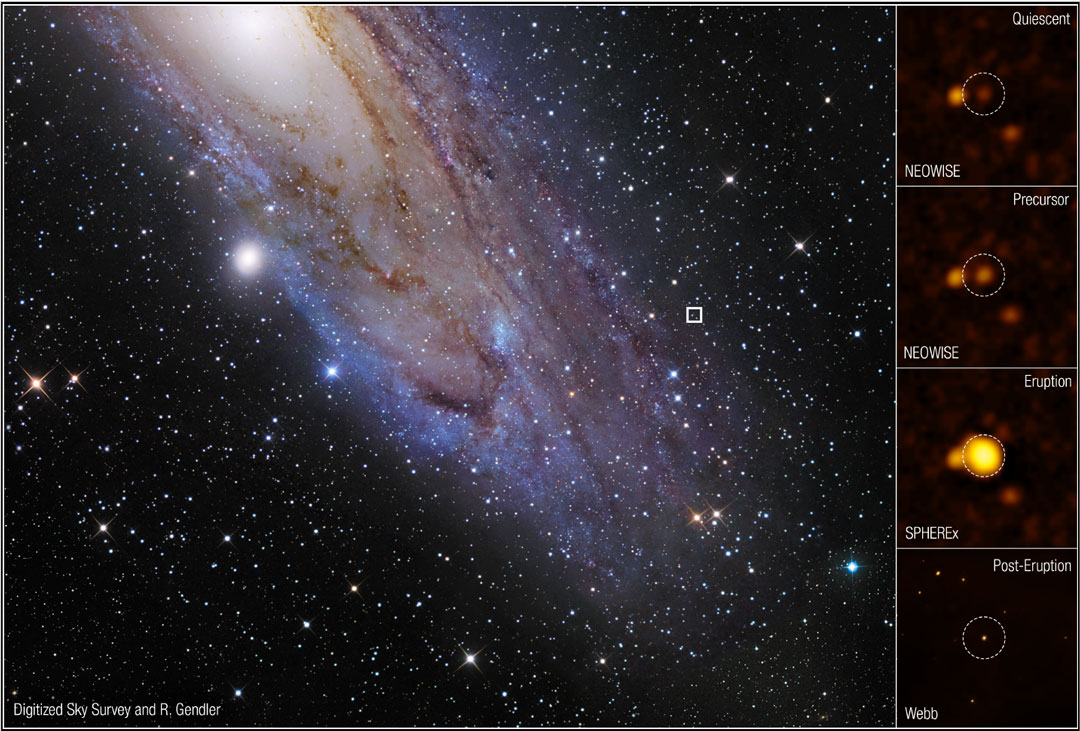
Researchers at Columbia University witnessed the event, called AT 2025abao, in the Andromeda Galaxy—verifying Nordhaus’s prediction. The merger was captured using telescopes monitored over a lengthy eight-year period.
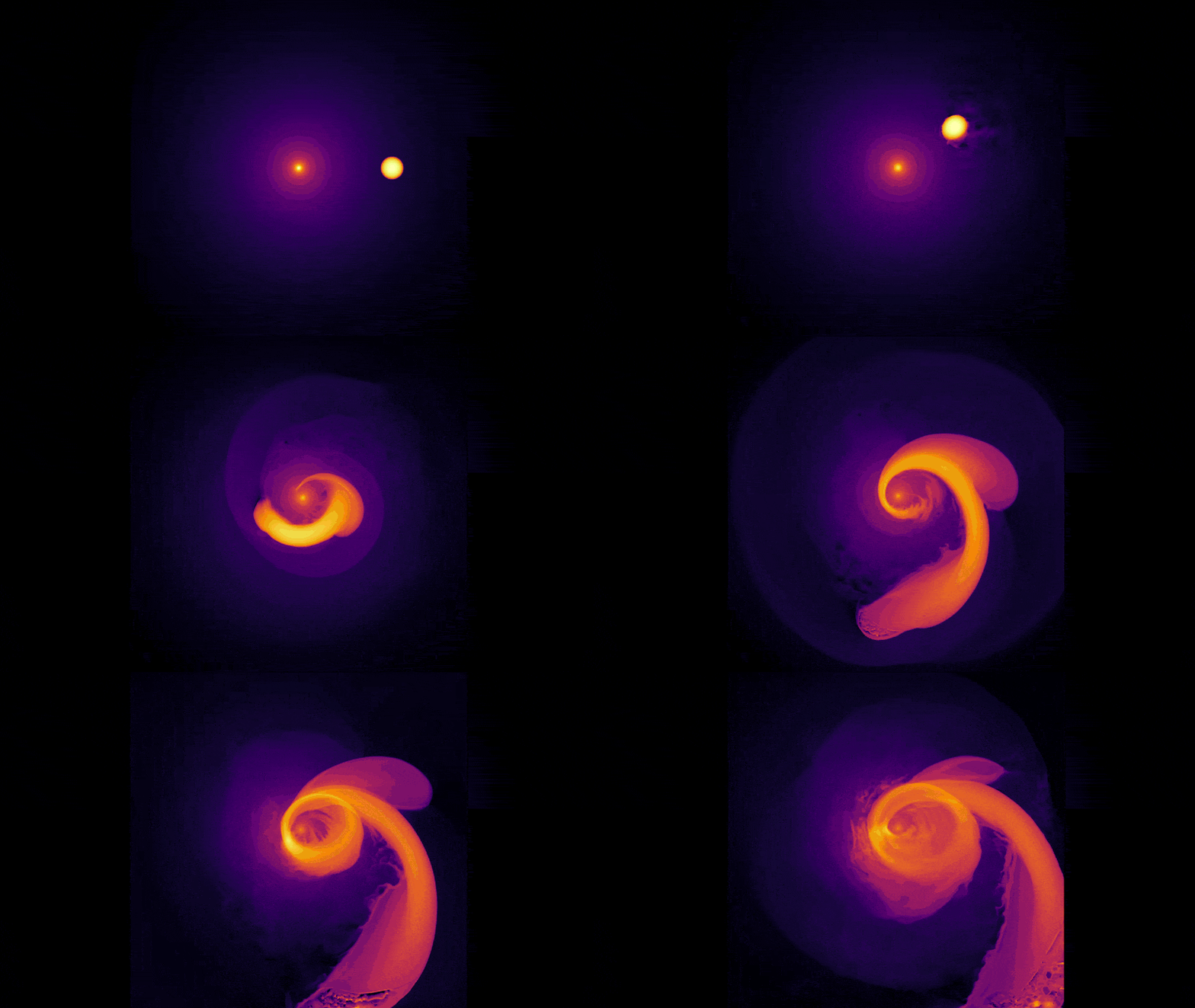
RIT astrophysicist Jason Nordhaus predicted what happens when two stars merge. The smaller star loses energy and sinks into a spiral pattern toward the center of the giant star.
What do merging stars tell us about the universe?
“What we can learn from this is immeasurable,” said Nordhaus. “We can’t directly see into the insides of stars; we can only see the surface. For example, if you look at the Sun, you see a turbulent surface with lots of convective bubbles. But, because the light comes out slowly over time, it is a way to ‘see’ into the interiors of giant stars that wasn’t possible before.”
The common envelope phase is how tight binaries are produced in the universe. Seeing this slow increase in light makes it easier to find stars orbiting inside giant stars and provides enormous insight into this phase which is one of the most uncertain and important phases in the lifecycle of stars.
Nordhaus says in addition to what merging stars can reveal about its structural components, it can shed light on how binary systems produce black holes, white dwarfs, or neutron stars; where gravitational waves come from; how elements are created; and how magnetic fields inside stars work.
RIT researchers find clues in the stars
Nordhaus’s research, which was funded by a continuation of a previous National Science Foundation grant, was conducted alongside two graduates of RIT’s astrophysical sciences and technology Ph.D. program. Emily Wilson ’22 is now an assistant professor of astronomy at Lycoming College and Nikki Noughani ’25 is a Canadian Rubin Postdoctoral Fellow at University of Toronto. Michael Richmond, RIT professor of astronomy and astrophysics, also contributed to a portion of the research.
Last year, Nordhaus spearheaded research that uses AI and a mathematical method that searches astronomical data for signs of hidden star systems. His team, which included RIT astrophysical sciences and technology Ph.D. student Bailey Filer and collaborators from the University of Toronto, Boston University, and the University of California San Diego, mapped a plan to use newly identified systems to determine how stars change before and after the common envelope phase.
In addition to his work at the National Technical Institute for the Deaf, Nordhaus is also a researcher with RIT’s world-renowned Center for Computational Relativity and Gravitation, which advances knowledge and discovery at the frontiers of relativistic astrophysics, gravitational physics, and cosmology.
NASA
Researchers witnessed AT 2025abao in the Andromeda Galaxy, seen here, verifying the prediction of RIT astrophysicist Jason Nordhaus who hypothesized what happens when a star orbits inside another star.
About RIT’s astrophysical sciences and technology Ph.D. program
RIT’s doctoral program in astrophysical sciences and technology focuses on the underlying physics of phenomena beyond the Earth and on the development of the technologies, instruments, data analysis, and modeling techniques that will enable the next major strides in the field. The program’s multidisciplinary emphasis sets it apart from conventional astrophysics graduate programs at traditional research universities.
About RIT’s National Technical Institute for the Deaf
Established by the U.S. Congress in 1965, the National Technical Institute for the Deaf is the first and largest technological college in the world for deaf and hard-of-hearing students. NTID offers associate degree programs for deaf and hard-of-hearing students and provides support and access services for deaf and hard-of-hearing students who study in the other eight colleges of RIT. Deaf and hard-of-hearing students come from all over the United States and around the world to take advantage of the opportunities available to them at RIT/NTID.