Presidents reflect on how RIT’s past is shaping its future
From creating shared governance to growing globally and defining cutting-edge research, leaders give insight at historic event
Carlos Ortiz/RIT
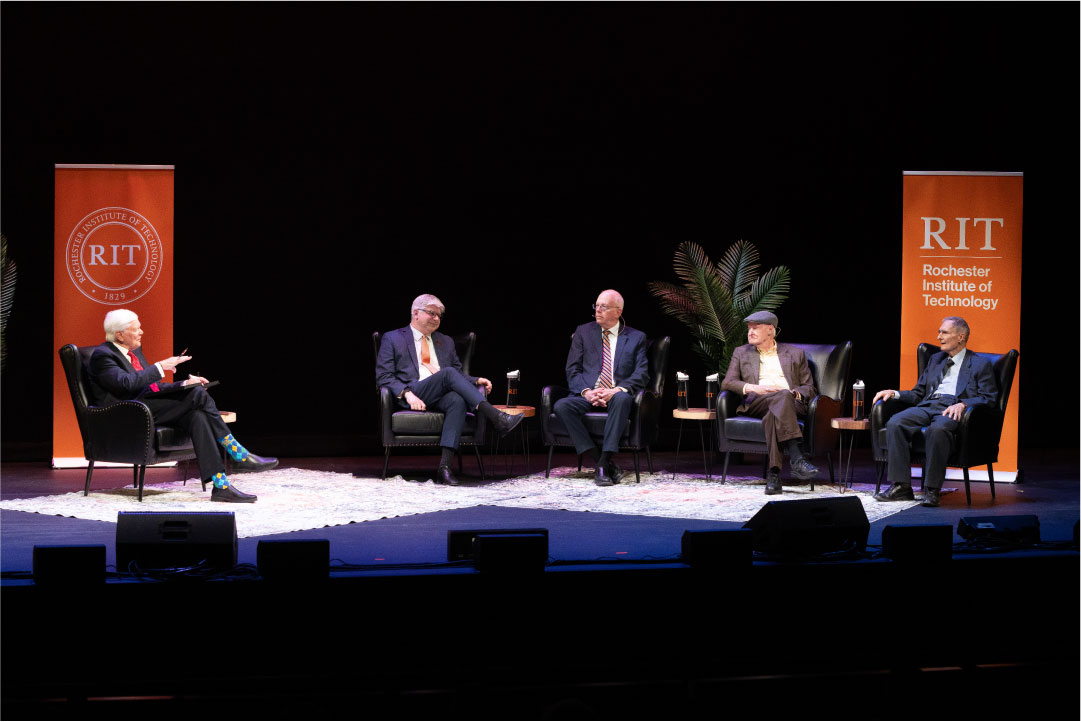
From left, moderator and longtime broadcast journalist Don Alhart leads a discussion with President Bill Sanders and Presidents Emeriti David Munson, Bill Destler, and Albert Simone at the new RIT Performing Arts Center. The presidents talked about their history of leadership and its impact on the university’s upward trajectory.
RIT’s past and present converged as four presidents—spanning more than three decades of leadership—reflected on the university’s evolution and how they have helped position it for the future.
Held April 10 inside the newly opened RIT Performing Arts Center, “Presidential Perspectives on RIT’s Transformation” offered a rare opportunity to hear from past presidents Albert Simone, Bill Destler, and David Munson, and current President Bill Sanders. Moderated by legendary broadcast journalist Don Alhart, the discussion ranged from championing diversity to expanding applied creativity and innovation, and blending technology, the arts, and design to empower the next generation of leaders.
Sanders opened the discussion by acknowledging the foundation built by his predecessors. A self-described student of history, Sanders expressed both gratitude and enthusiasm for the role he now holds.
“I want to thank our past presidents for the journey that they led RIT on for so many years. I’m so inspired by what they have done,” Sanders said. “This campus is second to none. Our students are kind, thoughtful, smart, and creative. Our staff and faculty are dedicated to the mission. This place is clearly defined by its people.”
He emphasized RIT’s beginnings with its strengths in technology brought together with liberal arts, the arts, design, creativity, and innovation, reinforcing an approach that continues to set the university apart.
That spirit of collaboration traces back to earlier administrations. Simone, RIT’s eighth president, reflected on the importance of shared governance during his tenure.
“What I valued most was the ability to listen and learn from faculty, staff, and students,” Simone said. “That collective voice helped shape the university in meaningful ways.”
Simone also highlighted efforts to diversify the campus and deepen RIT’s connection to the broader community, initiatives that helped expand both opportunity and impact.
Building on that foundation, Destler focused on expanding RIT’s reach beyond its Rochester campus. During his presidency, the university significantly grew its global presence, establishing partnerships and campuses that have immeasurably raised its international reputation.
“In the future, you won’t see many universities that are not internationally engaged in some way," said Destler, the university’s ninth president. “That’s a good foundation for us to move forward.”
A longtime advocate for diversity, Destler emphasized the importance of involving more segments of the population in higher education, which he considers essential.
Destler also spearheaded Imagine RIT: Creativity and Innovation Festival, a defining example of the university’s culture. The festival on April 25 marks its 18th year.
“It shows what happens when you give this community an idea,” he said. “Students, faculty, and staff can turn a half-baked idea into a good one.”
He also fondly recalled moments that brought the campus together, including RIT’s memorable run to the NCAA Frozen Four in men’s hockey, underscoring the value of athletics in building school spirit and teamwork.
For Munson, the focus turned to infrastructure and opportunity. Munson was among the proponents of the performing arts center, describing it as a promise fulfilled.
“We needed a venue that matched our students’ aspirations and capabilities,” said Munson, RIT’s 10th president. “Any kind of student on our campus can be involved here.”
He noted that the center represents a broader strategy to position RIT alongside top-tier institutions, particularly through its unique integration of colleges like NTID. Munson also pointed to the expansion of the university’s Ph.D. programs, the construction of the SHED makerspace, and upgrades to athletic facilities as milestones that strengthened the university’s academic and campus life.
Looking ahead, Sanders outlined a forward-thinking vision rooted in adaptability and impact. In his first year, he worked to establish a Strategic Framework designed to keep RIT nimble in a rapidly changing world.
“The future of work is evolving,” Sanders said. “We need to prepare students to become leaders and build careers that don’t even exist yet.”
He highlighted priorities including artificial intelligence, health technologies, and student success, while reaffirming the importance of co-op experiences, global engagement, and world-changing research.
“We want our students to be world citizens with a global mindset,” he said. “Community well-being is also essential, creating an environment where everyone can thrive.”
The conversation also addressed broader challenges facing higher education, from rising costs to concerns about return on investment. Destler acknowledged the pressures but remained optimistic.
“It’s crucial that we continue to rise and take our place among the nation’s top universities,” he said.
Added Sanders: “Many universities will fail in the years ahead. We’re going to define our own success and continue moving toward the top tier of higher education becoming sought after from around the nation and the globe.”