Puppy-in-training attends classes this semester
Spirit begins his 14- to 16-month initial training to become a guide dog for the blind
Carlos Ortiz/RIT
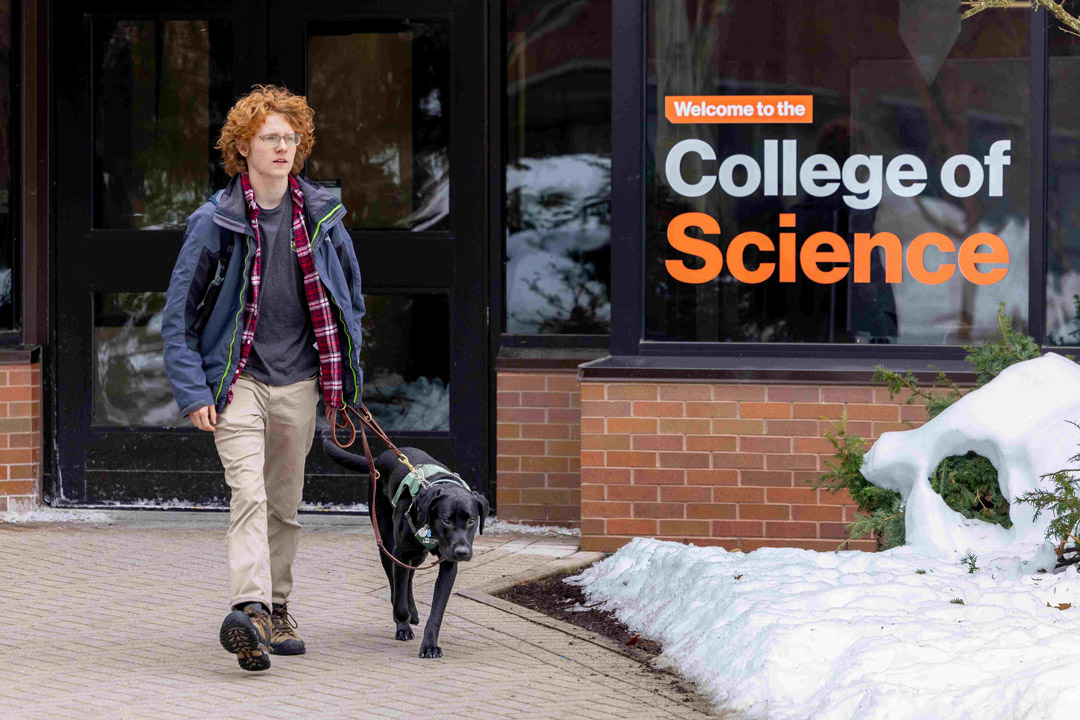
Lucas Newquist, who with his family has helped raise eight puppies to become guide dogs in the past 10 years, accompanies Spirit to RIT this semester.
Lucas Newquist, a second-year microelectronic engineering major from Easton, Pa., has an additional workload on campus this semester: training a puppy to become a guide dog for the blind.
Spirit, a 9-month-old black Labrador retriever, started attending classes with Newquist in January.
“The word about Spirit on campus has spread more than I thought it would,” he said. “A lot of people already know his name.”
Carlos Ortiz/RIT
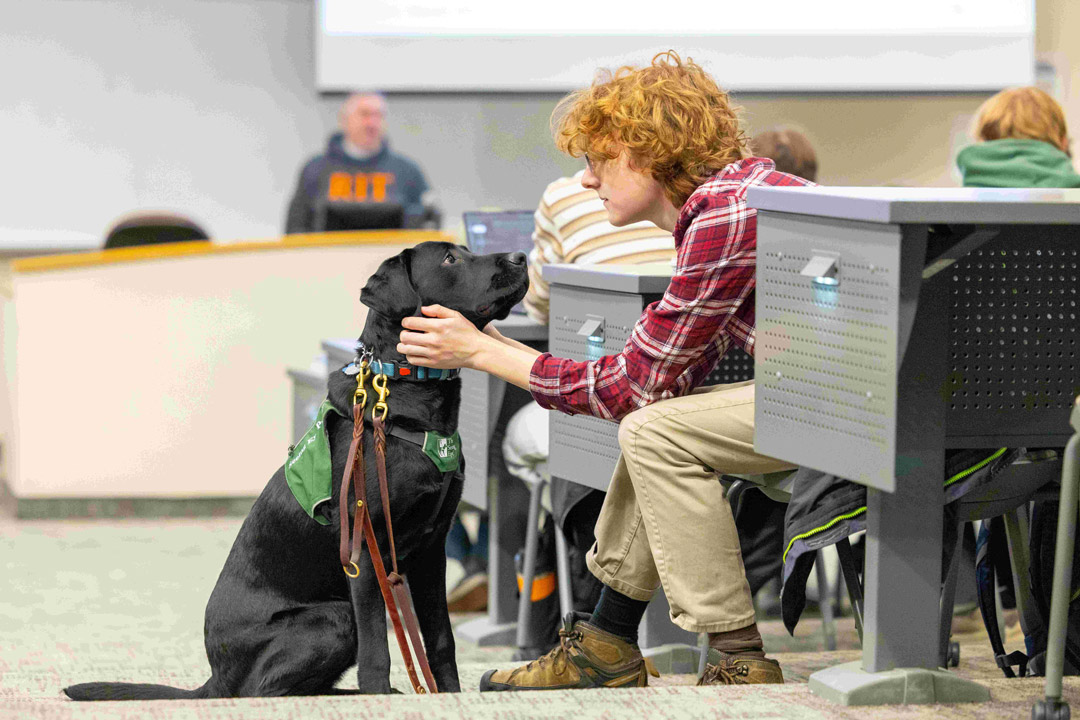
Lucas Newquist, who is training Spirit to become a guide dog for the blind, gently tugs his leash or changes the tone of his voice to help Spirit know how to behave or how to react in a variety of environments, like in class.
Most of Spirit’s training is basic obedience, with commands to sit, rest, and go to the bathroom. “When he comes to lectures with me, he can’t be a disturbance, he just has to chill out and sit under the desk or chair,” he said. “It’s a lot to ask of an 8-month-old puppy, but he’s done pretty well.”
Spirit, who coincidentally had “RIT” in his name when he was given to Newquist, usually wears a green vest identifying him as a puppy-in-training from The Seeing Eye, in Morristown, N.J.
On the first day of classes, Newquist told classmates that they can say hi to Spirit if he isn’t wearing his vest.
While approved service and emotional support animals are allowed on campus, animals being trained for assistance aren’t normally allowed. But since Newquist and his family have helped train eight dogs in the past 10 years, an exception was approved based on this specific experience through a limited agreement overseen by the Center for Residence Life as a pilot arrangement, which will be reviewed to assess its outcomes. As part of this pilot, specific stipulations were put in place to support campus safety and inform the overall evaluation.
“I needed permission to take Spirit into buildings and housing, and part of the agreement is I must be in control of him at all times,” he said. His three roommates in their Riverknoll apartment all love Spirit.
Spirit doesn’t go into dining areas or the Semiconductor Nanofabrication Lab.
“We don’t have a clean room suit for the puppy,” Newquist said.
The training will continue for 14 to 16 months, and once that’s done, Spirit will go back to The Seeing Eye headquarters in New Jersey to be more professionally trained for safety considerations, such as walking near traffic, navigating sidewalks and curbs, and avoiding obstructions. Then Spirit will be matched with an individual who is blind.
Michelle Barlack, a spokeswoman for The Seeing Eye, said they typically have 500 puppies in training, and about 240 are permanently placed with individuals each year. She said it is rare for puppies to be primarily trained on a college campus.
“A lot of our applicants are getting their first dog between high school and college, so it’s quite possible the dog could end up on a campus with a young college student,” she said. “But even if it doesn’t, the hustle and bustle of a college campus prepares them for their future in a big way with all the experiences there.”

