RIT researcher studies how exercise could reduce the risk of aneurysm rupture
Zhongwang Dou was honored with a National Science Foundation Faculty Early Career Development award
Scott Hamilton/RIT Photography
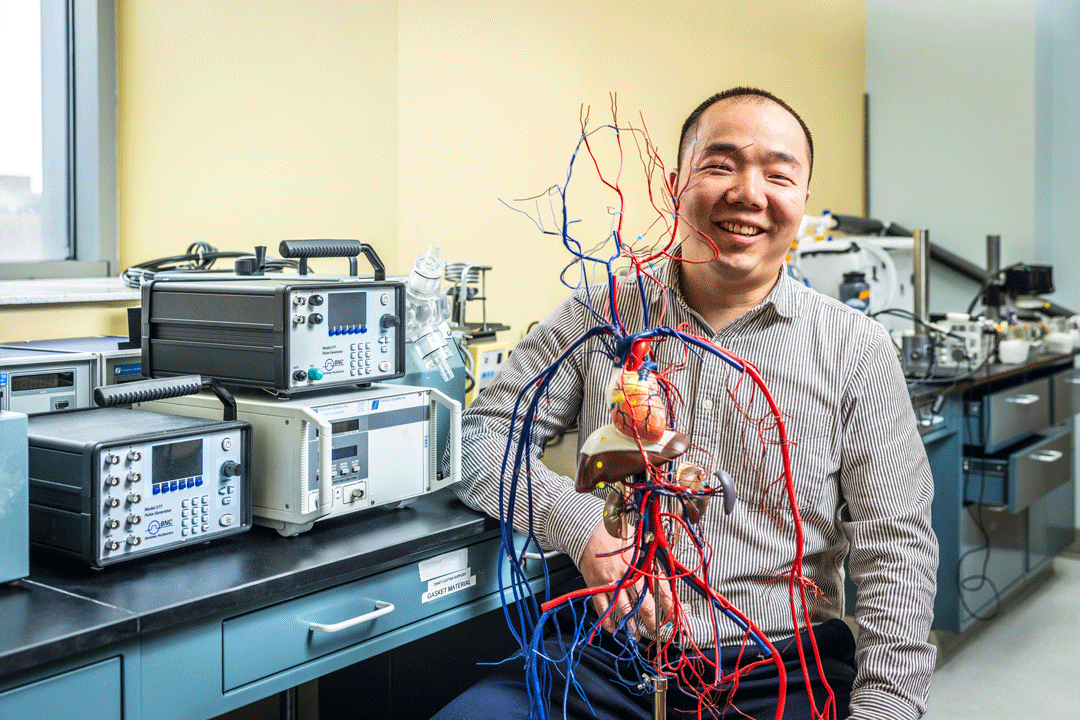
Zhongwang Dou, shown with a human vascular system model he uses in his biomedical engineering classes, recently received a prestigious NSF CAREER award. He will lead a project to understand how human body movement affects blood flow in aneurysms.
An aneurysm can produce a life-threatening emergency if it ruptures. RIT Professor Zhongwang Dou believes physical activity just might alter that risk.
Blood is fluid in motion and there is an impact on the body’s vessels, and larger systems, if that motion is disturbed or impeded. By applying engineering principles to human systems, Dou, an expert in fluid dynamics, will explore how body movement may affect the chance of an aneurysm rupture.
Dou recently received a prestigious National Science Foundation Faculty Early Career Development (CAREER) award for a five-year project to detail how blood flow within an aneurysm is affected by movement, and how physical exercise might affect the risk of aneurysm rupture.
“If an aneurysm ruptures in the brain, it can cause a stroke. In the aorta, it is even more severe,” said Dou, an assistant professor in RIT’s Kate Gleason College of Engineering. “There are many studies about trying to understand how blood flow contributes to the initialization, growth, or rupture of the aneurysm. However, the effect of human movement, excitation, on this matter has not generally been asked before.”
During the project, Dou will model the geometry—the size and shape of an aneurysm—then assess changes after different mechanical flow rates and boundary conditions are applied through various types of physical activity. He will utilize a robotic system he helped build to simulate these physical activities.
“We have been studying fluid dynamics for years as mechanical engineers. There are a lot of tools and mechanical equations we can use to apply to different biomedical problems including blood flow in the vascular system,” said Dou.
Before coming to RIT, Dou worked as a research scientist at the Canon Stroke and Vascular Research Center at the University at Buffalo. While there, he became interested in connecting the concept of fluid dynamics related with intracranial aneurysm. He continues this work as part of RIT’s biomedical engineering department.
Using a novel experimental platform, Dou’s team will quantify how movement reshapes the hemodynamics linked to aneurysm growth and rupture, said Thomas Gaborski, professor and department head of the biomedical engineering department.
“Zhongwang’s CAREER project is a great example of biomedical engineers translating fundamental physics into actionable healthcare guidance,” he said. “The resulting scaling laws could help clinicians move toward more personalized, evidence-based exercise recommendations, while also creating hands-on research and outreach experiences that bring biomedical engineering to undergraduates, K–12 students, and non-engineers.”
The National Institutes of Health estimates that about 5 percent of the U.S. population can have an undetected aneurysm. Checking for an aneurysm is not standard in general exams, but can be detected through procedures such as an MRI, CAT scan, or angiogram.
“Once diagnosed, we can see the geometry of an aneurysm, then we can model the hemodynamics to see what is pushing it and if the hemodynamics might change when human movement is added,” said Dou.
Doctors make different suggestions regarding care and exercise, but more quantitative information could support their recommendations for non-invasive interventions.
“Doctors give conservative estimates for exercises, but what kind? We have so few answers to this, and this research might answer these questions.”
RIT now has 18 NSF CAREER award winners, including Dou, working at the university. Funding supports early-career faculty members who have the potential to serve as mentors in research and education while advancing their field.