RIT receives grant to expand access to computing education
NSF grant will fund a three-year project at NTID with workshops, webinars, and other outreach programs
Matthew Sluka/RIT
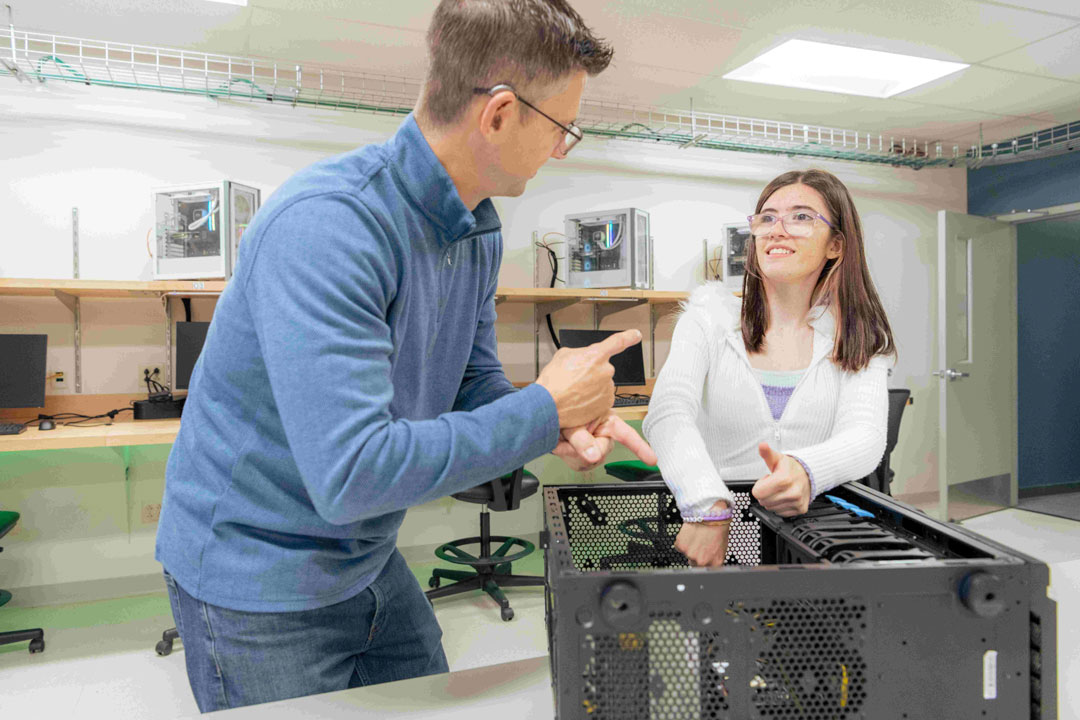
Brian Trager, chair of NTID’s Department of Information and Computing Studies, explains the rebooting process of a computer with Haley Devlin, a first-year NTID student from Carlisle, Pa. A nearly $1 million National Science Foundation grant will fund a three-year program to better prepare and offer pathways to computing and information degrees and careers for students across the country.
Rochester Institute of Technology’s National Technical Institute for the Deaf has received a $980,047 grant from the National Science Foundation to expand access to computing and information technology education for secondary and post-secondary students, especially those who are deaf and hard of hearing.
The three-year project, Strengthening the Pathway to an Information and Computing Education (SPICE), will create new opportunities for students to explore computing, build problem-solving skills, and prepare for further education and careers in technology.
The project is led by Brian Trager, chair of NTID’s Department of Information and Computing Studies, with Associate Professor Donna Lange serving as co-principal investigator.
“Many students have limited opportunities to explore computing before they begin college,” Trager said. “This project will help students see themselves as capable technology learners while giving educators practical tools to support them. Our goal is to build stronger and more accessible pathways into computing education.”
Through the project, NTID faculty and staff will provide hands-on workshops, webinars, coding activities, and other outreach opportunities for students at schools across the country. Opportunities will be shared broadly through NTID’s recruitment and educational networks, including schools for deaf students, mainstream schools serving deaf and hard-of-hearing students, and other secondary schools.
SPICE will also provide professional development for high school teachers and NTID faculty. Training will focus on computational thinking, problem-solving, artificial intelligence literacy, and strategies for making computing instruction more accessible and engaging.
Another major component of the project is the development of a new course at NTID in computational thinking and problem-solving. The course will introduce students to approaches used in computing, including breaking complex problems into smaller parts, recognizing patterns, designing step-by-step solutions, and evaluating possible outcomes. The course, currently planned to begin next fall, may also be offered through dual-credit partnerships, allowing qualified high school students to begin earning college credit before enrolling at RIT.
The project will support NTID’s continuing development of computing programs in emerging areas such as artificial intelligence, cybersecurity, and connected technologies. NTID is currently developing an Associate of Science degree in artificial intelligence designed to prepare students for transfer into bachelor’s degree programs including AI within RIT’s Golisano College of Computing and Information Sciences.
Project activities will also contribute to the development and sharing of standardized American Sign Language terminology for computing concepts. The goal is to help students, faculty members, interpreters, and other professionals communicate technical ideas more clearly and consistently.
An industry advisory group composed of professionals with relevant technical, educational, workforce, and accessibility expertise will provide guidance throughout the project. Members will help the project team ensure that instructional activities reflect current workforce needs and prepare students for continued study and employment.
“This award represents an important investment in students, teachers, and the future technology workforce,” Trager said. “By connecting outreach, teacher preparation, accessible learning materials, and college pathways, we hope to create a model that can be adapted by other schools and institutions.”
The project began in October and will continue through September 2029.
Established by the U.S. Congress in 1965, the NTID is the first and largest technological college in the world for deaf and hard-of-hearing students. NTID offers associate degree programs for deaf and hard-of-hearing students and provides support and access services for deaf and hard-of-hearing students who study in the other eight colleges of RIT. NTID also offers a certificate in healthcare interpretation, bachelor’s degree programs in sign language interpreting, and community development and inclusive leadership, and master’s degrees in healthcare interpretation and secondary education for individuals interested in teaching deaf and hard-of-hearing students. Deaf and hard-of-hearing students come from all over the United States and around the world to take advantage of the opportunities available to them at RIT/NTID.