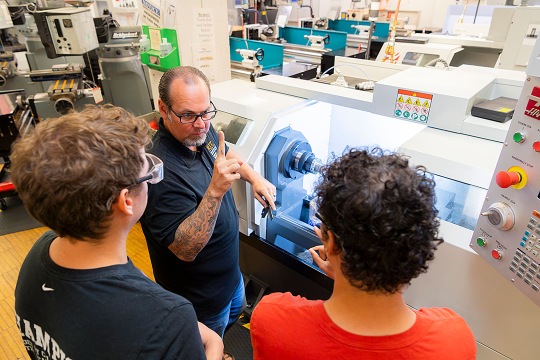
NYSED has approved the proposal to establish the AAS in Precision Manufacturing Technology. This new A+B program builds on the successful AOS offering in the same major by including courses that bridge students into an RIT bachelor’s degree and has an articulation agreement with three bachelor’s degrees offered by the College of Engineering Technology. Current students will be able to enter the program starting in fall 2026 and newly admitted students will be able to start in fall 2027. The program webpage will be available later this spring.
NYSED has approved a variety of program modifications for the BS in Community Development and Inclusive Leadership, including the addition of the “Deaf Community Advancement” track, which permits students to apply certain ASL (INTP and MLAS) and Deaf Cultural Studies coursework to the core area of the degree. The program webpage will be available later this spring.
RIT has approved the addition of two new NTID pre-baccalaureate programs: Business and Computing and Information Technology. These programs will be offered alongside the existing AS in Business and AS in Information Technology programs as additional pathways for students who are close to entering a bachelor’s degree, but who need additional coursework to strengthen their applications.
NCC, Graduate Council, and Faculty Senate recently approved modifications to the MS in Deaf Education, including expansion of the practicum requirements and revisions to numerous courses. The modifications will be sent to NYSED soon for review.
RIT Provost David approved the New Program Intent Document (concept paper) for the MS in Deaf Educational Administration. The proposal for this new graduate program is underway by the NTID Department of Deaf Education.
The NTID Department of Deaf Education will offer two undergraduate special topics courses this fall: DEAF-289 Historical and Cultural Perspectives in Deaf Education and DEAF-489 Ethics, Equity, and Social Justice in Deaf Education Leadership. Both courses have been approved as RIT social perspective courses, and both require students to have already completed a First Year Writing course.