From RIT to the Final Frontier
From co-ops and student teams to the Kennedy Space Center, Andrew Bernacki ’25 shows how RIT’s hands-on, career-focused education can turn an ambitious goal into a career doing work that matters.
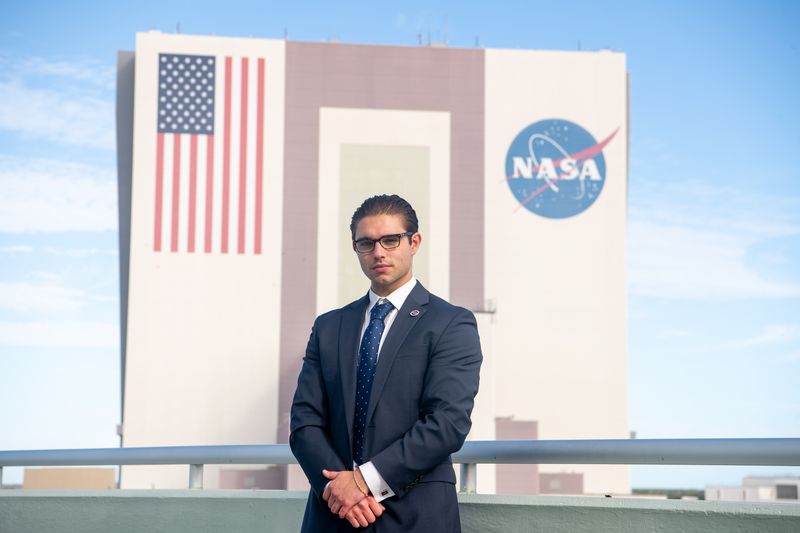
For Andrew Bernacki ‘25 (mechanical engineering BS/MS), a career in space once felt beyond reach. Today, Bernacki is a spacecraft engineer at Kennedy Space Center, helping lead complex mechanical test operations for large-scale aerospace projects—and working on systems that push the boundaries of what’s possible.
His journey was shaped by more than what he learned in the classroom. Co-ops gave him experience working on real engineering problems. Student teams, like Javelin, taught him how to collaborate and lead alongside people who shared a similar passion. Along the way, Bernacki discovered a love of photography.
Bernacki’s work in the space industry has taken him inside the Orion crew capsule for the Artemis II mission, into the United Launch Alliance launch control center, and face-to-face with astronauts.
We recently sat down with Andrew to talk about how RIT helped turn an ambitious career goal into a reality—and what he learned about experience, teamwork, curiosity, and doing work that matters.
I understand that several of your classmates are also working at leading organizations including NASA, SpaceX, and Blue Origin. What do you think that says about RIT?
RIT creates an environment where students can challenge themselves, support each other, and prepare themselves for meaningful work. Employers recognize academic rigor, co-op experience, and project team involvement as core competencies for competitive candidates. During freshman year, I heard stories of graduates working for companies like SpaceX and NASA, but it felt out of reach. As I matured through my academic career, I recognized that the possibility of starting a career at one of these prestigious companies was not such a farfetched possibility. After graduating, I got a job with Lockheed Martin Space, and multiple friends moved forward with roles in some of the most competitive players in the space industry. I strongly believe that RIT’s reputation of producing driven, credible engineers allowed us to get a foot in the door and work on some of the most interesting systems in the world.
Where was your first co-op? How did it change the way you saw your future?
My first co-op was at Advanced Energy. It showed me the value of real-world experience and how it could shape my future career. My mentors taught me how to apply my CAD skills to real products, design within real-world constraints, and communicate with senior engineering leaders. They also gave me the independence to make mistakes, learn from them, and become a more confident engineer.
That experience made me a stronger candidate for future co-ops and full-time roles, and showed me how much professional experience could open doors. I went on to co-op with four different companies before transitioning to a full-time position with Lockheed Martin Space. I can confidently say I wouldn’t be where I am today without taking full advantage of RIT’s co-op program.
I know that you were on the Javelin team and CubeSAT (a satellite design and launch student team). What did participation on these teams teach you beyond engineering?
That passion is contagious. Being around people who genuinely cared about what they are doing, and who bring joy into the work, made me want to work harder and rise to that same level.
I also learned how much more people can accomplish together rather than alone. Even though javelin is technically an individual sport, I trained with teammates every day and they pushed me further than I would have gone by myself.
With CubeSat, everyone brought their own skill set to a complex problem and together we were able to create something far beyond what one person could realistically accomplish alone. That lesson has carried into the corporate world, where the systems I work on are too large and complex for any one person to handle alone. It takes other people to build something meaningful.
What’s something you discovered at RIT that you didn’t expect to love?
I had always been curious about photography, but my communication immersion gave me real exposure to it, and that’s when I truly fell in love with it.
Taking an immersion helped me explore interests I may not have pursued otherwise. Photography is now something I still do regularly for fun, and it has become a meaningful part of my life.
Photography helped me realize that my identity was bigger than engineering alone. I was not just graduating to become an engineer; I was also becoming someone with creative interests, lifelong passions, and different ways of seeing the world. It became an outlet for creativity, and I think that creativity also carries into my engineering work.
What advice would you give to a high school student thinking about RIT?
I would encourage students to visit RIT in person. Take tours, walk around campus, and try to get a feel for the culture, classrooms, and overall environment. An application is not a commitment, so if you’re on the fence, just apply to RIT. I can only speak from my own experience, but RIT helped me set myself up for my dream career directly out of college. There’s nothing I would change in choosing RIT.
More Featured Profiles and Work
Aashrita Mandalapu