What is the best way to develop products ? It depends…
Mechanical and Industrial Engineering Ph.D. student Hrushikesh Godbole is rethinking how we teach engineering capstone design courses by customizing the process for every student project. His research shows how tailoring the “how” of doing a project, based on the people involved and the product being built, may improve outcomes.
Mechanical and Industrial Engineering Ph.D. student Hrushikesh Godbole is rethinking how we teach engineering capstone design courses by customizing the process for every student project. His research shows how tailoring the “how” of doing a project, based on the people involved and the product being built, may improve outcomes.
Capstone design project is the final stop in an undergraduate engineering education, bridging from textbooks to the real world. Students work on industry-sponsored projects, applying technical knowledge to develop tangible products, while gaining critical experience in problem-solving, teamwork, and communication. However, most capstone programs use a one-size-fits-all approach to how these projects are managed.
Capstone projects differ dramatically from one another: one team maybe building a medical device with heavy regulatory constraints, while another is developing a tooling fixture for a manufacturing shop. The students, too, vary in skills, learning styles, and teamwork preferences. Yet, project processes such as how they manage the project and make decisions tend to be standardized. Godbole argues that this rigidity is holding students back from achieving the best possible outcomes by forcing project process to conform to a single standard.
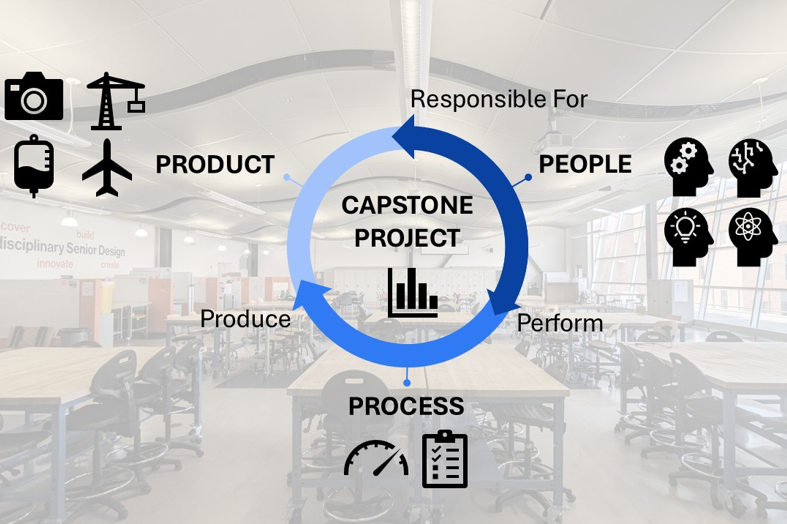
Working under the guidance of Dr. Elizabeth DeBartolo, Godbole sets out to answer a key question: Is having a single standard capstone process leading to systemically poor outcomes based on certain student and product characteristics? A project is like a tripod standing on Product, People, and Process. The first two legs are usually fixed: the capstone program must work with students who register for the course. And have them develop products that industry sponsors need done. However, the processes are a control knob that can be adjusted. By tuning processes to better suit the people and the products involved, outcomes of technical product success, teamwork experience, and overall learning can be improved.
More Featured Profiles and Work
Atik Faisal

Divyprakash Pal

Dumbari David Kabari