Co-op seminar class and a strategic approach help students land co-ops
Computer science major and career services coordinator provide tips for internships
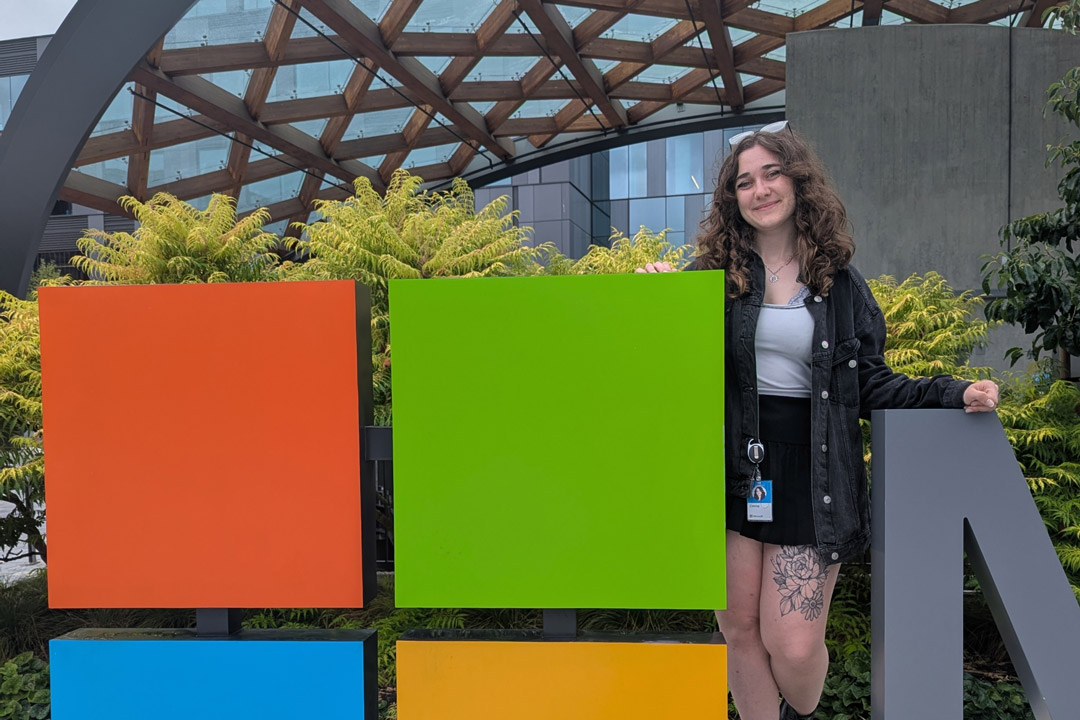
Emma Schmitt said that she has developed professionally, met industry mentors, and made amazing friends while on co-ops. This summer, she is returning to Microsoft for a co-op working with AI and ensuring that it helps people.
When Emma Schmitt was first applying for co-ops and internships, it was stressful and overwhelming.
“I was just really burnt out, because I was sending out so many applications a day and then getting a bunch of rejections at once,” said Schmitt, who is now a fourth-year computer science major.
She needed a different approach and a new mindset. She centered her strategy on achieving one career-related action each day and decided to view every rejection as a redirection. She also took the undergraduate co-op seminar class that is required for her major.
“I was building myself up more gradually and that seriously helped me stay motivated,” said Schmitt, who is from St. Louis. “Doing something every day can build confidence—whether it’s going to an event at RIT to network, writing a cover letter, researching a position, or asking for résumé advice.”
With that tailored mindset, she landed an internship at the manufacturing technology company Barry-Wehmiller. The seminar class helped her get co-ops at Honeywell/LenelS2. And this summer, she’s returning to Seattle for a second internship at Microsoft to work on the Viva Engage site reliability engineering team.
Co-op seminar opens new doors
Schmitt came into her major with no prior programming experience. That first year, she began to question if computer science was the right major for her.
During her co-op seminar class, Schmitt heard from industry speakers, including Paul Wisotzke, a senior engineering program manager at Honeywell. She approached Wisotzke after class, asking for advice with an upcoming screening interview at a different company.
Tips from a student:
1. Don’t be afraid to ask interviewers for their advice and what to improve upon.
2. Take any available opportunity to connect with recruiters and industry professionals in person—you’ll become more than just a name on a résumé.
3. You’ll get a lot of advice on how to prepare your résumé. Your résumé is a representation of your experiences, so if the advice doesn’t feel right for you, consider not taking it.
“We had a great conversation about the implementation of Honeywell’s technology all over the RIT campus,” said Schmitt. “He reached out about a week later saying there was a co-op available and asked if I’d be interested.”
She joined the MAS team, working on emergency alarm monitoring technology for isolated workers, including Uber drivers and delivery drivers. After the co-op, she continued to work with the company on a Honeywell-sponsored senior project. This spring, she is doing a second Honeywell co-op to work on cloud-based alarm technology solutions.
“I’ve also returned to co-op seminar multiple times as a guest speaker with Paul—he loves to bring up that story just to talk about how impactful networking can be,” said Schmitt. “I have truly felt incredibly supported in both my personal and professional development by my manager, the other co-ops, and my mentors.”
Schmitt said that co-ops gave her a ton of exposure to what it means to be a software engineer and the development process. At Barry-Wehmiller she worked with the Digital Innovation team to develop a variable extraction feature to pull critical information from programmable logic controllers. At Microsoft, she developed an internal AI-powered tool that helps team members efficiently triage and handle tickets from other development teams within Engage.
Building confidence for co-op
All computing majors take a version of the co-op seminar course, with customized examples to match each field. Anna Lombard, a career services coordinator in Golisano College of Computing and Informaiton Sciences, has taught the co-op seminar class for many computer science students—including Schmitt.
Advice from an instructor:
1. You don’t need to know everything to be successful on co-op—you just need to be curious, reliable, and willing to learn. Employers expect interns and co-op students to ask questions.
2. Treat the co-op like a long interview—your attitude, communication, and professionalism matter just as much as your technical skills.
3. It’s okay if the first co-op isn’t your “dream job”—even a less-than-perfect experience can teach you what you don’t want, and that’s incredibly valuable.
“The co-op preparation seminar is really about helping students translate ‘being a student’ into ‘being a professional,’” said Lombard. “We also talk a lot about what to do before, during, and after a co-op so students can get real value from the experience rather than just completing a requirement.”
Lombard said the co-op class helps normalize the idea that everyone is figuring things out as they go. She said it also prepares students for the University-Wide Career Fair—held every spring and fall—and talking to recruiters directly.
“Many students walk in feeling unsure of themselves or intimidated by the job market, and a big win is seeing them leave feeling prepared and capable,” said Lombard. “Co-op is a learning experience, and the seminar helps students see it as a growth opportunity rather than something they need to be perfect at from day one.”
In the course, instructors cover the practical aspects of résumé and LinkedIn development, job searching strategies, interviewing, networking, and workplace expectations. They also spend time on less obvious skills, including professional communication, navigating team dynamics, understanding company culture, managing feedback, and self-advocating in a workplace setting.