Got big ideas? RIT Gap Year fellows do
RIT’s Gap Year Entrepreneurial Fellowship helps students and alumni build businesses
Scott Hamilton/RIT
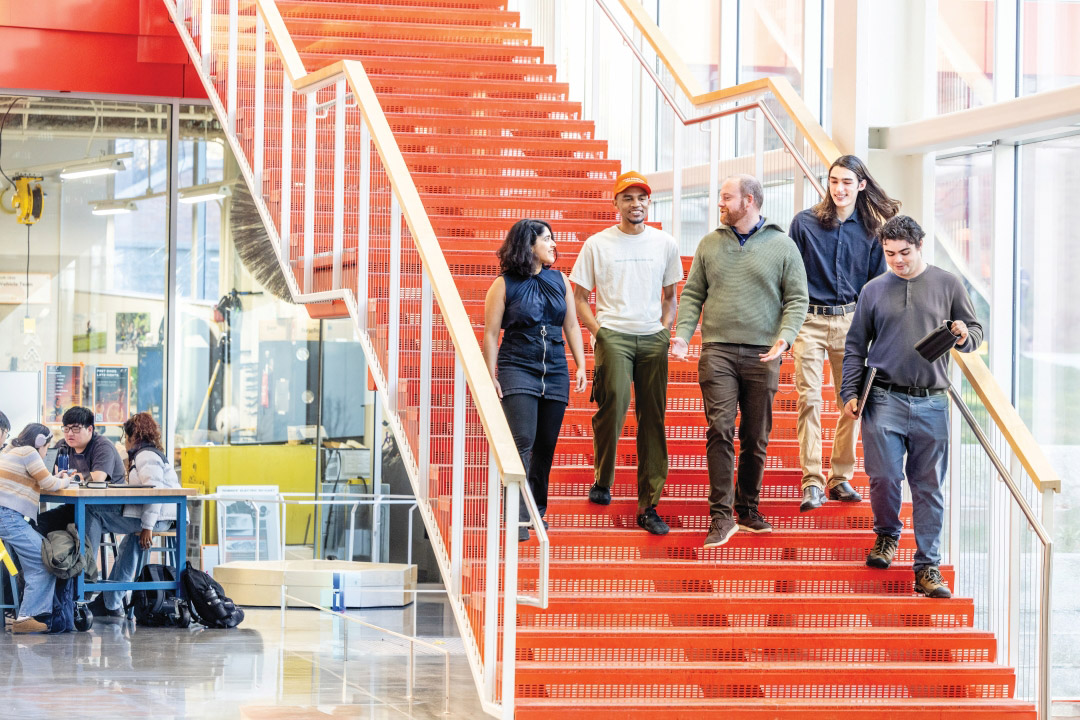
The current class of Gap Year fellows shared their product ideas with alumnus Austin McChord ’09, who created the fellowship program. From left are Hridiza Roy ’25, Jonathan Bateman, McChord, Aidan Makinster, and Michael Norton. Roy used her fellowship to work on an animation software tool. Bateman created Real Recognizes Real AI (realxreal.ai) to prevent wire fraud, deepfakes, and AI impersonation scams. Norton launched RocIn Industries to build underwater drones. And Makinster designed a multiposition mountain bike stem and started Raize Industries.
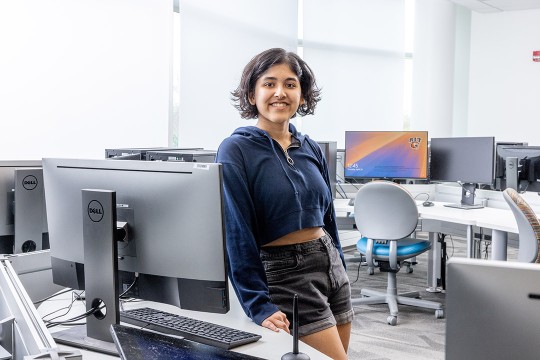
Hridiza Roy ’25 (individualized program, computer science) made building a business in the entertainment industry part of her college education.
Roy followed a summer internship at Disney Studios in Burbank, Calif., with a fall position in the Gap Year Entrepreneurial Fellowship. The RIT program gave her a block of time and a stipend to advance her passion project—Painterly, an animation software tool.
Roy created Painterly to give artists a tool for rendering objects with the appearance of brushstrokes. Getting the tool in the hands of artists is where the Gap Year Fellowship came in.
Roy is one of four Gap Year fellows this academic year—the seventh cohort since the program began in 2018. Each fellow receives a $20,000 stipend as well as business coaching, this year through a partnership with Upstate Venture Connect, a network of business professionals.
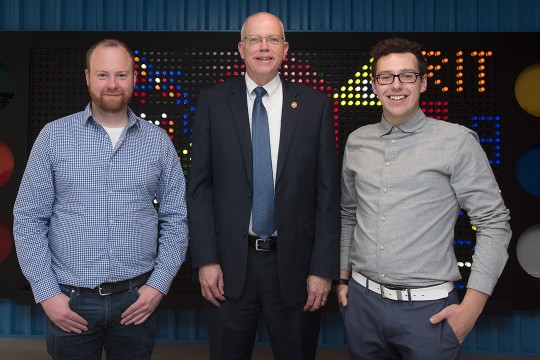
RIT trustee Austin McChord ’09 (bioinformatics) started the competitive program for students in the School of Individualized Study who want to launch a business while working on their college degree.
As a student himself, McChord didn’t have access to a similar program and left RIT to build his company, Datto, a global provider of data protection.
He later sold the business to Vista Equity Partners for around $1.5 billion. He now runs a venture capital firm and is the CEO of Casana, a healthcare technology firm that started at RIT.
“I am an experimental philanthropist, and the fellowship is one of many different pieces of that,” McChord said. “The people who are part of the Gap Year Fellowship say it’s working well, so I think that’s exactly what we’re looking for.”
McChord funded the program with part of a $50 million gift he made to RIT. He also funded the makerspaces in the SHED, where Gap Year fellows and students from across campus explore ideas. Since 2018, the Gap Year program has supported 28 fellows.
The fellowship enabled Roy to share Painterly with artists in the entertainment industry at LightBox Expo 2025 and to get feedback on the product. She hopes to one day see Painterly become an industry standard and an umbrella for her related stylization tools.
In the meantime, Roy’s fellowship segued into a job at Pixar Studios as a software engineer on the visualization team further developing a specialized rendering framework called Hydra. She started in February.
“Learning how to research new animation techniques, along with developing skills to work with both artists and technologists, has really helped me hone the skills needed for Pixar,” Roy said.
Roy has long had her heart set on working at Pixar. In high school, she learned about the company through an online computer graphics class called “Pixar in a Box.” That’s when she got hooked.
“I still can’t believe that my first job out of college is my dream job,” Roy said. “It has been absolutely surreal.”
Keep reading to learn about where some of RIT’s first Gap Year fellows are today.