Professor honored for teaching with compassionate curiosity
Professor Deborah Blizzard to receive the Eisenhart Award for Outstanding Teaching
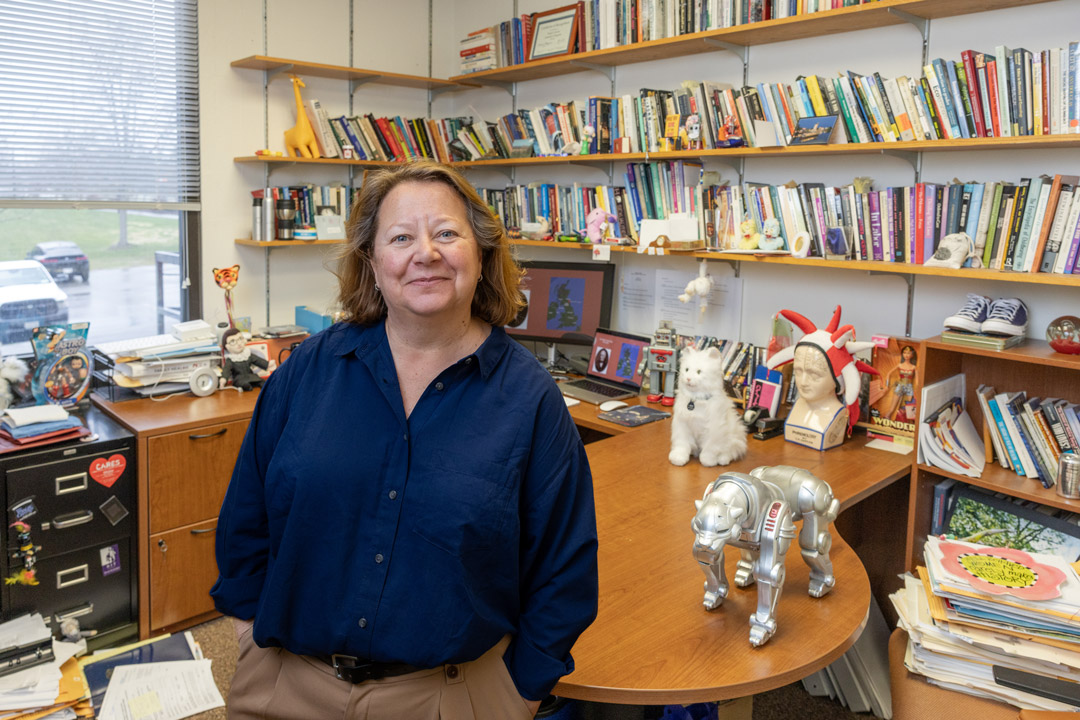
Traci Westcott/RIT
Professor Deborah Blizzard describes her classroom as a “liminal space,” and said her class discussions are akin to “Mr. Toad’s Wild Ride” because they’re full of tangents and side-quests that allow her to nurture the curiosity of her students.
Students in Professor Deborah Blizzard’s class know that each day holds a new adventure. Depending on the course, discussions can range from silly topics, like opinions about pineapples on pizza, to complex ideas, such as what makes one human and what constitutes a cyborg.
Read More
Teaching and scholarship awards recognize top educators, students.
Regardless of the question, Blizzard’s students feel confident in sharing their answers because of the positive energy she brings to class. When asked what influences her teaching style, her answer is simple.
“It’s important to me that my students know that their value isn’t tied to how well they consume education. They’re valuable just as they are; as multi-layered, multi-faceted human beings trying to learn and share their ideas,” said Blizzard, professor in RIT’s Department of Science, Technology, and Society.
Leading with compassion in her classroom, and her dedication and care for her students, earned Blizzard a 2026 Eisenhart Award for Outstanding Teaching.
Blizzard has taught in RIT’s College of Liberal Arts for 24 years. In addition to teaching, she has served as chair of the Department of Science, Technology, and Society, chair of the Women, Gender, and Sexuality Studies program, and she contributed time and leadership to numerous campus committees.
“Receiving this award has been a very humbling, overwhelming moment. I’ve sat on this committee, so I know the history and the quality of past recipients. It’s really humbling to say that I can stand in the company of that group,” she said.
Blizzard found her way to RIT through a friend from graduate school: the late Franz Foltz. Foltz, former associate professor in the Department of Science, Technology, and Society, recommended she apply for an open position in the department.
Now, years later, she is proud to say she found her niche and has enjoyed every minute of educational exploration with her students.
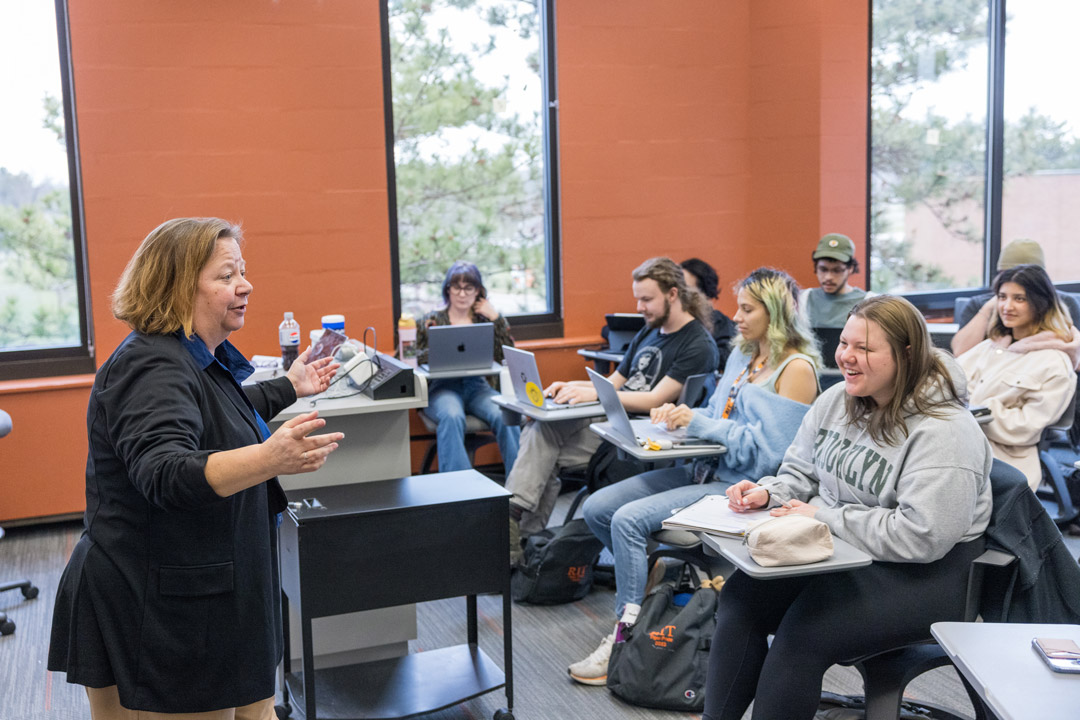
Traci Westcott/RIT
One of the keys to student success, according to Blizzard, is curating a welcoming classroom environment where everyone is comfortable voicing their thoughts and questions.
Blizzard tries to have as much fun as possible with her students, and she aims to dispel their fear of bad grades and assumptions that grades are inherently punitive. With courses that require students to engage in complex philosophical questions that provoke them to dissect and debate ideas they previously saw as undisputable facts, Blizzard believes that levity is necessary.
“Asking them to confront these questions can feel risky, so I try to take the risk out of it,” she said. “I tell my students that learning is an adventure. We don’t necessarily always know the destination, but we’re going to closely examine whatever path we’re taking.”
When Blizzard first came to RIT, her teaching focus was the study of gender, science, and technology. While that focus evolved over time, she created eight new, innovative courses that pushed those boundaries.
One of her favorite courses—and one of her most popular courses that fills to capacity nearly every semester—is Cyborg Theory: (Re)thinking the Human Experience in the 21st Century.
“With Cyborg Theory, I got to embrace so many different things from the technological, to the philosophical, to the anthropological, and beyond,” said Blizzard. “I tell students at the beginning that, by the end of the semester, I promise they will not have any answers, but they will have better questions. And that’s why it’s fun.”
Blizzard’s hope is that students leave her classroom empowered to be critical thinkers and inspired to be kind, collaborative, gracious, and willing to accept or offer help before it’s asked. She accomplishes this by leading by example. In her eyes, giving a lecture is equally as important as lending a kind ear to a stressed student or celebrating someone’s non-academic accomplishments.
“People tend to look for these big moments when they reflect, but I think that’s a problematic view. It doesn’t have to be major victories. A lot of times, it’s just one little step that has an impact,” said Blizzard. “As a professor, you may never know the impact you have on a student. You just do your best and hope that it lands.”