RIT chemical engineering students reshaping particles to help build the materials of the future
RIT’s Jairo Diaz Amaya receives DARPA Directors Fellowship and mentors students to advance smart materials
Scott Hamilton/RIT Photography
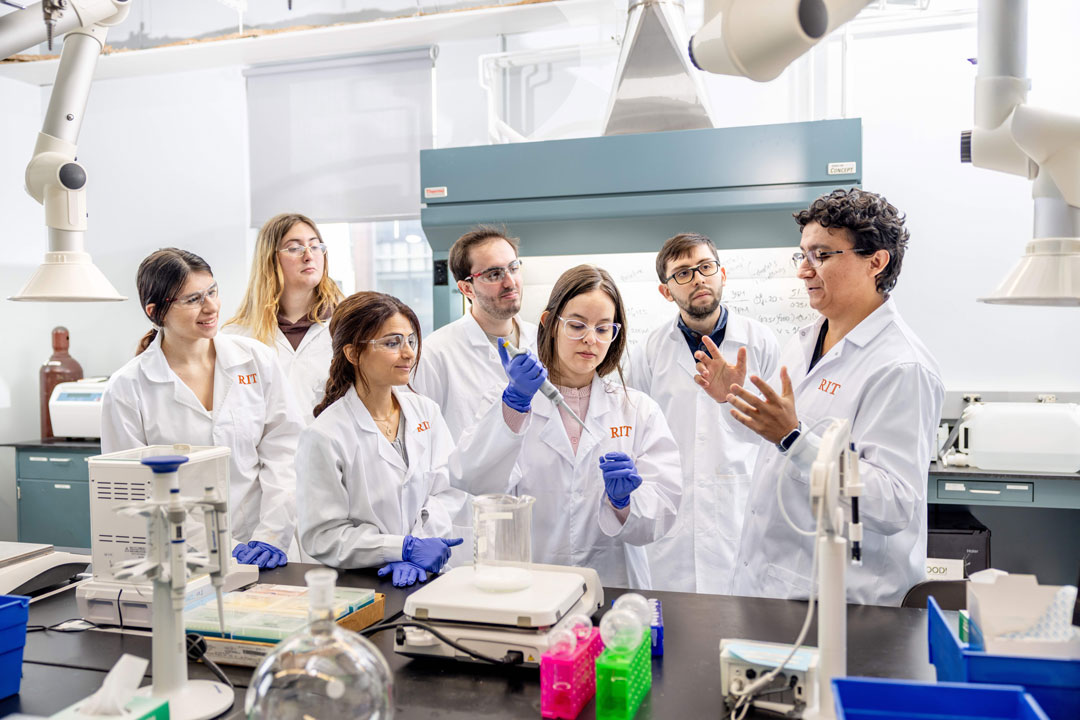
Jairo Diaz Amaya (right) works with students in his Soft Matter Signaling Lab, from left, Natalie Bedolla-Mortensen; Avery Antonacci; Ayyuce Guzide Teke; Orazio Ippolito; Laura Galeano Tirado; and Felipe Martinez Boretto.
Chemical engineering student Natalie Bedolla-Mortensen is playing a role in reengineering tiny particles that could one day become cell tissues of 3D-printed organs. Her research is part of Rochester Institute of Technology’s work in the growing field of soft matter development.
Led by Jairo Diaz Amaya, an assistant professor of chemical engineering in RIT’s Kate Gleason College of Engineering, Bedolla-Mortensen and a group of engineering students are learning about soft matter from a faculty member immersed in an emerging and growing field.
Members of Diaz Amaya’s Soft Matter Signaling Lab had work published in the July 21, 2026 issue of Nature Communications. Led by Timothy Niper ’22 (BS, chemical engineering, MS, materials science) ’25 (chemical and biomedical engineering Ph. D.) and Laura Gaelano Tirado, they demonstrated that depletion forces can be used to modulate dimensional changes in a colloidal lattice, a process that can stabilize the new materials.
“Our field of soft matter—polymers, droplets of liquid crystals, materials that react to stimuli—is getting us closer to mimicking responses or interfaces with biology,” said Diaz Amaya, an expert in soft matter related to biological systems. “This is extremely complicated because it happens at the nanoscale. But we still need to study the phenomenon because colloidal fabrication can be the start of ‘smart’ building blocks that interact with each other and emerge or create new materials with different properties.”
In Diaz Amaya’s Soft Matter Signaling Lab, graduate and doctoral students work on making the particles, or colloids, change shape through simple parameters like temperature or chemical reactants. They also are creating materials with optical properties by regulating how particles interact with light.
Colloidal fabrication is the process of manipulating particles to form new, and stronger, materials. By engineering the particles, the RIT scientists are building materials that might not otherwise be formed and that could have improved functionality, such as selective filtration, improved diagnostics for medical devices or advancing sustainable materials.
Diaz Amaya was recently honored with a DARPA Director’s Fellowship, an extension of his Defense Advanced Research Projects Agency recognition as a Young Faculty Awardee in 2024. The new fellowship supports early-career scientists to develop projects toward national security initiatives. He has involved undergraduate, graduate and doctoral students in the developmental work through the DARPA award, and the group has seen results in chemical processes that transform polymers.
Scott Hamilton/RIT Photography
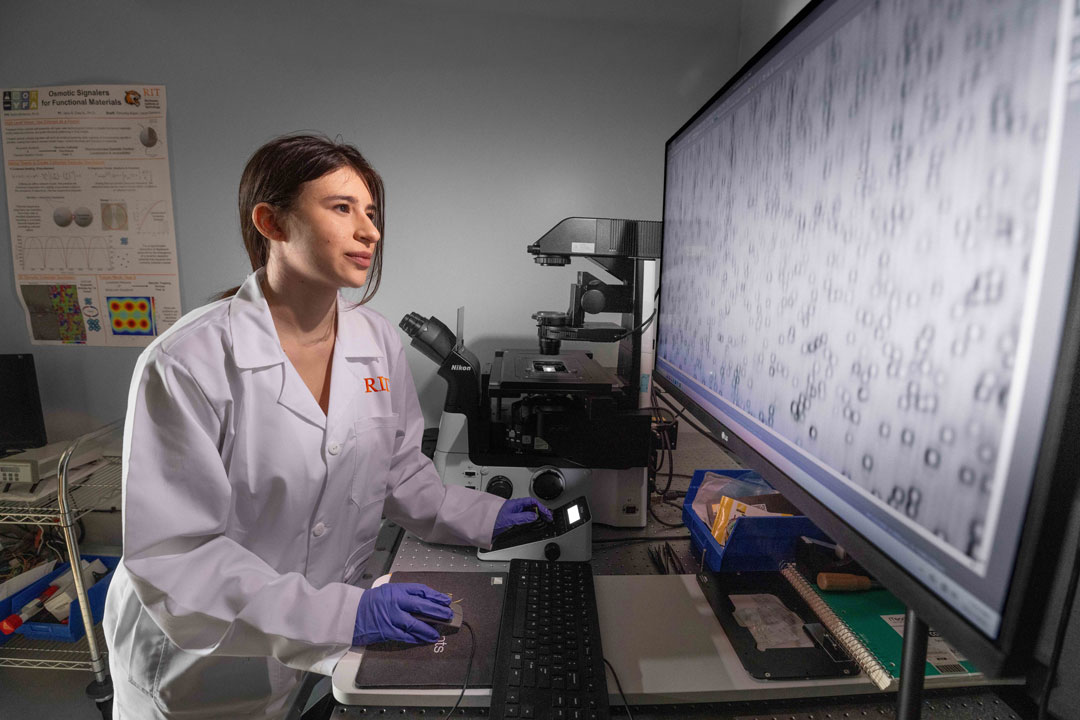
Natalie Bedolla-Mortensen reviews some of the colloidal material experiments she and her lab mates enacted recently.
“I have come to love the versatility of the research we do, especially as a lot of what we do is heavily based on proof-of-concept because it has not been studied as in-depth before,” said Bedolla-Mortensen. The third-year chemical engineering student from Chesapeake, Va., began working with Diaz Amaya in her first year at RIT and connected her interest in developing smart textiles, a field she’ll be pursuing after graduation, with the chemical principles she is using in the colloidal research project.
“It was a large part of why I joined Jairo’s lab. I would like to work with textiles in order to make them more environmentally sustainable, either through biodegradability or other qualities, and to create a material for clothing that adapts to body temperature and changes thickness or size of stands as a result,” she explained.
RIT’s chemical engineering program in the Kate Gleason College of Engineering is known for its focus on designing and controlling chemical processes to create new and alternative materials that strengthen applications for energy and battery systems, biomedical devices and materials, pharmaceuticals and other elemental resources.
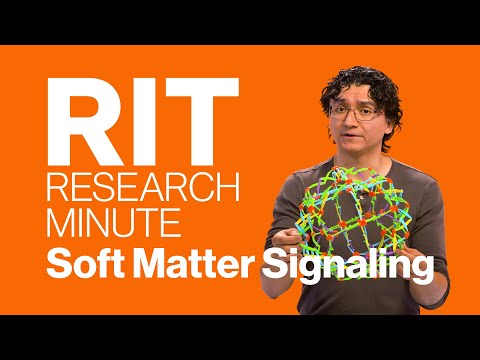
RIT Research Minute: Soft Matter Signaling