RIT initiative helps golf courses cut pollution and protect waterways

Provided
Golf courses across Central and Western New York have adopted new sustainability practices through a program led by RIT's New York State Pollution Prevention Institute.
When a golf course superintendent called the New York State Pollution Prevention Institute (NYSP2I) in 2014 with a wastewater problem he couldn't afford to fix, few expected it to become a model for the sport.
More than ten years later, the program that grew from that phone call has not only helped hundreds of New York golf courses measurably reduce their environmental footprint, but it has also attracted the attention of the golf world from Scotland to Japan looking for a better way to care for one of the most resource-intensive sports in the world.
The effort, funded by the New York State Department of Environmental Conservation, was led by Eugene Park, a researcher with NYSP2I and RIT’s Golisano Institute for Sustainability, who brought a structured, data-driven approach to a problem the golf industry had long struggled with: getting courses to adopt better environmental practices.
“It was a win-win proposition,” Park said. “You're helping businesses remain healthy economically while improving the environment. There's nothing you can not like about what we did.”
Working with Cornell University's turfgrass program, led by specialist and professor Frank Rossi — who had spent decades trying to move the industry toward better practices — the team surveyed a randomly selected group of courses across 17 counties in Central and Western New York, then launched a targeted education campaign built around materials designed by NYSP2I's communications team — a handbook, poster, and wash station guide distributed to courses across the region. The team then surveyed the courses again to measure what changed.
“I've been working on this for 30 years,” Rossi said. “Getting people to adopt best practices is a totally different animal than educating them about it. This is the first time we could really effect change.”
RIT co-op students were also embedded in the work throughout, notably Jessica Wagner ’23 (industrial engineering), (sustainable systems) and Khursten Alphonso '24, (mechanical engineering), both of whom contributed mapping, data analysis, and reporting to the project.
“The program gave us the opportunity to contribute to something that really mattered,” said Wagner, who works as an engineer for JK Muir. “We had the opportunity to learn from people who are doing this work at the highest level.”
One of those people was former Locust Hill Country Club golf superintendent Rick Slattery. Like Rossi, he had long believed that healthier turf didn't require the heavy use of water and chemicals relied on by industry. When he connected with NYSP2I, the goal was simple: find an affordable alternative to wash systems that could cost upwards of $80,000.
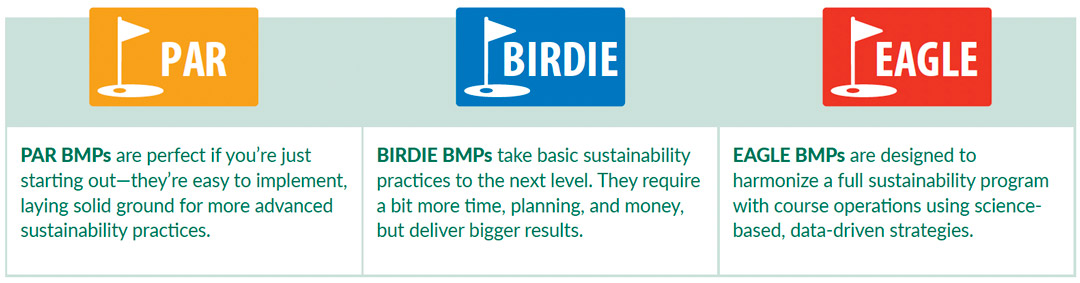
What the team developed was a tiered framework using golf's own language: par, birdie, and eagle, to make change feel manageable for any course regardless of budget. A par might mean a $20 nozzle that uses less water. An eagle, a full water recycling system.
Provided
A graphic from the sustainability handbook designed by RIT's P2I communications team breaks down best management practices into three tiers—par, birdie, and eagle—making environmental stewardship accessible to any course.
“We had to meet each person where they were at,” said Cornell researcher Carl Schimenti, who created the framework. “By dipping your toe in the water, you build momentum. One thing leads to another.”
The results backed it up. The team found measurable improvements in how courses handled water, fertilizer, pesticides, and runoff — and estimated that a single practice change eliminated the equivalent of more than 68,000 pounds of excess fertilizer from the region's waterways each year, reducing the risk of algal blooms in New York's lakes and rivers.
At a national Golf Course Superintendents conference in Orlando this past February, attended by more than 12,000 people from around the world, the team's approach generated significant interest. A professor in Scotland's Rural College has also begun using the NYSP2I handbook in the classroom. The team has since launched a new phase of the project on Long Island, one of the more environmentally sensitive golf landscapes in the country.
“This work shows how New York State can lead in environmental progress with influence extending across the country and beyond,” said Roy Green, NYSP2I’s director. “By working closely with our university partners and student co-ops, we’re driving innovation that helps the golf sector take practical steps toward sustainability.”
“It wouldn't have happened without the people at NYSP2I," Slattery added. “They lit a fire under all of this.”
Funding was provided from the Environmental Protection Fund as administered by the New York State Department of Environmental Conservation. The opinions, results, findings, and/or interpretations of data contained herein are the responsibility of Rochester Institute of Technology and do not necessarily represent the opinions, interpretations, or policy of New York State.