RIT Research Computing earns international recognition with new supercomputer
Benjamin Meyers
TIGRIS, RIT’s supercomputing cluster, expands computing power, accelerates research, and ranks among the world’s fastest and most energy-efficient systems.
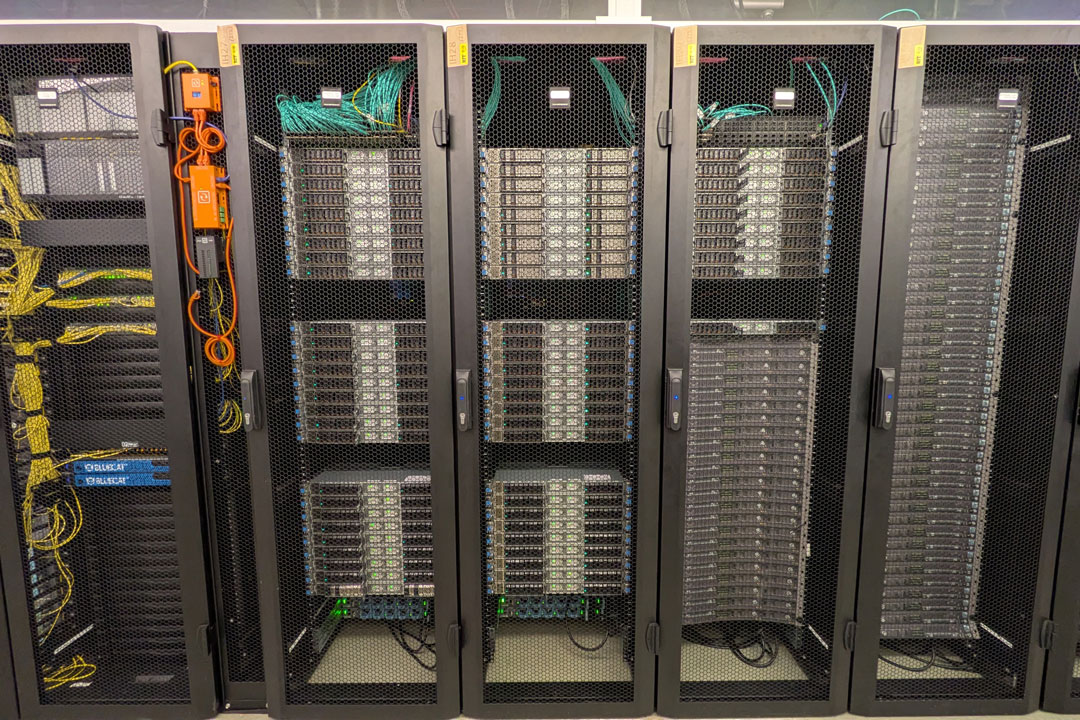
Rochester Institute of Technology is strengthening the computing infrastructure behind its growing research enterprise with a new high-performance computing cluster ranked among the world’s fastest and most energy-efficient supercomputers.
The computing cluster, known as TIGRIS, appears at No. 302 on the TOP500 list of the world’s fastest supercomputers and No. 18 among systems at U.S. academic institutions. It also ranks No. 82 globally and No. 15 among U.S. academic institutions on the Green500 list, which measures supercomputer energy efficiency.
More than a technology upgrade, TIGRIS expands the capacity of RIT Research Computing to support faculty, students, and research teams across the university. Research Computing provides researchers with shared computing infrastructure, software support, data storage, training, and consultation so they can pursue complex projects without having to purchase and maintain specialized systems of their own.
Launched this summer, TIGRIS delivers three times the central processing unit performance and seven times the graphics processing unit performance of SPORC, RIT’s previous high-performance computing cluster.
That additional capacity is already accelerating researchers’ work. Computing jobs that waited an average of six hours to begin processing on SPORC now start in about 18 minutes on TIGRIS. The improvement gives researchers faster access to results and allows them to move more quickly from data collection and analysis to discovery.
“Our goal was to provide a resource that allows researchers to focus on their discoveries rather than spending time managing hardware and software,” said Matangi Buch, executive director of Research Computing. “TIGRIS allows researchers to get faster results, opening up new possibilities for research across RIT.”
RIT researchers use high-performance computing to study questions that would be difficult or impossible to address with conventional computers. Their work includes modeling mergers of supermassive black holes, studying biological systems and large genomic datasets, and using atom-level simulations to investigate materials for next-generation fuel cells.
TIGRIS gives these researchers greater computing power, shorter wait times, and the ability to undertake larger and more computationally intensive projects. It also supports interdisciplinary work by providing shared infrastructure that can serve research teams across RIT’s colleges, centers, and institutes.
“Research Computing has been an invaluable resource for our research,” said Stefan Schulze, assistant professor in RIT’s School of Life Sciences. “Access to university-supported computing and shared data storage allows us to work with large datasets and gives multiple students the ability to access and process them efficiently.”
TIGRIS was developed in collaboration with Nvidia, Supermicro and Chilldyne. The system uses advanced liquid-cooling technology to support its computing performance while maintaining energy efficiency. Its design and operation contributed to the system’s Green500 ranking.
The investment builds upon the broader work of RIT Research Computing, which supports researchers by providing high-performance computing, distributed research storage, software support, training, workflow optimization, grant-proposal assistance, and other research facilitation services. The Research Computing reports that the organization has supported more than 830 scholarly works since 2016.
By expanding this shared infrastructure, RIT is giving researchers and students greater capacity to pursue ambitious projects while strengthening the university’s broader research ecosystem. Research Computing describes the operation as a university-wide resource supporting hundreds of faculty members, more than 1,600 students, and millions of computing jobs over a decade.
Researchers interested in TIGRIS, data storage, software support, training, or other services can learn more through RIT Research Computing. The site also provides access to project requests, user guides, resource-allocation tools, events, and consultation services.