RIT researcher targets biopolymers as alternatives to laminates and plastics
Plant-based starch biopolymers are the newest innovation in paper-based packaging
Supplied
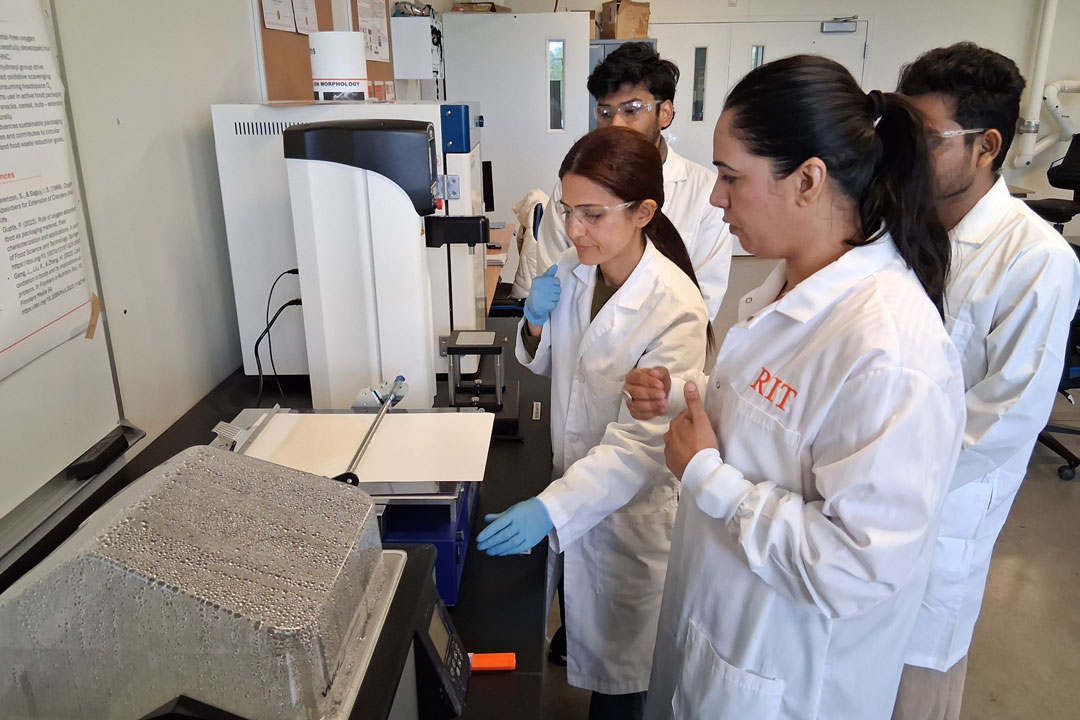
From left, Ayyuce Guzide Teke, Balaveera Srinivasaguru, and Victor Immanuel, students in the Food Packaging Lab, developed new barrier materials made of starch to protect paperboard packaging with Assistant Professor Sneh Bangar (foreground).
Alternatives to plastics are being created by researchers at Rochester Institute of Technology using plant-based starch, a plentiful and highly sustainable material.
Sneh Bangar, an assistant professor of packaging science in RIT’s College of Engineering Technology, is developing a new use for a biopolymer based on modified starch that acts as a protective barrier for paper-based packaging.
Paper-based packaging is one of the most used materials for many food products. For example, milk cartons are paper-based, and companies provide a laminate on the surfaces to strengthen the initial material and to preserve the product. The drawback is this synthetic material makes the package difficult to recycle or compost, Bangar explained.
“We were able to achieve the same barriers that the plastic lamination or plastic coatings give,” said Bangar, who leads the Food Packaging and Shelf-Life Testing Laboratory in CET. “The goal is not to eliminate plastics but reduce the use of the plastics.”
Using crosslinking techniques to modify and strengthen pearl millet, a native starch, the researchers altered its structure to strengthen its stability and viscosity.
Crosslinking is a chemical process that bonds polymer materials to strengthen the substances at the molecular level. This process is used in materials science to develop alternatives to petroleum-based plastics. Starch, although it is a renewable, plentiful, and relatively inexpensive material, needs to be processed, or strengthened, before being used as a possible bio-plastic that is fully water-resistant, strong and stable. The results of recent testing were detailed in the Aug.14, 2026 edition of the International Journal of Food Properties.
“When it comes to packaging, the food category contributes the most in the need for packaging options. We can add value to alternative packaging options with this new work,” said Bangar, who was recently recognized with the 2026 American Polymers Association Young Scientist Award, given to researchers working in alternative materials for packaging. Her project is a collaboration with Clemson University and was funded by a grant through the U.S. Department of Agriculture’s program Assisting Specialty Crop Exports—Sustainable Packaging Innovation Lab.
As brands and consumers continue to seek more sustainable packaging solutions, there is growing interest in renewable materials that can reduce reliance on traditional plastics and synthetic coatings without sacrificing performance, said Kyle Dunno, professor and department chair of CET’s Department of Packaging and Graphic Media Science. He worked closely with Bangar and her research group on the biopolymers project.
“RIT is uniquely positioned to address these challenges through the integration of packaging science, materials research, manufacturing technologies, and product testing,” Dunno said. “Research like Dr. Bangar’s exemplifies how our interdisciplinary approach can transform promising bio-based materials into practical packaging solutions that support a more sustainable future.”
CET integrated its packaging science and print media programs in 2022 to reflect the strategic growth in the evolving packaging and print industries emphasizing sustainable practices, alternatives to plastics and improvements to manufacturing and distribution processes. Students, faculty, and industry partners have access to extensive labs within the college to develop new materials and test products.