RIT researchers find everyday vaping delivers more nicotine than expected
Real-world vaping data could shape how e-cigarettes are tested
Scott Hamilton/RIT Photography
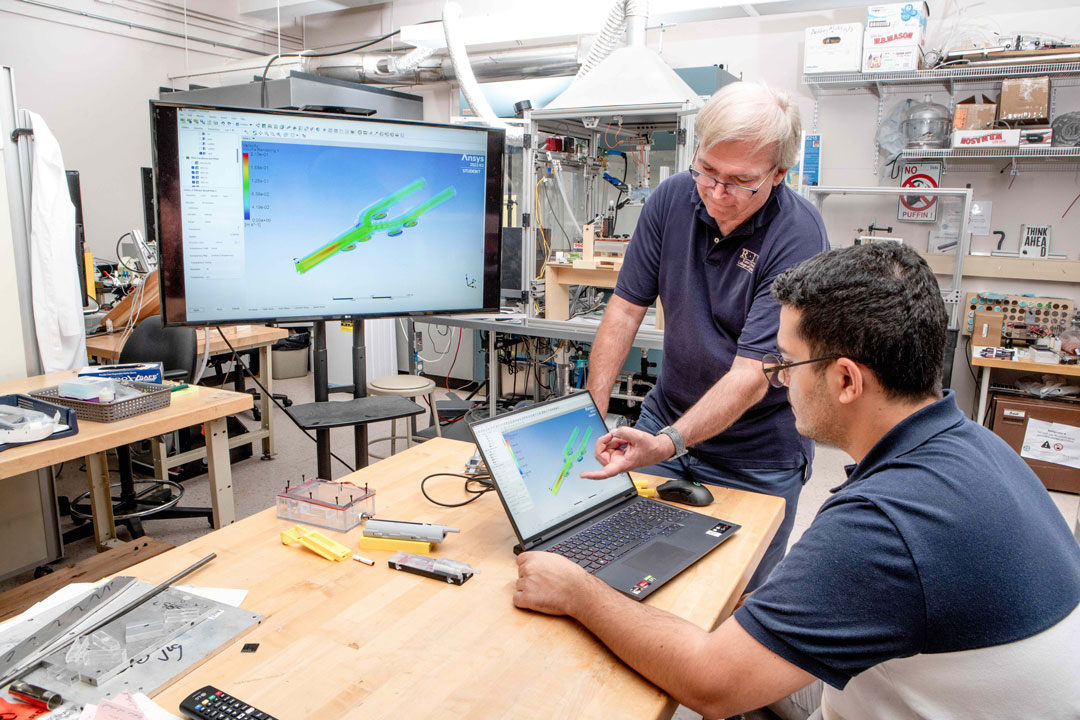
Ed Hensel, standing, associate dean for graduate programs in RIT’s Kate Gleason College of Engineering, works with a student on the design one of the Respiratory Technology Lab’s original wireless Personal Use Monitors.
Researchers at Rochester Institute of Technology have found that everyday use of e-cigarettes can be more intense than what is observed in controlled laboratory studies. While lab studies provide valuable data, they may not capture the entire story about how people use e-cigarettes at home or in other real-world settings.

RIT Photography
Professor Risa Robinson, Kate Gleason College of Engineering
E-cigarettes have been on the market for more than a decade, but research into their use, exposure, and toxicity has not yet reached the level of research on traditional cigarettes. RIT’s research aims to help close that information gap by studying how people use e-cigarettes in their daily lives.
Early data indicate that e-cigarette users may inhale more often and take longer, deeper puffs than laboratory studies suggest. As a result, even e-liquids promoted as having low nicotine content could lead to greater exposure depending on how they are used.
The research, funded by a $4.8 million, four-year grant from the Food and Drug Administration (FDA), will contribute to future testing standards before e-cigarette products are brought to market.
RIT’s multidisciplinary research team includes Risa Robinson, the James E. Gleason Professor of Mechanical Engineering; Edward Hensel, associate dean for graduate programs in the Kate Gleason College of Engineering; Nathan Eddingsaas, associate professor in the School of Chemistry and Materials Science, who analyzes the chemical contents of emissions and e-liquids; and Stephanie Godleski, professor in the School of Psychology and Cognitive Sciences who uses ecological momentary assessment to better understand people’s motivation for using e-cigarettes.
“We are looking for key indicators of harm and addiction,” said Robinson. “We have these for smoking; it is well-understood. But vaping differs quite a bit from traditional cigarette smoking. We aim to mimic the natural use behaviors of vaping. We want lab testing to better represent the real world.”

RIT Photography
Professor Stephanie Godleski, College of Liberal Arts
E-cigarette use and the associated harm are multifaceted. To best inform policy, prevention, and intervention efforts, the researchers are taking an approach that mirrors that complexity, Godleski said.
“As part of this work, we examine real-time psychological, affective, and contextual influences in concert with use in the natural environment as well as the composition of e-liquid and emissions,” said Godleski. “Being able to understand each of these pieces all together as they occur in daily life helps us to find patterns and determine what factors maintain or exacerbate e-cigarette use and dependence and ultimately inform how to support changes.”
A key element of the process is gathering data on how people vape in real-world settings. Robinson and Hensel built a wireless Personal Use Monitor (wPUM), a device that measures usage (frequency, duration, and volume) as well as emissions. With no device on the market to measure puff topography in the natural environment, the wPUM was built in-house to give to test subjects.
Data from the wPUM provide details about constituent exposure and potential harm. The device also adapts to the different types of e-cigarette devices sold today.

RIT Photography
Associate Professor Nathan Eddingsaas, College of Science
“Every e-cigarette and device that we test is slightly different. But our wPUM monitor is universal; like choosing a different case for your phone. Same idea, just a different shape,” said Robinson, who was appointed to the FDA Technical Committee on Regulatory Science (TCORS) Tobacco Products Scientific Advisory Committee in 2021.
She and Hensel have expertise in fluid dynamics, particle deposition, and design of medical devices. They have extensive funding awards from organizations such as the American Cancer Society and the National Institutes of Health (NIH). Most recently, they received an award of $3.7 million from the NIH to assess the effect of nicotine content of e-liquids.
RIT’s research enterprise is focused on advancing knowledge, solving complex global challenges, and making a meaningful impact across disciplines. This past year, RIT received $105 million for faculty and student research. In the 2025 fiscal year, the faculty-researchers at the Kate Gleason College attained more than $20 million in awards.
Youth vaping
An estimated 1.63 million middle and high school students currently use e-cigarettes, according to the Food and Drug Administration (FDA).
E-Cigarette Research at RIT