RIT tech helps NASA astronaut photograph the cosmos
RIT-developed star tracker mount was used on the International Space Station
Don Pettit
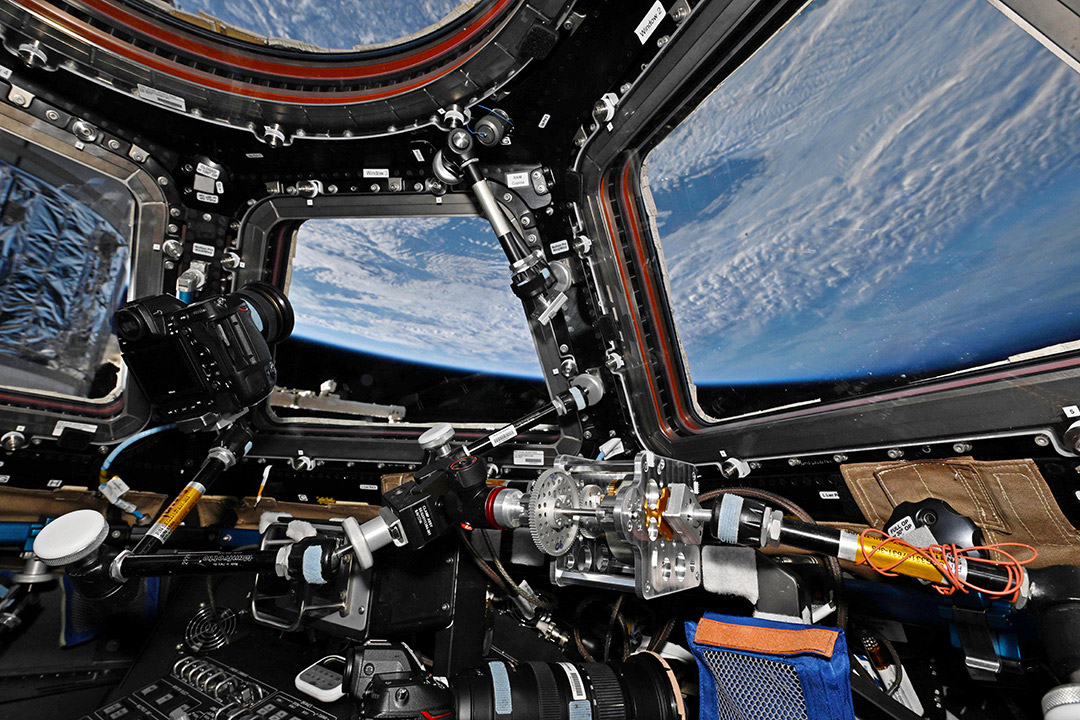
The orbital sidereal tracker camera mount, seen above, accounts for the constant movement of the International Space Station by rotating every 90 minutes. The rotation enabled astronaut Don Pettit to capture more accurate images of his view from space.
When Don Pettit, NASA’s most senior astronaut, sought a way to accurately capture his view from the International Space Station (ISS), alumnus Peter Blacksberg ’75 (photography) connected him with Ted Kinsman, associate professor in RIT’s School of Photographic Arts and Sciences.
On Pettit and Blacksberg’s request, Kinsman designed an orbital sidereal tracker camera mount that allowed Pettit to take a clear image of the stars from a window on the ISS.
“Images from space help tell the story to people on Earth that don’t have the opportunity to go into space. So, the photographs help complete the story of what it means for human beings to expand into space and expand into this frontier,” said Pettit in a video interview by NASA.
Photography alums train NASA astronauts
The astronauts on NASA’s Artemis II mission were well equipped to document their journey around the moon because of training from RIT alumni. Katrina Willoughby ’04 and Paul Reichert ’01, flight operations imagery instructors, worked with the astronauts for about two years before the launch on April 1.
According to Kinsman, sidereal camera mounts, often referred to as star trackers, are commonly used for astrophotography to increase the quality of photos. The mounts are designed to rotate at the exact speed the Earth rotates, cancelling out Earth’s motion and allowing the camera to maintain focus on a specific star or portion of the sky. The final product is a more crisp, clear image that can reveal dim and distant stars.
For this project, Kinsman explained that the mount needed to rotate once every 90 minutes to account for the space station’s constant motion. It also needed to be completely mechanical to ensure it could withstand its intended use.
Instead of reinventing the wheel, Kinsman opted to repurpose a well-tested device: a chart recorder clock drive designed for industrial ovens.
“The biggest design problem was that it had to survive lift off. In most cases they test things like this with vibration systems at special test facilities, but we couldn’t do any of that because of the timeline. We had to go for the most durable system we could find, and I think we were lucky to hit on the right solution,” said Kinsman.
Kinsman, Blacksberg, and Pettit initially connected about the project in Spring 2023, and the mount design was finalized before the end of that year. Once completed, the mount was shipped up to the ISS on a supply mission in advance of Pettit’s arrival in September 2024.

Ted Kinsman
The final camera mount was etched with a crediting statement that explains what the mechanism is and who was involved in its creation. The etching was completed at the SHED.
To meet this tight deadline, Kinsman employed the help of his son, Parker Kinsman ’25 (industrial design), to create the CAD files needed to manufacture some of the elements of the mount. Then, he leveraged the facilities and machinery in the College of Art and Design’s Fab Lab and the SHED Makerspace to create the prototypes. The final design was machined out of aluminum at MP 3D Designs in Scottsville, N.Y.
Mike Buffalin, director of the SHED Makerspace, said projects like this are a reminder that the maker community on campus isn’t exclusive to students.
“Democratizing access to technology across campus has been really important for us, and we’ve outfitted the space with a variety of maker tools to really empower our community,” said Buffalin. “Bringing the maker community together in these highly visible spaces can really spark an interest. If a student were to walk in and see Ted’s project, they might get curious about exploring space photography, machining, or laser cutting on their own.”
Buffalin noted that Jim Heaney, a SHED makerspace lab technician, was instrumental in laser etching the final device. Kinsman added that Tiree Walker, instructional support specialist, was a great help when printing the prototype gear spaces for the mount in the Fab Lab.