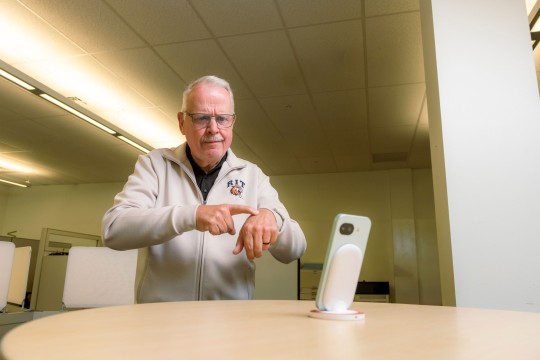
RIT’s occupational therapy program blends technology and patient-focused care
Scott Hamilton/RIT
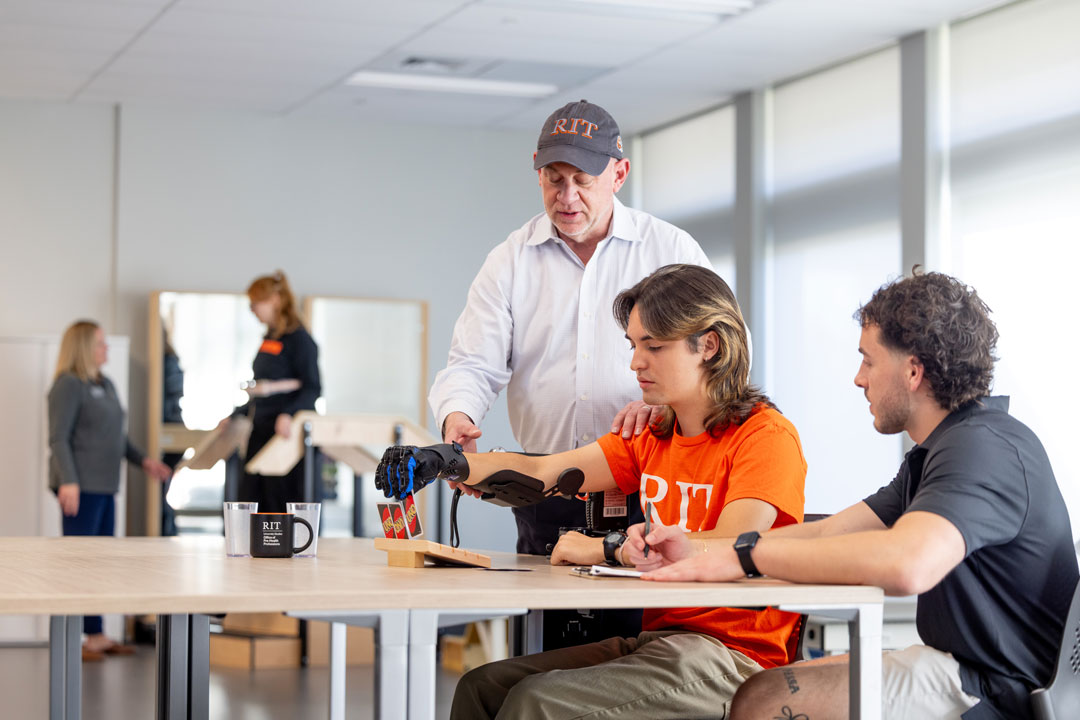
Access to emerging technologies gives RIT Occupational Therapy doctoral students like Joshua Luciano, right, new ways to apply design interventions that support movement and independence. Stephen Van Lew, left, assistant professor, demonstrates how to use a rehabilitation glove.
RIT’s clinical doctorate in occupational therapy blends technology and patient-centered rehabilitation in labs dedicated to five specific focus areas:
- Activities of daily living;
- Clinical skills (with a teletherapy room for remote rehab);
- Fabrication lab/OT makerspace;
- Occupational performance and movement analysis; and
- Pediatric occupational therapy.
The future of occupational therapy (OT) is on display at Rochester Institute of Technology in cutting-edge laboratories that support the university’s new doctorate in occupational therapy (OTD).
Gamified therapy, augmented/virtual reality environments, wearable devices, 3D-printed orthotics, and telehealth for remote rehab are innovative approaches to occupational therapy taught at RIT. These therapeutic technologies enhance traditional methods for helping people with injuries, illnesses, and disabilities regain skills and independence.
Scott Hamilton and Paul Besch Turner/RIT
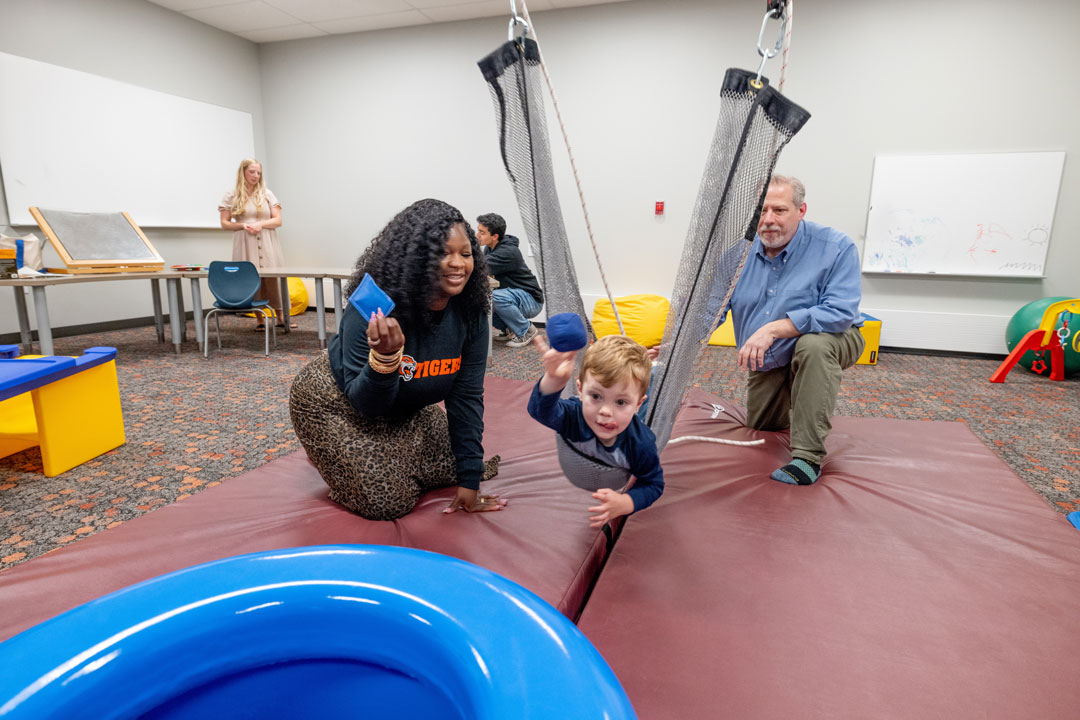
Movement and play are tools used in RIT’s pediatric occupational therapy lab to help children develop fine and gross motor skills, sensory processing, self-regulation, and other functional skills for everyday life. Here, Christopher Alterio, RIT director of occupational therapy, right, is an expert in pediatric therapy.
Today’s technological solutions are expanding the occupational therapy toolbox beyond button hooks, extendable shoehorns, and hand-molded orthotics—reliable 20th century tech still in use today—and give OTs options when treating patients.
“The unique value of occupational therapy at RIT is the university’s engineering, design, and innovation mindset,” said Christopher Alterio, RIT clinical professor and director of occupational therapy, the university’s first clinical doctoral program. “At RIT, we can apply technology, art, and design solutions and purposeful problem solving to human-centered care.”
RIT is nationally recognized for degrees in engineering, bioengineering, computing, and gaming, all of which are leveraged in the development of occupational therapy interventions. OT’s focus on patient experience and capstone research will tap into the synergy of technology, the arts, and design on campus.
An entry-level OTD program
OTD at RIT is an entry-level clinical doctorate with a multidisciplinary curriculum. RIT student Adira Blumenthal, from Silver Spring, Md., enrolled in the program with work experience as a computer software engineer developing assistive technology. The experience made her want to work directly with end users, especially children, who rely on assistive devices to manage their cognitive and neurological disorders.
Blumenthal’s focus aligns with the pediatric occupational therapy lab to develop clinical reasoning skills, and the occupational therapy fabrication lab, a makerspace for building personalized assistive devices for patients.
“People talk about ‘tech neck’ and effects from the way we hold our phones and use our thumbs and wrists, and our shoulder posture from typing,” said student Adira Blumenthal. “Occupational therapy isn’t just about getting back to doing laundry and getting dressed. Being able to use your phone is a big part of daily living, and we need to know how to make modifications to phones and computers.”
Joshua Luciano, from Irondequoit, N.Y., entered the OTD program with a background in kinesiology and a personal interest in Parkinson’s disease. Inspired by his grandfathers—both of whom were diagnosed with Parkinson’s—Luciano’s goal is to specialize in preventative occupational therapy for patients with neurological disorders.
“There are many neurological issues that respond to early intervention and early medication that could slow down their condition and prolong a good quality of life,” Luciano said.
The occupational performance and movement analysis lab includes high-end motion capture cameras and a force plate that will give Luciano hands-on experience integrating data. He will learn to combine movement and ground force data with information about muscle activity and eye tracking collected from wireless devices worn by patients. The data will enable him to isolate patterns of movement and identify interventions for people with illnesses or injuries.
“Technology enables our OT students to record and integrate these elements and measure how it fits together,” Alterio said. “Every decision is grounded in who the person is, what they need or want to do, and the contexts in which life happens.”
Students learn to observe each patient’s situation, plan a purposeful response, and implement the plan, following a measure-design-make framework unique to RIT. This method differentiates the program from other universities’ approach to OT, Alterio said.
Forward-looking occupational therapy
Scott Hamilton/RIT
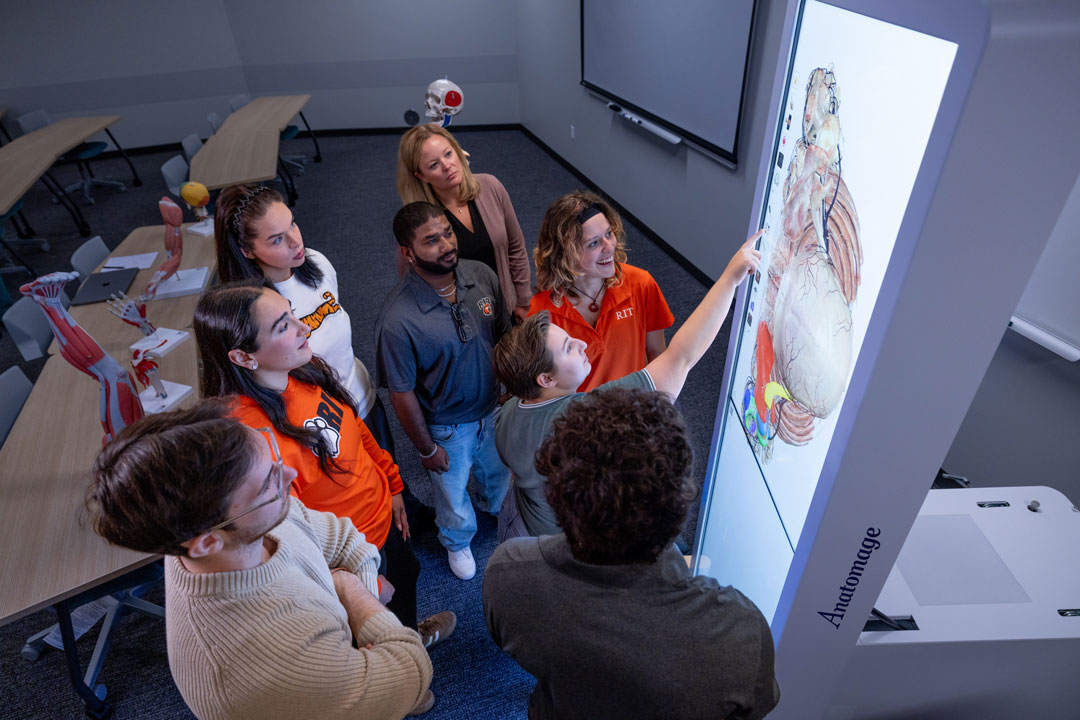
RIT doctoral student Adira Blumenthal, center, isolates and examines anatomical structures and relationships on the digital anatomy table, while Marcia Shea, assistant clinical professor in RIT’s occupational therapy program, looks on.
The expansion of RIT’s health sciences programs aligns with job opportunities in the healthcare industry, the largest private employment sector in the nation. The U.S. Bureau of Labor Statistics projects the occupational therapy field to grow 15 percent by 2035, faster than the average growth for all occupations.
Job opportunities for occupational therapists exist beyond schools, hospitals, and out-patient clinics, Blumenthal noted. OT practitioners can work in skilled nursing facilities and nursing homes, and in support of mental health management, early intervention for children diagnosed with or at risk of developmental delays or disabilities, and as consultants to companies developing assistive technologies.
RIT’s forward-looking OTD program will prepare graduates in the latest technology and teach them to evaluate emerging innovations, Alterio added.
The technological focus of the program will differentiate RIT graduates from their peers when entering the workforce, Luciano said. “It will set us apart.”
Tech-savvy occupational therapists will bridge a knowledge gap in the workplace, and RIT’s program can fill that need, added Blumenthal. “It’s important to have OT practitioners who are comfortable with technology, keep up with developments, and educate other practitioners and patients about the technology.”