Student creates out of this world design for NASA internship
Interactive design goes interplanetary
Elizabeth Lamark
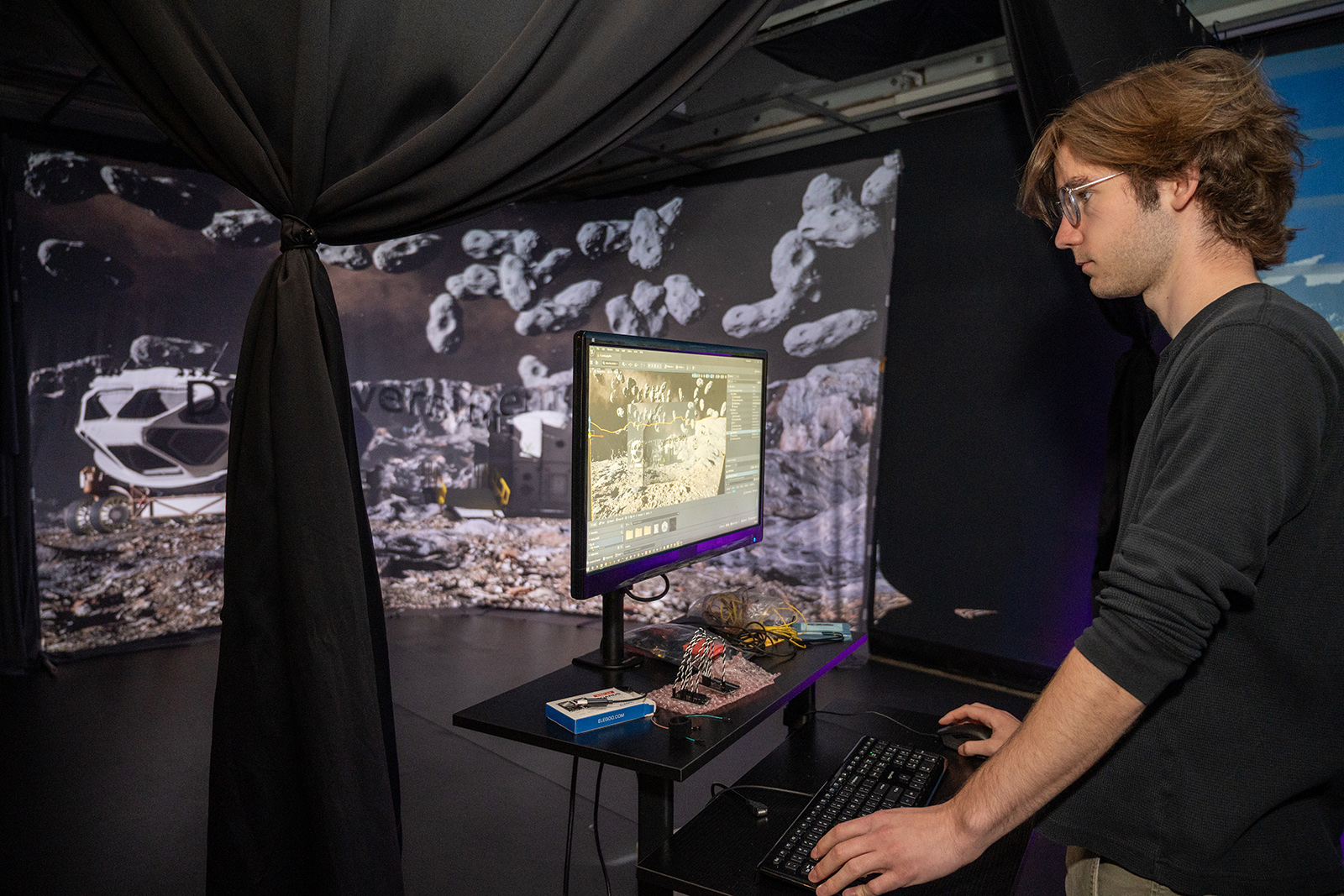
Tommy Desjardins works in the 3D digital design program's newly designed Simulation Lab, equipped with everything a student needs for projection and interactive design projects.
An extraterrestrial scene painted with a blanket of regolith, rover models, steep craters, and floating rock formations fills a giant, panoramic screen. The setup is a centerpiece of the RIT 3D digital design program’s Simulation Lab, newly designed as a playground for student and faculty research in projection and interactive design.
Tommy Desjardins ’26 (3D digital design) is taking full advantage of the space while completing the Psyche Inspired internship program, an opportunity for students around the country to support NASA’s Psyche mission through their creativity. They are producing projects that educate the public about the ongoing effort to reach a metal-rich asteroid orbiting the sun between Mars and Jupiter to study its properties.
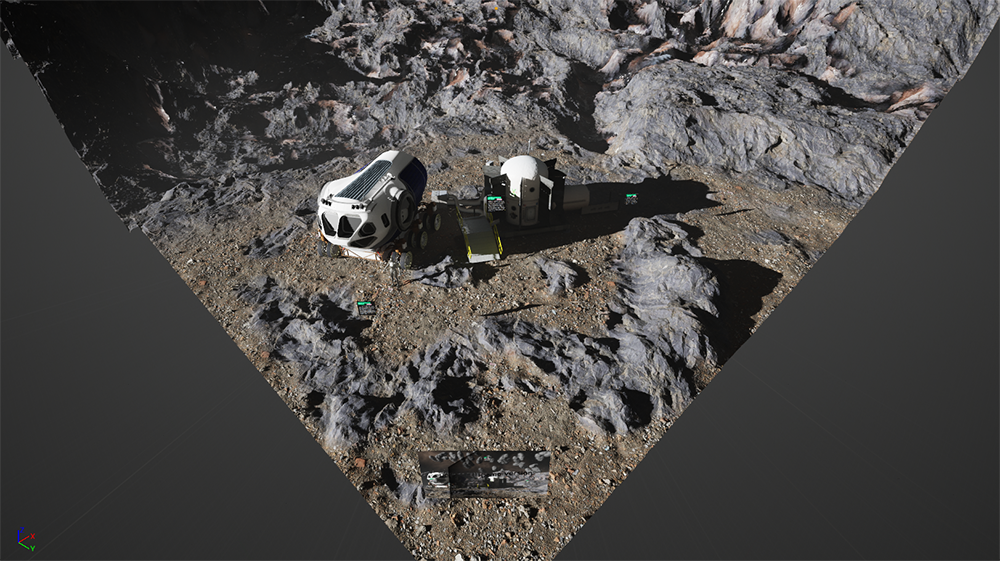
For his first Psyche Inspired project, “Standing on Psyche,” Desjardins created an immersive environment for users to experience a visualization of the Psyche asteroid’s potential landscape. Users can deploy their phones as a scanning device to activate information displays about the sizable projection’s different elements.
Information related to the landscape’s material makeup (types of rock and metal), NASA’s associated technology, and the actual Psyche spacecraft is all a click away from being discovered.
“I wanted to create a museum exhibit or experience that integrated the audience,” said Desjardins, from Bedford, Mass. “I really love the internship. At our weekly meetings we get to talk with the real scientists and engineers who work on the Psyche mission. It’s really cool that I’m showing them my project for Psyche.”
Tommy Desjardins
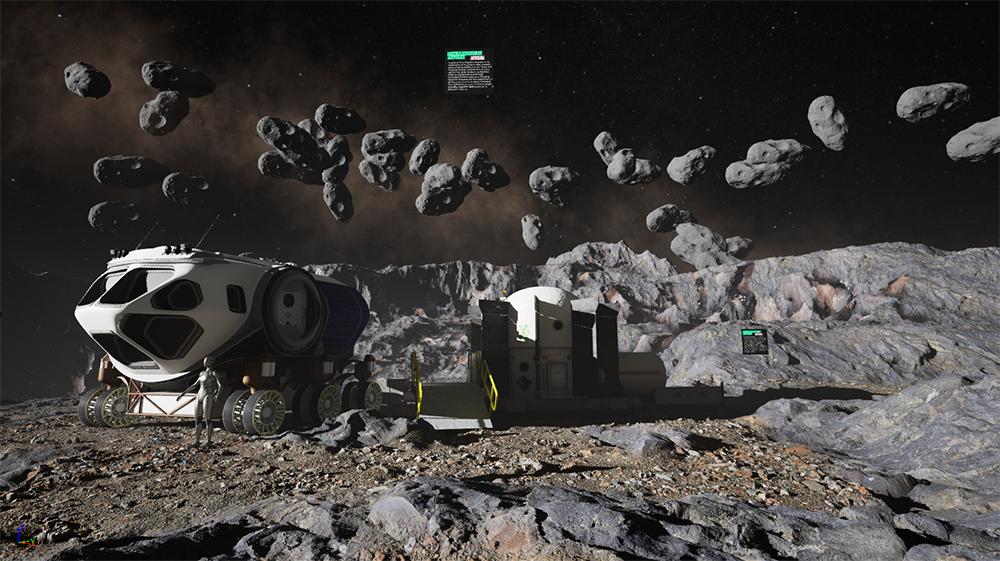
The "Standing on Psyche" project allows people to explore an asteroid, no spacesuit required. This is part of Desjardins' regolith-heavy visualizations of the Psyche asteroid.
All of the projects from this year’s internship cohort are being featured on the Psyche Inspired program website.
Desjardins leveraged resources and data provided by Psyche Inspired to generate the exhibit’s text information as well as details that inspired his visual estimation of the asteroid’s appearance.
“A theory about Psyche is this potential landscape where you have rough, gravely regolith. And then these stonier hills with metal ore exposed in them,” Desjardins said. “So we don’t know if this is what Psyche would look like, but some data suggests this is a possible landscape.”
Desjardins tapped into his coding knowledge to establish the project’s sophisticated foundation.
He programmed his scene to project onto a curved canvas in the Simulation Lab. It can adjust to different-sized walls in other settings, too. He then constructed the landscape, materials, and models in Unreal Engine.
Tommy Desjardins
An overhead view of Psyche's potential landscape, visualized by Desjardins.
“It showcases how modern visualization and interactive design can bring NASA’s missions closer to the public, transforming data and research into a tangible experience,” Desjardins’ project description reads.
Desjardins originally learned about the Psyche Inspired opportunity last year after joining RIT Kate Gleason College of Engineering students on a Multidisciplinary Senior Design project. He took a rover designed by the team of RIT engineers and rendered it moving through the Psyche asteroid.
The experience exposed him to the internship. And using innovative techniques to tell stories about NASA discovery was a natural appeal.
“It’s a great opportunity to use this technology and I love space,” Desjardins said.
Desjardins is the latest in a line of RIT College of Art and Design students to be accepted into the NASA-sponsored internship program.