Students to showcase alternative controllers at Game Developers Conference
New media students head to San Francisco to present interactive capstone experiences
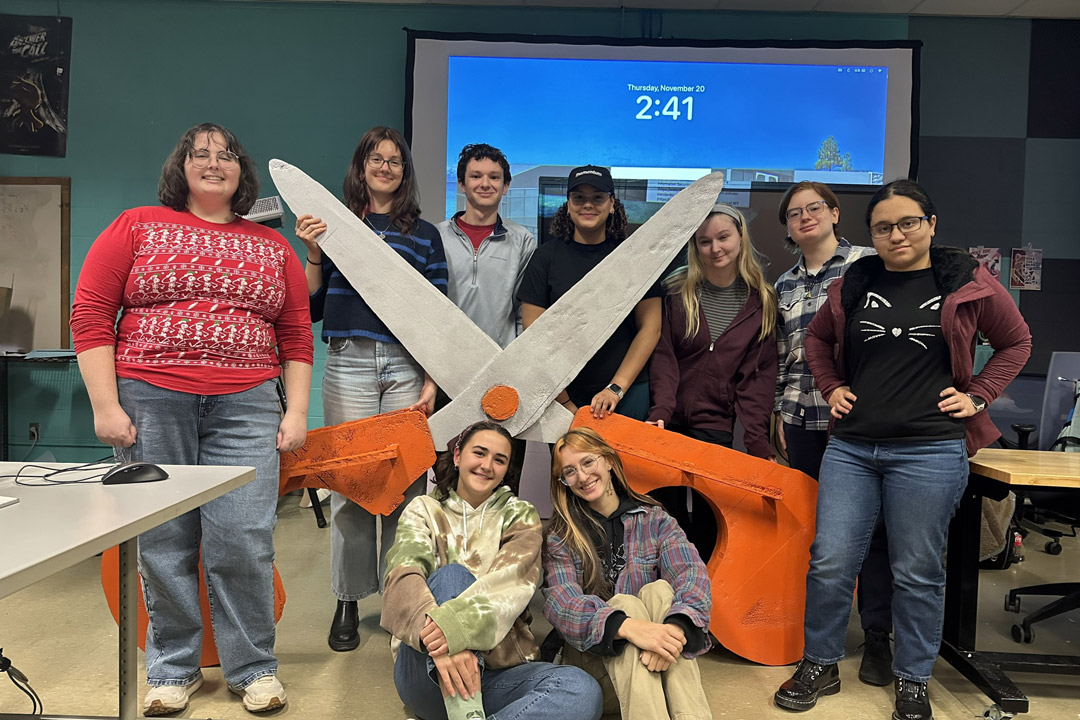
Three student teams were selected to exhibit interactive experiences with alternative controllers at the GDC Festival of Gaming in San Francisco. Don’t Run With Scissors is one RIT-created game that allows players to wield 8-foot-long scissors.
RIT students are proving that game controllers can be more than just a button and a joystick.
As part of a collaborative capstone project, students from new media design and new media interactive development degree programs are creating interactive experiences with alternative controllers. In the class, students are working to bring a giant pair of scissors, a monster-making lab, and a comically sized toothbrush to life.
Three of the student projects have been selected for the alt.ctrl.GDC exhibit at the Game Developers Conference (GDC) Festival of Gaming, March 9-13, in San Francisco. Members of the RIT community will be exhibiting their prototypes on the convention floor.
The alt.ctrl.GDC exhibit has become a popular stop at GDC, where people can try out unique controllers and gameplay experiences. This year, the exhibit selected 20 teams from more than 100 applicants.
RIT’s teams are part of a two-semester capstone course taught by Jason Arena, associate professor in the College of Art and Design (CAD), and Travis Stodter, lecturer in the School of Interactive Games and Media. For 24 years, the cohort has been bringing together fourth-year students from CAD and Golisano College of Computing and Information Sciences.
“The whole idea is to merge design with strong interactive coding skills,” said Arena. “And we make applications come to life—not just the concept—we actually make them. It’s invaluable to have students work together because in the real world nobody works in a vacuum.”
This year, the capstone courses worked with RIT’s MAGIC Spell Studios to make projects that could be submitted to the alt.ctrl.GDC exhibit. Read more to learn about the three RIT teams that will be showcased at GDC 2026.
Floss Boss
In Floss Boss, users become a tiny shrimp hero who scrubs and flosses a lake monster’s massive teeth. By using an oversized toothbrush and flosser controllers, players must physically brush and floss larger-than-life teeth to attack scuds in real time.
Maya Probeck, a fourth-year new media design major, is a project manager and designer with Floss Boss. She said the project forced the team to brainstorm and think outside the box.
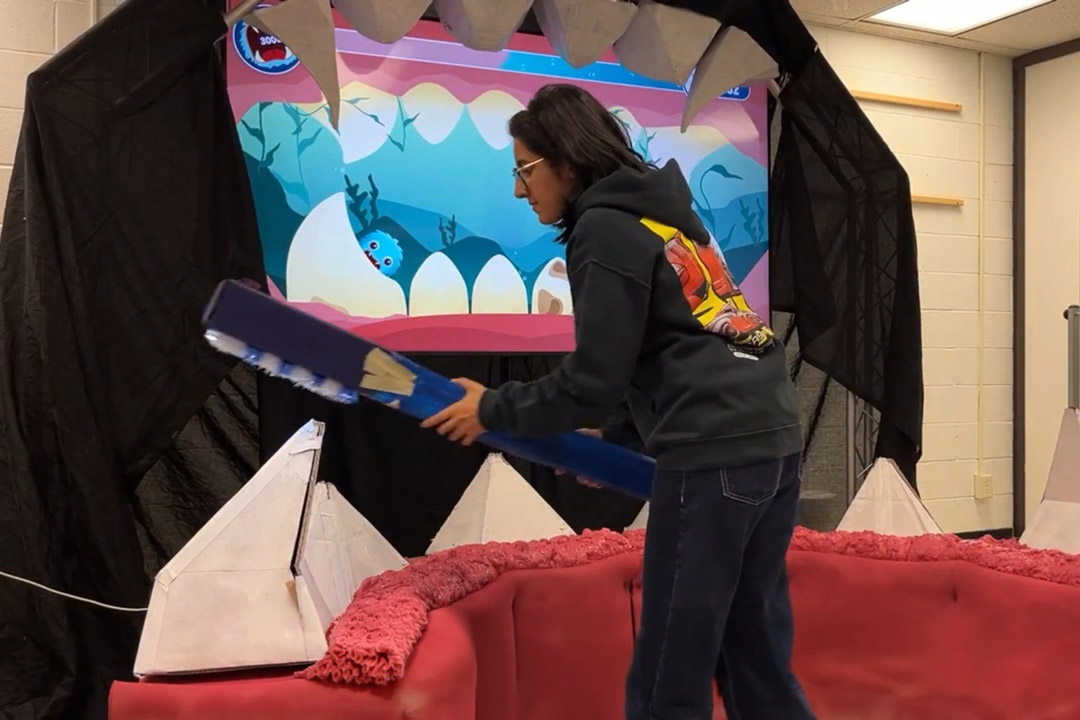
A member of the Floss Boss team tests a prototype of their interactive teeth cleaning experience.
“The process of building our alternative controllers has involved lots of prototyping and playtesting to determine what users find intuitive and to try to optimize our controllers to withstand hundreds and thousands of users testing them,” said Probeck.
She said it has been a one-of-a-kind experience to work on a large-scale project as a team.
“It’s been really cool to see everyone’s niche area of expertise blossom and grow across the course of this year,” said Probeck, who is from Albany, N.Y. “As a designer, it has been really helpful to gain experience working with a development team before graduating and going out into the industry.”
Patchwork
Patchwork is a two-player exhibit where people can bring their own monster to life in a laboratory. Players must move around cables and different-shaped parts quickly to construct a unique monster.
Finn Marable, a fifth-year new media interactive development major, is a lead presenter and working on hardware for the project. He said that lighting played a major factor in getting each of their pieces to interact in the game.
“During prototyping, we had to write an algorithm to recalibrate the lighting, so that the components check with the changing environmental lighting to compare values,” said Marable, who is from Manhattan.
For this capstone project, Marable and several other team members got certified in the Student Hall for Exploration and Development (SHED) woodshop. Marable said learning how to use the bandsaw and belt sanders was crucial for crafting the wooden podiums.
“This has been a cool portfolio piece,” said Marable. “Before capstone, I never would have built something like this. I wouldn’t have thought I was capable.”
Don’t Run With Scissors
In Don’t Run With Scissors, users literally take a step inside of 8-foot-long scissors. Then, they race against the clock to slice through dozens of everyday objects, rack up points, and leave a trail of destruction.
“You play as a little kid running around the house without your parents, ” said Sophia Pries, a fourth-year new media design major who is working on UI, motion, marketing, and branding with the team. “We wanted the experience to feel larger than life.”
The team has gone through several iterations of their creation and faced challenges related to material weight, navigation, and how to safely house the microcontroller in the hinge. Additionally, the students are adding sound design and low poly 3D graphics to the game.
“I haven’t always been super into games, but it was interesting to try and think of how to interact with something outside of typical buttons and joysticks,” said Pries, who is from Pittsburgh. “We want it to be something that people can just pick up and play.”
Try it at Imagine RIT
All the new media capstone teams will exhibit their interactive experiences and alternative controllers at Imagine RIT: Creativity and Innovation Festival from 10 a.m. to 5 p.m. April 25. Learn more at the Imagine RIT website.