Teaching Tai Chi to the elderly gives RIT students community health experience
Monroe County Department of Human Services funds program
Traci Westcott/RIT
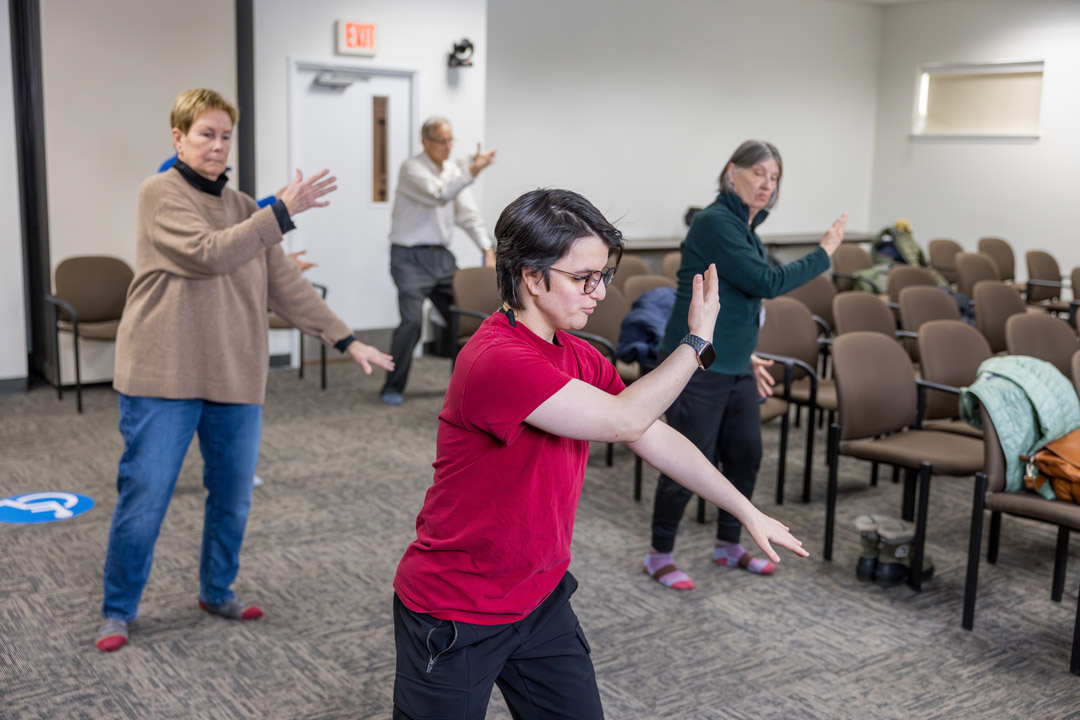
RIT biomedical engineering major Anna Nack, center, leads a Tai Chi class for seniors at Osher Lifelong Learning Institute on Feb. 9. Yong “Tai” Wang, dean of the College of Health Sciences and Technology, provides support at the back of the class.
RIT students are teaching Tai Chi to older adults in the community as part of a research program to help improve their physical and mental health, support pain reduction, and enhance their quality of life.
The students study Tai Chi Ten Forms (TC10) and take an active role leading classes and testing participants’ progress.
Led by Yong "Tai" Wang, dean of the College of Health Sciences and Technology, the student team teaches twice weekly at both the Henrietta Senior Center and at Osher Lifelong Learning Institute, RIT’s center for continued learning.
Student instructors teach hour-long Tai Chi sessions, demonstrating a sequence of 10 forms, like dance steps, which flow together in a gentle exercise. Participants learn breathwork, mindfulness, and balance. Initially, the scope of the project focused on 10 forms but participant interest at both sites led the team to teach the full 24 forms in the Tai Chi international standard.
The slow motion and mindfulness of Tai Chi have had an impact on the seniors, according to student team leader Colin Hutton, a fourth-year exercise science major from Fairport, N.Y., and a certified personal trainer.
“I think because Tai Chi is slow and you repeat motions, it gets better and better each time you do it,” Hutton said. “The biggest improvement I’ve seen is with people’s balance being better, and especially with the elderly population, it’s a huge one,” Hutton said.
Traci Westcott/RIT
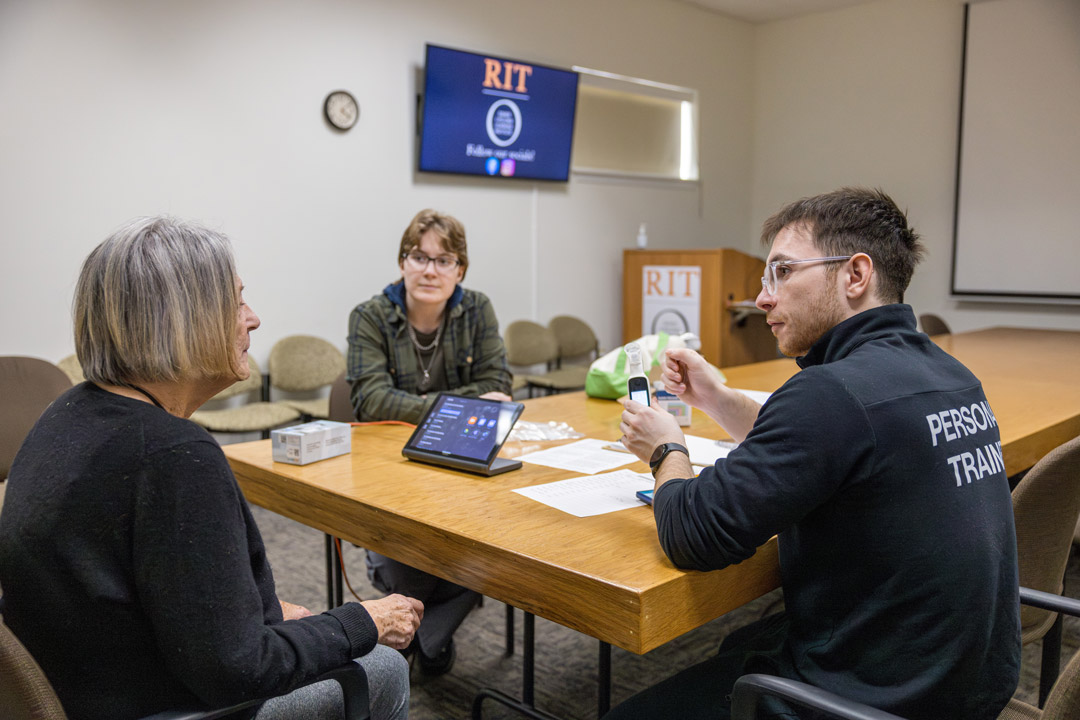
Exercise science students Ren Anderson, center, and Colin Hutton, right, record Rochester community member Elizabeth Pollock’s vitals and range of motion. They are studying the benefits of Tai Chi for senior citizens in Monroe County.
The team benchmarked participants’ blood pressure and blood oxygen levels, ranges of motion, and balance. A survey given to participants at the beginning of the program asked about their use of medications, including opioid painkillers. Hutton, who is leading the post-testing, said they are curious if Tai Chi reduced participants’ pain and led to lowered or discontinued medication use.
Like Hutton, Ren Anderson, a second-year exercise science major and an RIT Honors student, learned Tai Chi from Wang in the early stages of the project. Since then, they have gained hands-on experience collecting and analyzing data and learning valuable soft skills.
“I’ve learned how to explain body movements in a way that the average person can understand, how to catch mistakes and point them out in the right way, and how to instruct for a full hour and not make it boring,” said Anderson, who is from Ellenville, N.Y.
The Monroe County Department of Human Services, led by Dr. April Aycock, the mental health director, is funding the community program to improve elderly residents’ mental health and physical well-being. The project began in the fall and was extended through the spring semester. The combined $40,000 grant from Monroe County supports the student research team.
“As a college dedicated to health sciences and technology, we see it as our responsibility not only to prepare future healthcare professionals but also to promote community health and well-being,” Wang said. “By engaging with the community, we contribute directly to the public good.”
Wang, a Tai Chi master, has studied the benefits of Tai Chi among the elderly, disabled veterans in wheelchairs, and in people with Parkinson’s disease. For this project, he trained RIT students to teach Tai Chi, recruiting candidates from his own college and from a class he teaches through RIT’s Wellness program.
Camden Doyle, a second-year game design and development major from Alexandria, Va., wanted to continue learning about Tai Chi after the Wellness class ended last semester
User experience is important in game design, and Doyle brings that perspective to the project. “It has been really interesting seeing how Dean Wang and the other research assistants teach the class and how I am learning to teach it.”
Caitlin Morrison, a fourth-year biotechnology and molecular sciences major from Norwell, Mass., also came to the Tai Chi project through the Wellness program. The opportunity gave her a chance to add to her experience conducting environmental and microbiological research in an RIT lab.
“I have always had an interest in human-centered medical research, and this required me to learn a whole new skill set,” Morrison said. “It’s allowed me to see the direct impact scientific research can have on people’s daily lives.”
The Tai Chi research project will continue at least through the end of 2026, Wang said. “Our student Tai Chi instructors, along with a possible visiting scholar and Tai Chi Instructor from China, may continue leading Tai Chi classes at both intervention sites.”
Wang and Hutton hope to present the team’s findings at the American College of Sports Medicine conference in Salt Lake City, Utah in May 26-29.