Technical Theatre Pathways course helps students navigate RIT’s performing arts community
Carlos Ortiz/RIT
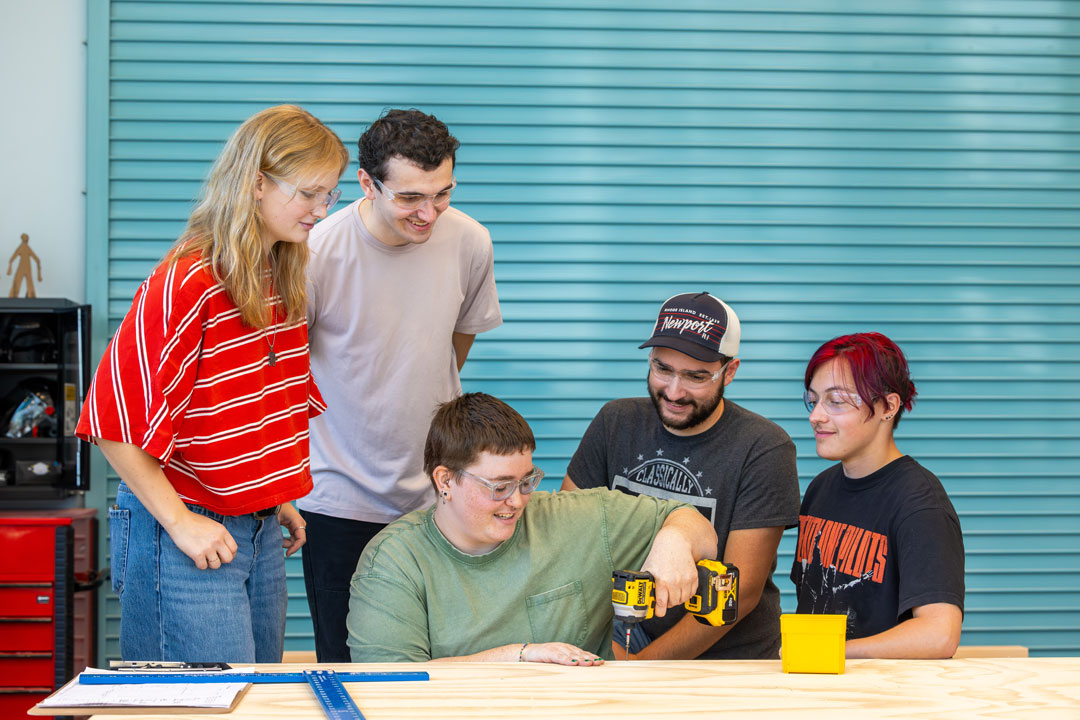
After giving them a tour of the Scene Shop, shop supervisor J. Frye offered students an up-close look at some of the set pieces they are building for the upcoming production ‘Turn of the Screw,’ which premieres on Thursday, Oct. 1.
Everyone knows you need actors and a stage crew to put on a musical or play, but there are many lesser-known technical roles that are vital for any production.
Technical Theatre Pathways, a new course offered by Rochester Institute of Technology’s School of Performing Arts, gives students a full picture of the varied behind-the-scenes roles that help bring a stage performance to life.
Want to see a show?
There is a full schedule of theatrical, music, and dance performances planned for the 2026-2027 academic year.
Go to RIT’s Performing Arts website for the full theatrical season schedule, updates on the music and dance performance schedules, as well as information on how to get involved with performing arts at RIT.
“Our performing arts community is wonderfully complex, but sometimes it can be difficult to navigate, especially for newer students who are interested in more technical roles,” said Andy Head, the course instructor and interim director of RIT’s School of Performing Arts. “This course introduces students to all the performing arts venues and tech-focused performing arts leaders, as well as the wide range of topics and roles available to them within the community.”
Each week, students in the course tour a different performing arts space on campus to learn how they can get involved with some of its niche technical roles. They’ll learn from theater professionals working as lighting specialists, dramaturgs, consent and intimacy coordinators, costume designers, and other backstage roles throughout the course of the semester.
In addition to exploring these spaces, students are asked to further their involvement with the performing arts community by attending at least three on-campus productions and a field trip to GEVA Theatre.
“I view this course as a steppingstone. My hope is that, by the end of the semester, these students feel like they are part of RIT’s performing arts community, and that they know how to go forward and what their next step can look like,” Head said.
While the course is primarily designed for first-year students, any interested students can enroll. The current cohort includes students from all nine colleges at RIT.
Seb Funk, a first-year ASL-English Interpretation major and a Performing Arts Scholar, enjoyed getting involved with theater in high school. Now that he’s at RIT, he said this course has provided the perfect guide for navigating the performing arts community on campus.
Funk was initially drawn to RIT because of the university’s ASL-English Interpretation program, and the opportunity to become involved with performing arts through the National Technical Institute for the Deaf (NTID) helped seal the deal for his decision.
“Seeing that there is an entire theater and department at NTID where Deaf, Hard-of-Hearing, and hearing students can work and perform together was extremely exciting given my major. I’m really looking forward to learning more about that and working in Panara Theatre,” said Funk, from Annapolis, Md.
Fourth-year student Matteo Cavallaro has been involved with performing arts at RIT since his first year on campus. He is a proud member of the RIT Players and is part of the Performing Arts Scholars program.
Despite his experience, the mechatronics engineering technology major was surprised to discover that, even after four years, he still didn’t have a full grasp of the different opportunities available to him.
“This has been a good way to make sure I see all the different performing arts spaces on campus before I graduate,” said Cavallaro. “I think this course is great for first-year students. If they had this class during my first year, I definitely think it would have changed my trajectory.”
Prospective students and families interested in applying to the Performing Arts Scholars program can find more information on the scholarship webpage.
Go to RIT’s performing arts webpage to learn about other ways to get involved with the community.