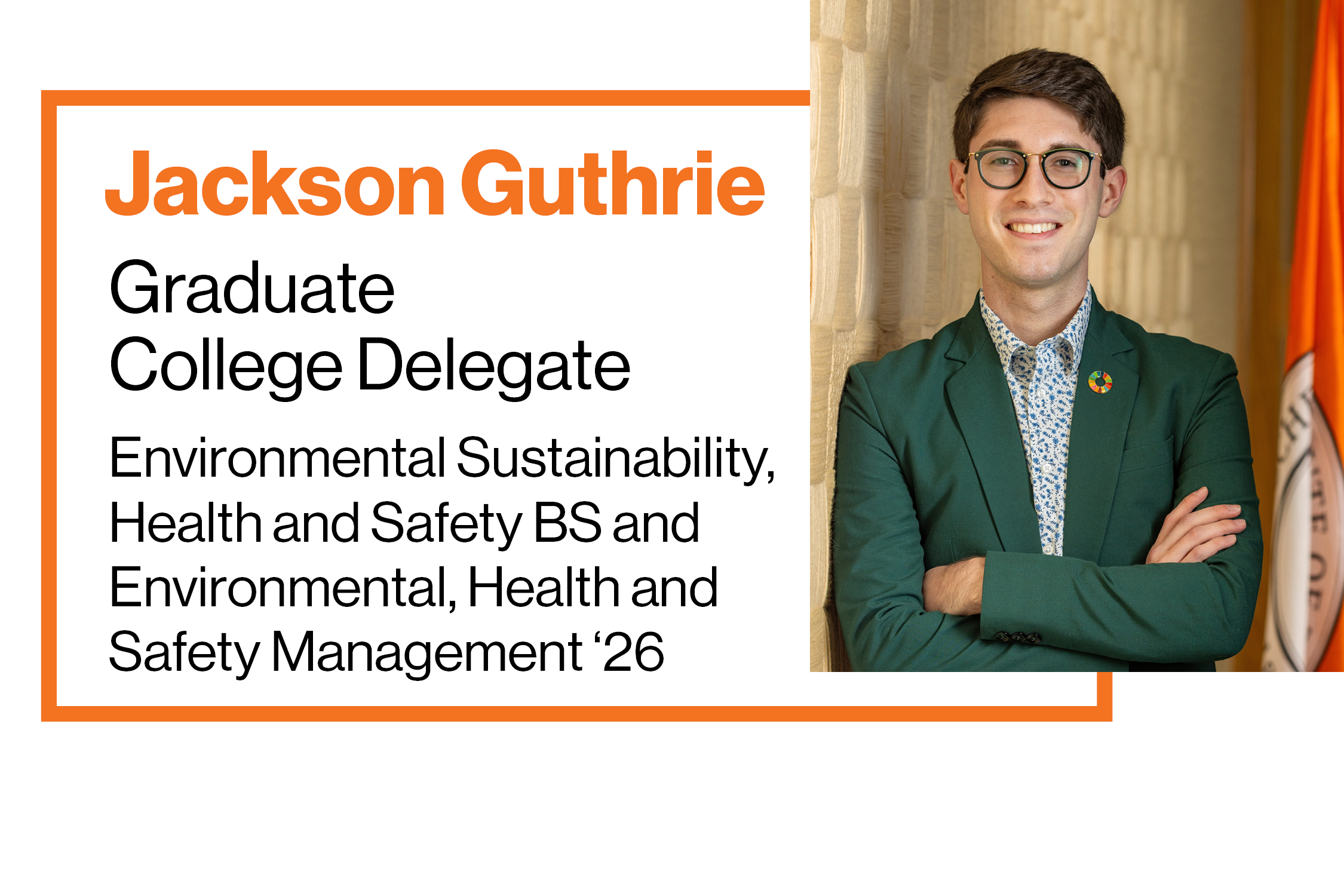
'26 Graduate College Delegate and Convocation Speaker: Jackson Guthrie
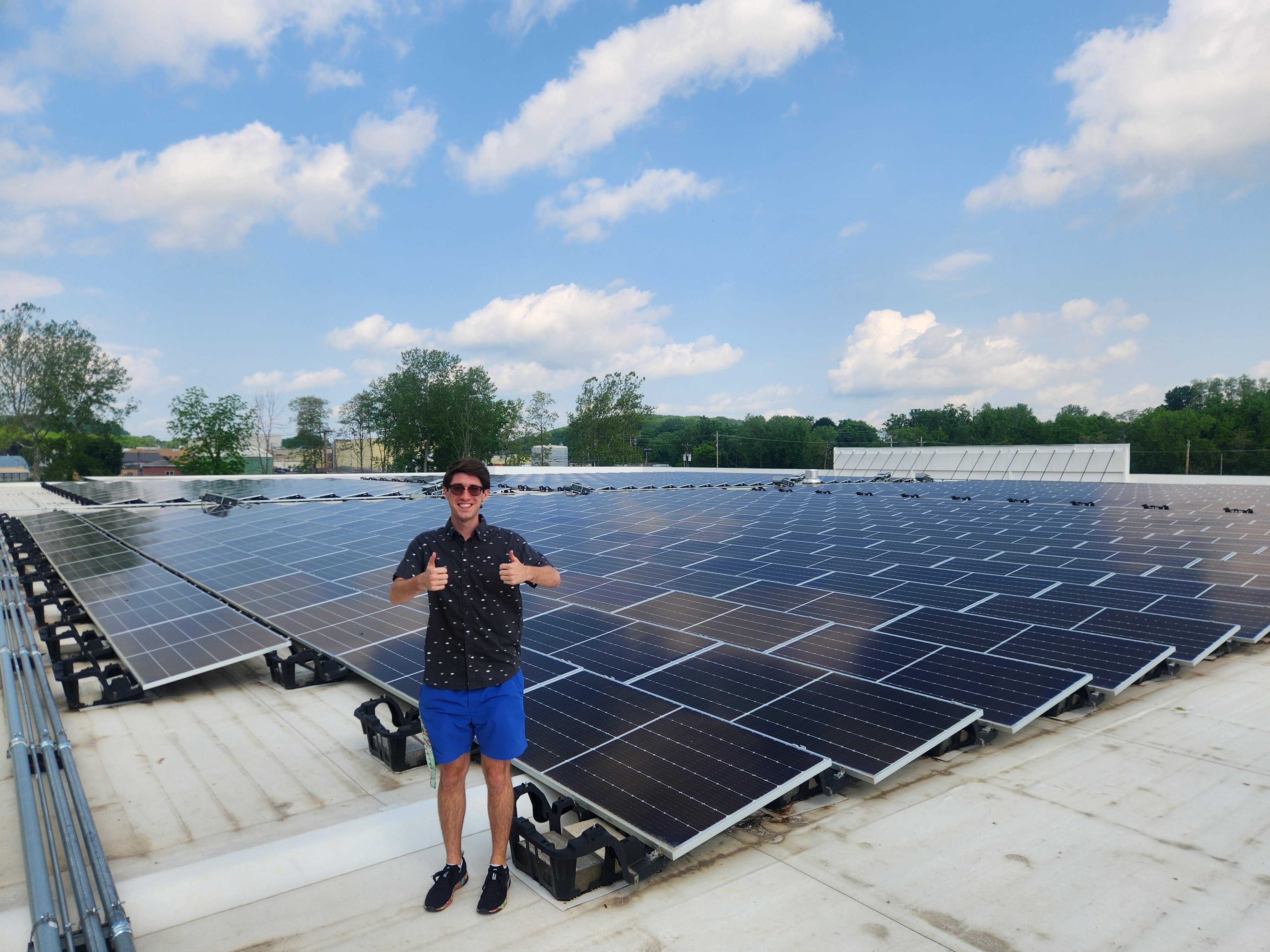
After graduation, Jackson will continue in his current, full-time role as a Project Manager for GreenSpark Solar.
Where are you from?
Rogers, Arkansas
What degree you are receiving?
B.S. Environmental Sustainability, Health & Safety and M.S. Environmental Management and Safety
What are your plans after graduation?
Continue in my current role as a Project Manager with GreenSpark Solar.
During your time at RIT what did you like best about your program?
The passion each professor had about their topic and wanting to teach it well.
Fondest RIT memory?
Playing Dungeons & Dragons with my friends in a group study room in the Library on the weekends.
What awards and/or recognition you received as a student while at RIT?
- Outstanding Undergraduate Scholar Award
- Outstanding Environmental Management Student Award ’24 – ‘25
- Outstanding Environmental Management Student Award ’23 – ‘24
- Dean’s List – Fall ’22 through Fall ‘25
What activities were you involved in (clubs, sports, and organizations)?
- Employed as the Recycling Coordinator with RIT Sustainability (Fall ’22 – Spring ’25)
- Employed as the Zero-Waste Arena Director with RIT Sustainability (Fall ’23 – Fall ’25)
- Goodbye, Goodbuy! Collection Captain: Spring ’23, Spring ’24
- Goodbye, Goodbuy! Sale Captain: Fall ’23, Fall ’24, Fall ‘25
- RIT E-Sports – Overwatch (Fall ’23 – Spring ’24)
As you reflect on your academic career, can you please briefly describe a time when…
...Thinking like you was celebrated (as opposed to following theory in a textbook - by peers, faculty, staff, or a rewarding result)?
The predominant solutions to enhance sustainability in waste management typically focus around increasing participant education or implementing a system which inflicts an extra cost (or perhaps provides an incentive) to divert food waste, waste less, and recycle. These can be incredibly successful method depending on the context and group implementing the efforts, however, at a university institution in which which receives and loses students yearly from across United States and the globe with all different histories of waste management norms, it becomes difficult to achieve these goals through these methods.
To solve this problem I requested permission to hire a team of paid student employees who would be trained in sorting trash. It seemed like a strange idea to everyone I told initially because sorting trash generally induces a reaction of distaste and an assumption that nobody would want do that job – it would be too different from normal out of sight, out of mind waste disposal methods.
Despite this, I did receive permission (Shout out to Enid Cardinal and Neha Sood in RIT Sustainability for acquiring this for me) to hire a team of students to do just that at some of RIT’s most high profile events – hockey games. I won’t bore you with the minutia, but the Zero-Waste Arena initiative I designed (based off previous experience as a trash sorter for a company back home) places stations around the perimeter of the rink to replace the trash cans typically available, and requires attendees to place their trash in tubs atop these tables where our Zero-Waste Ambassadors sort them into Compost, Recycling (cans & bottles, and everything else), and Landfill.
Now, ZWA is in the middle of its third season, now under the direction of my colleague Rachel Dodge, who was originally an ambassador herself and whom I trained during the second season to replace me. And has diverted over 16,513 pounds of food waste, with averages of over 300 pounds of food waste diverted per game in both the ’23 – ’24 and ‘24 – ’25 seasons. (Data for this season is not currently available and is not included.)
We get to disrupt the standard waste management system by placing the realities of waste management directly in front of them, reinvest in students by providing employment opportunities, and make a real impact by diverting food waste for composting (saves landfill space and reduces methane emissions) and minimizing contamination in recycling to support its ability to truly be recycled.
...The road to innovation was not as smooth as you expected (a cycle of failure and breaking to ultimately discover a solution)?
During my time as a captain for Goodbye, Goodbuy!’s sale I was typically one of the leads managing furniture sales and deliveries. In my first two years it was difficult to create a system that allowed for convenient tracking of specific items relative to who purchased them and delivery preferences.
The system suffered from pain points like having no inventory to track, no standardized way to complete the furniture purchase form, no photos to assist in identifying the furniture purchased, furniture not being grouped properly in the back for staging, no record of prices to assist in refunds, and even selling furniture twice by accident.
To solve this I spent dozens of hours this summer redesigning the system to have digital integrations by finding a free platform to create an inventory which could link to a google sheet, and then revamping the UI of the furniture purchase google form to be more easily understood and also link to the same sheet, essentially allowing the creation of a furniture inventory with unique IDs and photos for each item that was then integrated with the results from the furniture inventory purchase sheet to track what had been purchased, what needed to be staged for delivery, and as an added benefit allowing us to track the profits and associated quantity of furniture sales as a specific category.
Throughout this process I had to test and retest and then retest again and oh look the sheet isn’t working because google forms integrates in a ridiculous way, and those people don’t have permissions, and now I need to teach everyone how to use this, and don’t forget the system needs to be resilient to changes in location and limited extra labor to create the inventory in the first place. That’s the succinct version of all of the problems, but it did get completed, it was successful, and had limited hiccups for a first-time system and will only improve from here.
From your time in CET, what was unique in your experience from other engineering programs, schools or universities?
The emphasis on experience, both through co-ops but also the obvious promotion of research and employment opportunities. I was allowed a level of autonomy, respect, and participation in significant sustainability operations through my job with RIT Sustainability which served as an excellent jumpstart for my professional experience. Even my courses almost always include a project meant to show you how it may apply to the real world and give you preliminary exposure to a wide range of skills.
Let’s celebrate your journey – please tell us a little about how you got here! Looking back - What kind of student were you in high school and what initially drew you to CET?
I was the type of student that took accelerated classes as a default and didn’t believe in the phrase “free time”. I was fortunate enough to discover my passion for sustainability in middle school, which allowed me to tailor my experience in high school towards the field. I took 11 AP courses and was able to transfer in 39 credits, skipping an entire year of my degree. In case that wasn’t enough I was part of marching and concert band my entire high school career, as the section leader for my final two years. I was president of the National Honor society my senior year, a member of Model United Nations all four years and lead delegate for two years. I also played Tennis (JV freshman – junior, Varsity – senior) and was a member of the Spanish National Honor Society. Meanwhile I operated a community organization called E-Waste Warriors outside of school which partnered with a local e-waste recycling company to host community collection evens (we collected 14,791 pounds overall). All that being said, I was a doer, and my life during high school shows that.
We actually just tacked on RIT as a tour because we would be passing through despite not having the degree I was looking for at the time (Environmental Engineering). My tour guide introduced to me to CET as focused on applications over innovations, and RIT landed squarely in the lead for my top choice. Why go to schools that wanted me to be an innovator, when I could go to a school that also knew the value of doers? I sit squarely in the doer part of “Thinker, Maker, Doer” and felt that I would be a good fit accordingly (spoiler alert, I was).
How did your expectations translate to reality during your time here?
I tried not to have too many expectations because a university experience is so different from everything I had already experienced and adjusting to it would be plenty of effort without having a large set of preconceived notions about what I thought it would be like.
Overall though I expected RIT to be a good fit for me based on student culture and academics, which has proven to be true. I have an exceptional group of friends across multiple majors and from across the US. I have never struggled to find others with similar interests whether professionally, for hobbies, or otherwise.
Looking ahead - What’s the biggest lesson you’re taking with you after graduation?
The world is an incredibly diverse place full of different people, situations, ideas, and more. RIT helped me expose me to many new experiences and people and I believe in carrying the importance of building a better world for everyone, based on challenging myself to keep considering new contexts.
More Featured Profiles and Work
Jennifer Schneider
Tyler Fogarty
Lisa Greenwood, Jennifer Schneider