Analysis of Fluid Forces within a Magnetically Levitated Benchmark Blood Pump
Magnetic levitation (MagLev) is the concept of using magnetic forces to support an object without physical contact. The concept has been successfully applied in systems such as high-speed trains, wind turbines, and rotary blood pumps.
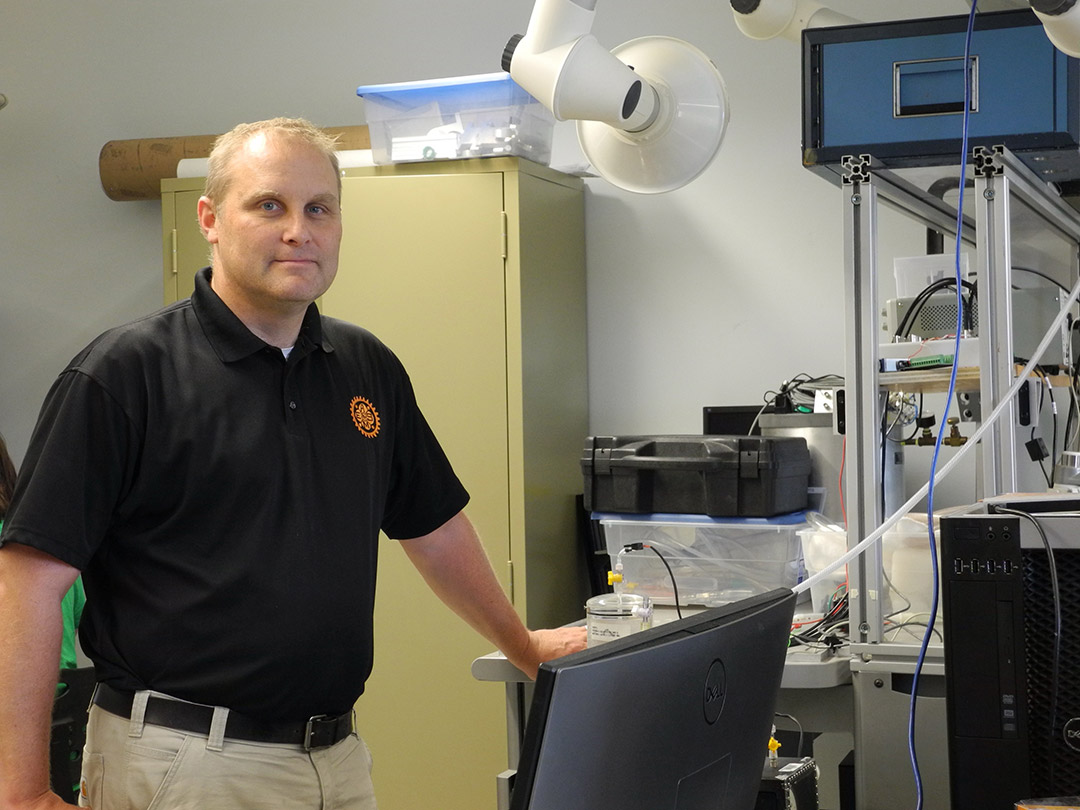
Jonathan Lawley is a Ph.D. candidate in the mechanical and industrial engineering Ph.D. program and works in the VADlab with advisor, Dr. Steven Day.
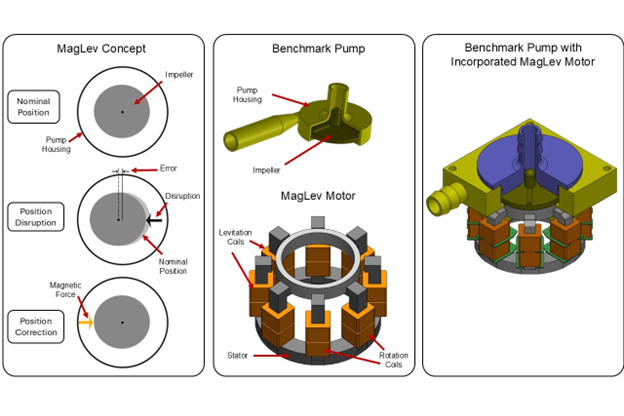
Magnetic levitation (MagLev) is the concept of using magnetic forces to support an object without physical contact. In practice, the target object to be levitated has a set nominal position and whenever it deviates from that nominal position, a magnetic force is used to correct its position. The concept has been successfully applied in systems such as high-speed trains, wind turbines, and rotary blood pumps. Blood pumps are required when the heart cannot adequately circulate blood, including during cardiopulmonary bypass in cardiac surgery and in patients with advanced heart failure. Magnetic levitation is particularly well suited for blood pump applications because blood is highly sensitive to mechanical trauma. Conventional contact bearings generate friction and heat that can damage blood components, while fluid bearings require small clearances and high shear stresses to support the impeller which damage the blood. In contrast, magnetically levitated bearings eliminate mechanical contact and permit larger fluid gaps which in turn reduces friction, heat generation, and shear-induced blood damage.
Prior research on MagLev blood pumps has largely focused on the development of novel device architectures, with limited emphasis on foundational characterization of fluid structure interactions. In contrast, the present work focuses on the development of a dedicated MagLev test platform designed to directly quantify fluid forces acting on the impeller under physiologically relevant operating conditions. The test rig was designed to achieve stable, high-precision levitation while operating at clinically relevant flow rates and pressures. An existing FDA benchmark pump geometry was used as the hydraulic reference, around which a custom magnetic suspension system was developed. Finite element analysis (FEA) was employed to design and evaluate the magnetic suspension, including passive axial and radial stiffness and active electromagnetic force capability, while computational fluid dynamics (CFD) was used to estimate hydrodynamic loads and ensure adequate force margins. The design was iteratively refined to incorporate integrated sensing for precise position and force measurement. The final system was fabricated in-house, with the exception of a custom rare-earth magnet incorporated into the rotor.
The developed platform will be used as an open source test rig to quantify fluid forces acting on the rotor during pump operation. A fundamental property of magnetically levitated systems namely, the direct relationship between electromagnetic force and coil current, will be leveraged to infer hydrodynamic loads from measured current draw. Using this approach, the effects of operating conditions on fluid forces will be systematically investigated, including flow rate, rotational speed, and pressure. In addition, the influence of blood’s non-Newtonian, shear-thinning behavior on rotor loading will be examined by employing blood-analog and blood-representative working fluids.
This work presents a novel MagLev centrifugal pump test rig and experimental framework for quantifying fluid forces under clinically relevant blood pump operating conditions, based on the benchmark FDA centrifugal pump geometry to enable comparison with existing datasets. The open source test rig and resulting experiments provide new insight into fluid forces across conventional operating regimes and conditions unique to MagLev blood pumps, including the effects of rotational speed, fluid viscosity, and non-Newtonian behavior on impeller dynamics.
More Featured Profiles and Work
Divyprakash Pal
Dumbari David Kabari