Biomedical Engineering Master's Capstone: ABO
There is a clear need for a fast, reliable, and easy-to-use method to determine a patient’s blood type when severe blood loss occurs. A device that enables first responders to identify blood type within minutes could significantly improve transfusion accuracy, reduce complications, and optimize blood resource utilization.
In trauma situations where severe blood loss occurs, timely and accurate blood transfusion is critical to patient survival. However, traditional blood typing methods require laboratory infrastructure and can take too long for immediate decision-making. As a result, emergency responders often rely on universal donor (O-negative) blood, which strains supply and can increase risks during subsequent transfusions. There is a clear need for a fast, reliable, and easy-to-use method to determine a patient’s blood type at the point of care. Current solutions either lack portability, require trained personnel, or depend on subjective interpretation. A device that enables first responders to identify blood type within minutes could significantly improve transfusion accuracy, reduce complications, and optimize blood resource utilization.
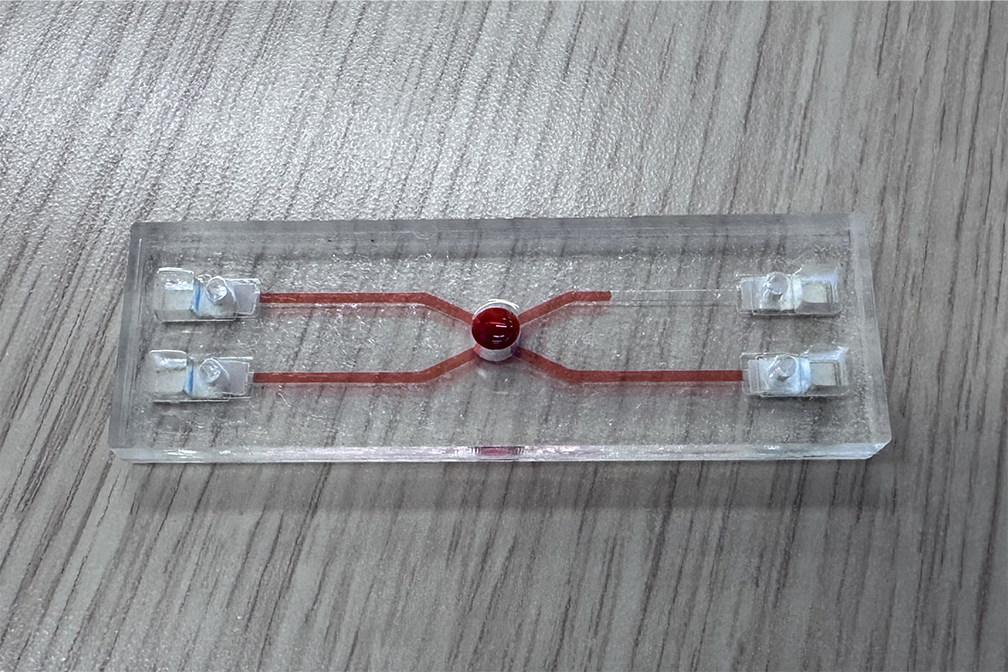
A Biomedical Engineering MS Capstone team - Amber Flynn, Gabrielle Mitchell, and Praneeta Sambaraju - developed a multi-layer, microfluidic device that determines ABO and Rh blood types using antibody-mediated agglutination. The system operates without external power and relies on capillary action/hydrostatic pressure to move a small blood sample through preloaded channels containing specific antibodies. When antigens are present, red blood cells agglutinate and are physically separated, producing a clear visual result. The device consists of layered materials including acrylic sheets, adhesive channels, a filtration membrane, and an absorbent pad. Together, these components guide fluid flow, enable controlled reactions, and produce easily interpretable results through a simple color-based readout.
Through iterative prototyping, the team validated key functional components including fluid flow, antibody interaction, and agglutination detection. Experiments demonstrated consistent capillary-driven flow and visible agglutination using optimized antibody-to-blood ratios. Design improvements, such as an increased inlet size and refined channel geometry, enhanced usability and performance. Current prototypes successfully demonstrate proof-of-concept, though further refinement is needed in filtration and consistency. Future work on a device such as this, designed for use by emergency medical services (EMS), hospital emergency departments, and military or disaster response teams, could enable rapid blood typing in the field. This would reduce reliance on O-negative blood, improve transfusion safety and outcomes, accelerate clinical decision-making, and enhance preparedness in high-stress environments.
More Featured Profiles and Work