Exploring New Frontiers of Imaging Science
Anjali Jogeshwar '23 came to RIT for imaging science and found a world of opportunity, leading to a Ph.D. and a role as Senior Computer Vision Engineer at Circle Optics.
“There’s so much to learn here! A master’s won’t be enough.” That’s what Anjali Jogeshwar '23 told her mom after just one day in RIT’s imaging science MS program. Fascinated by the discipline, she went on to earn her doctorate in imaging science and now works in vision systems at Circle Optics.
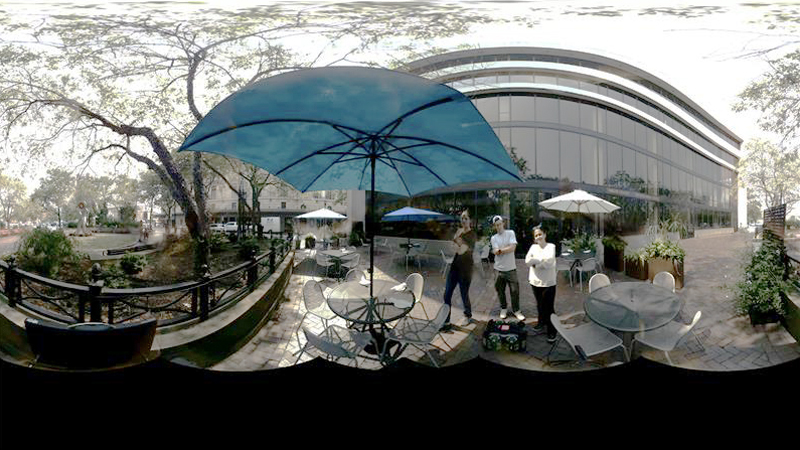
Anjali’s doctoral research focused on modeling human behavior using computer vision. She built tools to reconstruct and view environments in 3D and 4D, skills she now uses as a Senior Computer Vision Engineer at Circle Optics. There, she helps develop high-resolution imaging systems, including a 360-degree steradian camera that captures and recreates real-world environments. She is also contributing to a prototype camera designed for use in space.
At Circle Optics, Anjali helps push the boundaries of computer vision by developing systems that make spatial understanding faster and more precise. “As a computer vision engineer, I brainstorm on concepts, write documentation, and code for most of the day,” she says. “In my senior role, I’m also involved in leading projects to fruition.”
One of her current projects, supported by the U.S. Air Force’s AFWERX program, aims to speed up the creation of 3D digital twins using 360° imagery and sensor fusion, reducing a process that once took weeks to just two days. She is also part of a SpaceWERX-sponsored prototype project that supports Space Domain Awareness, the effort to detect, track, and characterize objects in orbit. The goal is to enable real-time situational awareness in space, improving how we monitor and understand activity beyond Earth. Through this work, Anjali is contributing to technologies that enhance our ability to see and interpret both our world and the space beyond it.
Anjali continues to explore the full range of imaging science. She says the field is wide and that her journey has taken her from image design to biology-inspired vision science to prototype space cameras. Although they are different disciplines, they are all connected through imaging.
Reflecting on her time at RIT, Anjali says the experience went far beyond academics. She credits the professors, staff, events, and students with helping her grow both personally and professionally. One of the most meaningful parts of her experience was learning in a diverse, collaborative environment. "Chatting with Hard-of-Hearing students and connecting with people from different departments helped broaden how I think about innovation," she says. "The more people you include from different backgrounds, the more perspectives you gain."
That outlook became the foundation of her dissertation, titled Look at a Bigger Picture, and strengthened her belief that imaging technology can and should be more inclusive. Building on that perspective, Anjali landed two key internships, first at Kodak Alaris as an MS student and later at Motorola Mobility while pursuing her Ph.D. “Both opportunities came directly from networking at department seminars,” she explains.
Her time at Kodak Alaris began as an eight-week internship, but her contributions impressed the team so much that they extended it multiple times, ultimately lasting almost 11 months. “It was incredibly validating to have them say they wanted me to stay on,” she says.
At Motorola Mobility, Anjali worked entirely remotely and never met her team in person. “That made it even more meaningful when they told me they valued my ability to research independently,” she recalls. The three-month internship wrapped up in December 2021, but the connection did not end there. Before she had even defended her Ph.D. in March 2023, Motorola offered her a full-time role.
“I officially started in February 2023, and they supported me with a lighter workload so I could finish my degree,” she says. “It felt like the perfect bridge between academia and industry. RIT gave me more than just technical skills. I was well equipped with the latest coursework from Imaging Science and ready for the role I was hired to do. But RIT also gave me the confidence to be self-reliant, the courage to network, and the grit in my work ethic that helped me succeed.”
To students considering the field, she encourages exploring as much as possible, staying curious, and showing up since that curiosity might lead somewhere incredible. “I’m so grateful for the people and support that made my experience at RIT truly transformational,” Anjali says. “The commitment to creating a space where everyone feels they belong changed me in ways beyond imagination. It made me a better person, and I’m proud to be an RIT Tiger.”
More Featured Profiles and Work