A Goal in Flight: How Jillian Antol Turned a Freshman Tradition into a Global Mission
At RIT’s convocation each fall, it’s tradition for new students to write hopes or goals on orange sheets of paper, fold them into paper airplanes, and launch them together at the ceremony. Symbolic and uproariously fun, it represents the beginning of their new journey as Tigers and celebrates what lies ahead for them. For Jill Antol, that goal came to fruition in a flash.
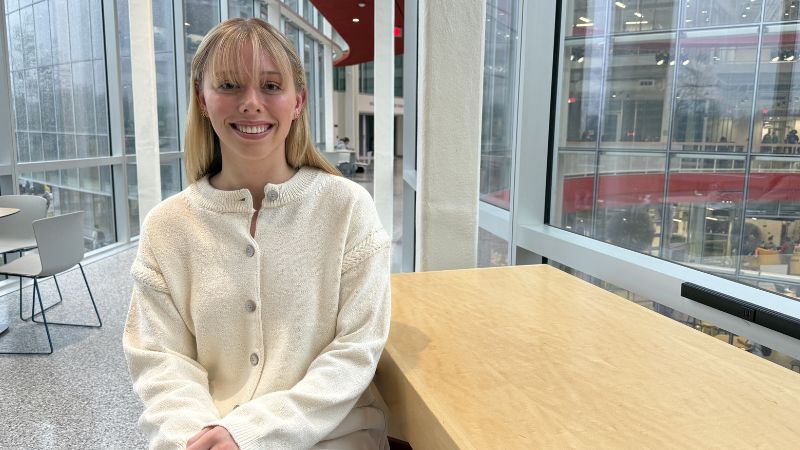
During the first semester of her first year, she wrote and published her first research paper, and it proved to be just the first of many career-launching, expertise-building experiences she would have at RIT. “It was a ‘full circle’ moment for me,” she said. “I realized then that there’s so much I can do here, so much opportunity at RIT. I just have to go out and do it.”
And, do "it" she did—three internships, two study abroad experiences, working as a research assistant, participating in clubs like the Pre-Law Society, competing on the RIT’s Women’s Soccer team all four years, and all the while earning awards, honors, and a spot on the Dean’s list every semester.
Now, preparing to graduate with RIT’s Class of 2026, this criminal justice and global public health double major is set for a two-year service commitment as a Peace Corps Volunteer. She recently shared highlights of her RIT experience, insights for new students, and a heartfelt shout out of thanks.
Meet Jillian Antol
Are you graduating with the major you began with or did you change your major or plan of study as you progressed at RIT?
I'm graduating with the same age I started with, but I also added a major halfway through when I was here. Originally, I always wanted to be a lawyer or do some kind of work that involved the legal system and helping people. I just wasn't really sure what that looked like, and criminal justice was a good way to learn all the different kinds of ways within the legal and criminal justice systems.
While at RIT, I had the opportunity to work at CPSI [Center for Public Safety Initiatives] through Dr. Altheimer, and he hired me to work with the Jordan Health System and also Rise Up Rochester, which involves interacting/intersupporting systems for healthcare, public health, and violent crime.
That was kind of the changing point for me where I knew I wanted to do something with healthcare, too, because it's all interconnected. It pushed me to take more CHST [College of Health Sciences and Technology] classes, and how I ultimately decided to add my second major in my second year, global public health.
How did your experiences at RIT— internships, research, or study abroad—affect your career path and goals?
Working on the Rise Up Rochester project, I got to sit in on meetings with different community-based organizations in Rochester that work with the whole system and work with Rise Up Rochester. I got to see them interact, how they work together, how they share resources, how they're identifying people at risk, and ways that they're helping them.
Before this, I just never really understood how community-based, grass-roots organizations are so deep into people's lives. I had no idea until I was sitting in these conversations (as an RIT CPSI researcher).
It inspired me to want to work directly with people rather than become a politician or a legal professional. I want to help people connect with resources, help agencies collaborate, and help educate people who work in the industry of where they can turn to help their clients or support the people that they're interfacing with.
Advice for younger you—if you go back in time and give your freshman self advice, what would you say?
Always talk to your professors and get to know them. In the criminal justice program, they are so willing to connect you to get some research or help you find an internship. When you build good relationships with your professors your education is better because you have a better connection with them. If you're going into their office more, they're learning about you and how you're thinking, so they also know how to better educate you or give you critiques on your papers.
I got my job at MCAC because we were in a technology and crime class, and our professor mentioned she worked at MCAC. After class, I walked up to her and I was like, “Hey, I really would love to work there. You guys have internships.” And, the next week, she gave me an interview, and I got to work there the following summer.
Reflecting on your time at RIT, what is your favorite memory?
When I was first visiting RIT, I came as an athletic recruit, and athletic recruits get to go to classes with professors, meet the dean of their college, and learn about the university in a way that I feel like a lot of prospective students don't usually.
When I first came here, I got to meet Dr. Tony Smith, and he took me to one of his classes. I just remember feeling like this is what I want to do—next year I want to take this class and learn about this because I thought it was so interesting. Dr. Smith was so welcoming. He called on me during the class, gave me lots of information, walked me around the department, and introduced me to the other professors.
I feel like that was the reason why I wanted to come here, because of that experience.
Then on my first day at school at RIT—my first class, freshman year, 10 a.m. on Monday— I was sitting in his class, the same one I’d sat in on during my athletic visit. I felt like I should be there, and I was supposed to be here in that major.
For supporting you along your RIT journey, is there anyone you’d like to thank?
Besides Dr. Smith, I want to shout out to Professor Joe Williams. He teaches intro classes and corrections classes, and even though I only had him my freshman year, he’s been super supportive.
I also got the chance to work with him as a teaching assistant for a K-12 high school program with the Rochester students who are taking a criminal justice class. He loves his students, he loves the topics, and he's always checking in on us. Even though he doesn't teach a lot of the classes that you take or even if you take just one or two, he will always make sure that you're still doing good and still involved, and I just feel like that's amazing.
Program(s) of Study
Criminal Justice BS and Global Public Health BS double major
Internships & Co-Ops
- Monroe Crime Analysis Center, Intern (Summer)
- Monroe County Research Strategy and Development, Intern (Summer)
- Greece Police Department, Intern (Summer)
- Center for Public Safety Initiatives, Research Assistant (Multiple Semesters)
Research
Center for Public Safety Initiatives, Research Assistant
Plans After Graduation
Conditional acceptance to serve as Peace Corps Volunteer in Fiji, departing in September. Includes three months of service training and two years of work.
Study Abroad
- Dominican Republic: GLPH-455 Global Healthcare Delivery (Short-term, faculty-led)
- Sweden: MGMT 758 Health Systems Management & Innovation (Short-term, faculty-led)
Honors, Engagement & Service
- Honors Program Participant (20 hours service/year); Leadership Committee (3 semesters)
- Student Athlete Advisory Committee (President, formerly Board Member)
- Student Athlete, RIT Women’s Soccer (4 years)
- Pre-Law Society & Global Public Health Association
Awards & Honors
- The Kristine and John Simmons Public Policy Internship Fund (2024)
- Foucault Award, Criminal Justice Department (2023)
- Richard B. Lewis Award, Criminal Justice Department (2024)
- NACDA Good Works Team (Fall 2025)
- Academic All District College Sports Communicators Award (Fall 2025)
- Dean’s List (Every Semester)
More Featured Profiles and Work

Hayder Alhafedhi
criminal justice
Criminal Justice 2025 Grad is a Change-Maker in Action
criminal justice
criminal justice