News by Topic: Personalized Healthcare Technology
-
November 4, 2020
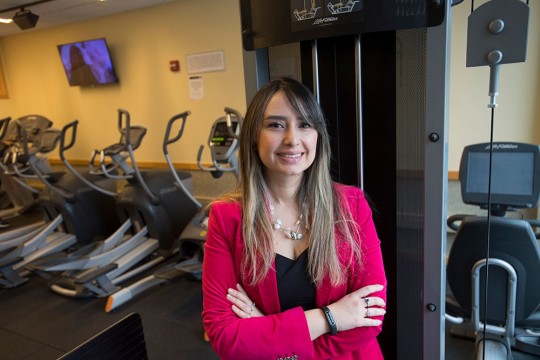
RIT researcher uses data to help wearable technology companies connect with consumers
New research is evaluating how wearable technology companies can better engage with their customers and humanize relationships in machine-mediated environments built to promote healthy behavior.
-
November 3, 2020
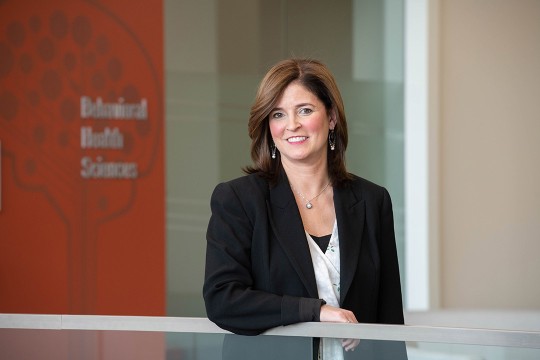
Telehealth, data, team-based care are increasingly important elements
The Rochester Business Journal talks to Caroline Easton, professor in the biomedical sciences program, about telehealth programs for addiction treatment and mental health treatment.
-
October 23, 2020

Research team wins Catalyst Award in first year of international challenge
David Borkholder, Linwei Wang, Caroline Easton, and Adam Smith, part of RIT's Personalized Healthcare Technology signature research initiative, recently won a Catalyst Award from the National Academy of Medicine for their project, “Improving Health for the Aging through Daily Vital Signs Monitoring.”
-
October 21, 2020

RIT scientist receives NSF funding to explore cellular compartmentalization in bacteria
Moumita Das, an associate professor in RIT’s School of Physics and Astronomy, received funding from the National Science Foundation to better understand the fundamental rules that allow bacteria to compartmentalize the functions within their cells.
-
October 16, 2020

RIT behavioral health researchers expand opioid addiction treatment to rural N.Y., N.H.
RIT’s Behavioral Health program is expanding in new directions with a clinic on campus and federal funding to deliver addiction treatment in rural communities in upstate New York and rural New Hampshire.
-
October 14, 2020

RIT, URMC receive grant to study benefits of AI-enabled toilet seat technology
Toilet seats with high-tech sensors might be the non-invasive technology of the future that could help reduce hospital return rates of individuals with heart disease. A joint project by researchers at RIT and the University of Rochester Medical Center will determine if in-home monitoring can successfully record vital signs and reduce risk and costly re-hospitalization rates for people with heart failure. The five-year, $2.9 million venture is funded by the National Institutes of Health.
-
October 9, 2020

Linwei Wang named new director of RIT’s Personalized Healthcare Technology initiative
Linwei Wang has been named the new director of the Personalized Healthcare Technology signature research initiative at RIT, and Adam Smith has been named Creative Director, a new position with the group.
-
September 16, 2020

RIT names Yong “Tai” Wang as dean of College of Health Sciences and Technology
Yong “Tai” Wang currently is dean and endowed chair professor of the Drs. Lee Roy and Lucy Mathis College of Nursing and Health Sciences at the University of Texas at Tyler, a role he has held since 2014. He was chosen for the RIT dean following a national search, and will begin his new leadership role in January.
-
July 16, 2020

The advantages of working differently
RIT Ph.D. candidate Mehdi (Aslan) Dehghani secured an internship at bio-device company after his team's research paper was published nationally.
-
July 16, 2020

Researchers develop new method to filter extracellular vesicles to improve diagnostics options
Researchers at RIT and the University of Rochester discovered an alternative to successfully purify biological particles to better understand how cells communicate with one another.
-
July 7, 2020
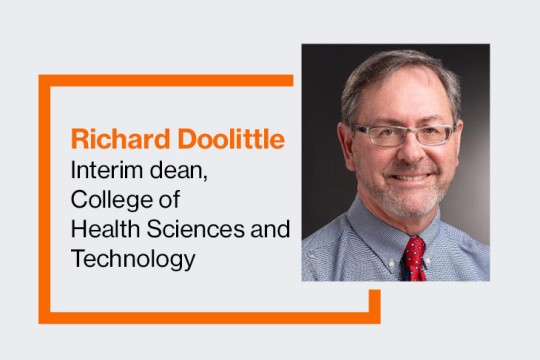
Richard Doolittle named interim dean of the College of Health Sciences and Technology
Richard Doolittle has been named interim dean of RIT’s College of Health Sciences and Technology, effective immediately. Doolittle has a long history with RIT’s health care programs, and he has served as vice dean of CHST for nearly a decade.
-
June 5, 2020
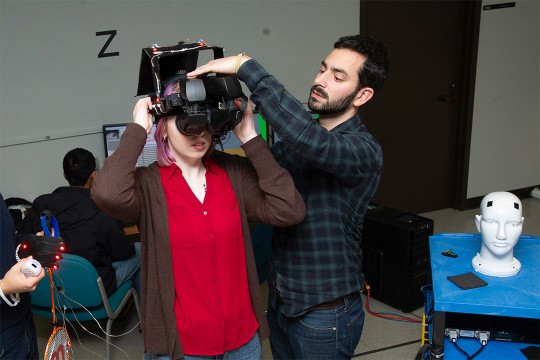
RIT faculty earns NIH grant to use virtual reality to help stroke patients regain lost vision
Scientists from RIT and the University of Rochester aim to use virtual reality to help restore vision for people with stroke-induced blindness. The team of researchers led by RIT's Gabriel Diaz, are developing a method they believe could revolutionize rehabilitation for patients with cortically induced blindness, which afflicts about 1% of the population over age 50.