News by Topic: Personalized Healthcare Technology
-
June 2, 2020

Telehealth connects homeless with therapists training at RIT
Residents of a homeless shelter in Rochester are continuing to receive therapy during the coronavirus pandemic from a team of therapists in a clinical internship program at RIT. The doctoral training program began as an exercise in using telepsychology to deliver care to a marginalized and underserved population. When New York shut down in March to stem the spreading virus, the therapists were already prepared to apply the telehealth protocols in the crisis.
-
May 8, 2020
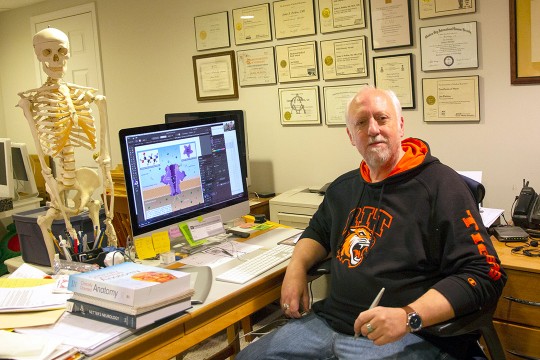
James Perkins wins Eisenhart Award for Outstanding Teaching
RIT Professor James Perkins ’92 MFA (medical illustration) has won the trifecta of RIT honors—this year adding an Eisenhart Award for Outstanding Teaching and Distinguished Professor to his 2015-2016 Trustees Scholarship Award.
-
April 15, 2020
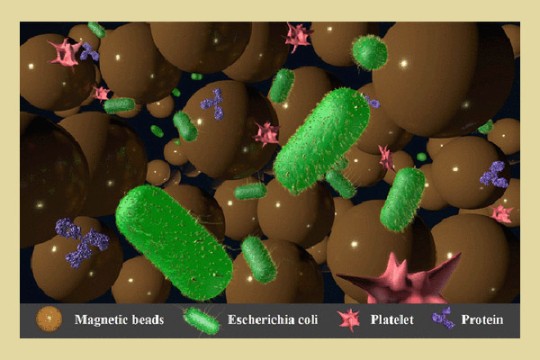
RIT researchers build micro-device to detect bacteria, viruses
Ke Du and Blanca Lapizco-Encinas, both faculty-researchers in RIT’s Kate Gleason College of Engineering, worked with an international team to collaborate on the design of a next-generation miniature lab device that uses magnetic nano-beads to isolate minute bacterial particles that cause diseases. This new technology improves how clinicians isolate drug-resistant strains of bacterial infections and difficult-to-detect micro-particles such as those making up Ebola and coronaviruses.
-
April 7, 2020

RIT Rallies: Research project moves from prototype to support for coronavirus care
A heart monitoring solution developed in a Rochester Institute of Technology engineering lab is helping to provide individuals with early signs of COVID-19 symptoms during the 2020 crisis.
-
February 14, 2020

Helping heart surgeons see more clearly
Associate professor Linwei Wang is leading an international group of researchers and clinicians developing computational systems for creating individualized 3D imaging of a patient’s heart. With these 3D heart models, clinicians now have a noninvasive way to study their patients.
-
February 6, 2020
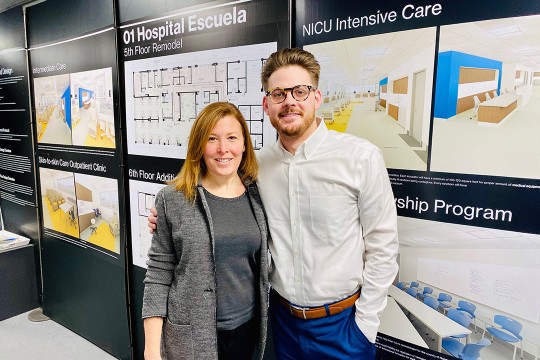
Podcast: Hope for Honduras
Intersections: The RIT Podcast, Ep. 31: A multidisciplinary contingent from RIT is creating design solutions to improve the quality of medical care and education in Central America. Mary Golden, interior design program chair and director of RIT Hope for Honduras, speaks with Christian Perry, a healthcare designer and co-founder of Little Angels of Honduras, about important initiatives to help reduce infant mortality in that region.
-
December 20, 2019
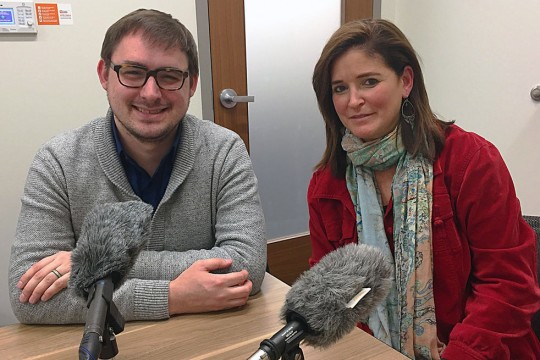
Podcast: The Benefits of Telehealth
Intersections: The RIT Podcast, Ep. 29: Caroline Easton, professor in RIT’s School of Behavioral Health, talks with Jacob Wadsworth, a doctoral intern in the university’s priority psychology internship program, about a project that uses telemedicine, the process of using telecommunications to evaluate, diagnosis and treat patients, to help homeless people access mental health and drug addiction counseling.
-
November 8, 2019

RIT conducts clinical trial on metabolic syndrome
RIT is seeking individuals diagnosed with metabolic syndrome to participate in a national clinical trial. The study will evaluate a wellness program designed to reverse conditions leading to heart disease, Type 2 diabetes and stroke.
-
October 21, 2019

Parenting app for mothers being developed at RIT
Research is underway at RIT to create an app that will serve as a resource to help young mothers answer questions about raising a child, connect them with programs and resources, as well as foster a virtual parenting community.
-
October 21, 2019

RIT researcher receives NSF grant to help build a synthetic neuron and neural network
Researchers from RIT and six other universities are teaming up to build synthetic neurons and a programmable network of such neurons in an effort to better understand the rules of life. The project is part of the National Science Foundation’s “Big Ideas” initiative— 10 bold, long-term research and process ideas that identify areas for future investment at the frontiers of science and engineering.
-
October 15, 2019

RIT wins $1.4M to help homeless with opioid addiction, mental illness
Making addiction treatment and mental health services accessible to homeless people via TeleHealth is the focus of a federally funded program at RIT.
-
September 5, 2019
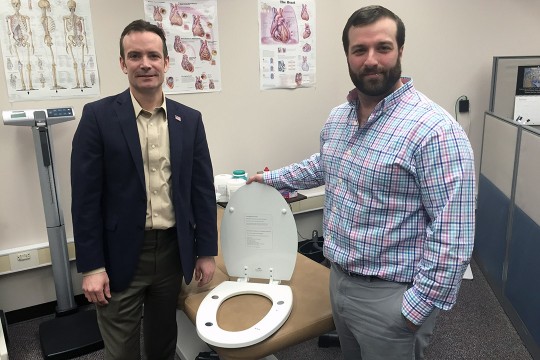
Podcast: Toilet Seat Measures Heart Health
Intersections: The RIT Podcast, Ep. 22: Heart failure costs the U.S. $34 billion a year, with most of those costs due to repeated hospitalization. David Borkholder, RIT’s Bausch and Lomb Professor of Microsystems Engineering, talks with Nicholas Conn, a postdoctoral fellow and founder of Heart Health Intelligence, about a new invention that could help patients easily monitor their health in the privacy of their own bathrooms.