First-year RIT students study the relationships between AI, technology, and society
The two new pilot courses, offered by the College of Liberal Arts, focus on how AI and emerging technologies impact human society
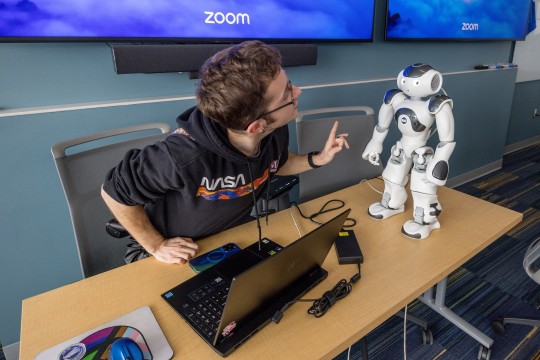
Two new pilot courses, Interdisciplinary Explorations of Human Problems and Science, Technology, and Values, encourage first-year students to think critically about the interactions between emerging technologies, like artificial intelligence, and society.
The widespread adoption of artificial intelligence (AI) systems and tools has undeniably altered human life and the workforce, but Rochester Institute of Technology (RIT) is making sure students are confidently prepared to navigate these changes.
Two recently introduced pilot courses with a focus on AI and emerging technologies aim to arm students with the knowledge to think critically about technology’s impact on human life. The interrelated pilot courses, offered by RIT’s College of Liberal Arts, were developed with a goal of enhancing first-year students’ understanding of the complex relationships between technology, society, and their college experience.
These pilot courses, Interdisciplinary Explorations of Human Problems and Science, Technology, and Values, are based in the Department of Criminal Justice and the Department of Science, Technology, and Society, respectively. Though the two courses share an overall curricular goal, each version of the pilot course is tailored to the individual department’s field of study.
These are the first of several planned courses that will introduce first-year students to the intersection of technology and society and encourage them to investigate the potential societal impacts of emerging technologies.
Irshad Altheimer, the Ellen M. Granberg Endowed Professor, is teaching the Criminal Justice-based pilot course, and Associate Professor Kaitlin Stack Whitney is teaching the Science, Technology, and Society-based pilot course.
Stack Whitney explained that the Department of Science, Technology, and Society was perfectly poised to test out a course of this nature.
“Science and technology studies is all about how people shape technology, and how technology effects change. That bi-directional understanding and approach is key, it’s not one or the other,” she explained.
The department recently launched a new immersion, minor, and dedicated course in Artificial Intelligence in Society. Stack Whitney was involved in these developments and has taught the course three times since it was introduced, so she was intrigued by the opportunity to teach this new pilot course.
In her version of the course, Science, Technology, and Values, students will explore how tools like social media, AI, surveillance systems, and medical innovations reshape communities, power, identity, and opportunity. Students will also investigate how human values, culture, politics, and economics shape what gets built, who benefits, and who gets left out.
“Technologies aren’t neutral. They reflect the goals and visions that folks have for both the present and the world they want to make,” she said. “We can help students understand how automation has changed life in the past and help them think critically about claims being made with certainty about the future.”
After witnessing the impact of AI tools on the justice system firsthand, Altheimer was similarly intrigued by the opportunity to craft the criminal justice-oriented version of the pilot course, Interdisciplinary Explorations of Human Problems. He will co-teach the course with Ashique KhudaBukhsh, assistant professor in RIT’s Golisano College of Computing and Information Sciences.
“Justice is a bedrock of a democratic society. How we use AI in the criminal justice system reflects our own ethics and values,” he said.
Students enrolled in Altheimer and KhudaBukhsh’s course will study the use of AI tools at different stages of the criminal justice system, and the impact that it has on key criminal justice outcomes such as arrect, conviction, and incarceration.
“Particular attention will be paid to whether AI tools actually make our system better, or if they just provide the illusion of justice,” said Altheimer. “Our students need to be equipped with the analytical tools that can help them evaluate this technology and its impact on society.”
Going forward in future semesters, any College of Liberal Arts faculty member will be able to craft and offer their own discipline-specific course on emerging technologies. The courses are also helping to inform planning for revisions to RIT’s General Education framework, which is currently in the vetting and approval stages.
These pilot courses add to a healthy variety of AI-related curricular offerings across the university. RIT recently introduced a new bachelor’s degree in AI and, in 2023, RIT began offering a master’s degree in AI. The university also aims to launch an AI institute in 2027, which will advance AI education, research, and responsible application across disciplines while helping develop the talent needed to guide, apply, and improve emerging technologies.
Go to RIT's Artificial Intelligence webpage to learn more about how AI is being studied across the university.