RIT and URochester research collaboration aims to improve STEM student success
NSF-funded projects examine how universities can better support engineering and computer science students
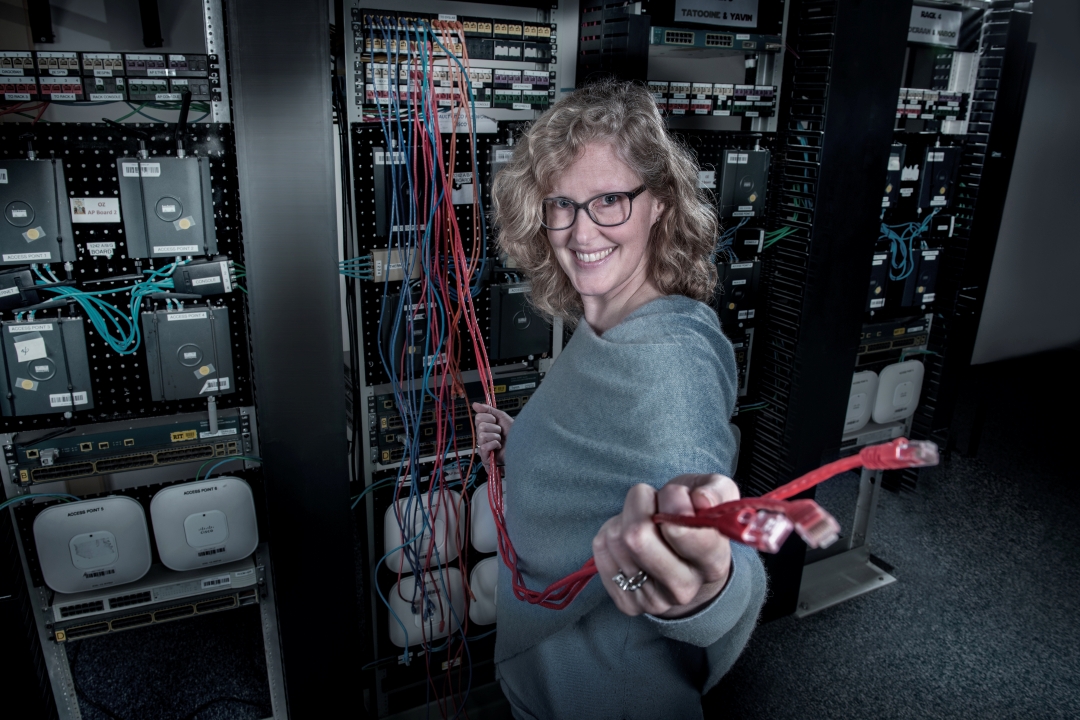
RIT Professor Sharon Mason is working with the University of Rochester to build a national research hub to understand how universities can improve outcomes for low-income undergraduate students in engineering and computer science. The project is an extension of Mason’s $1 million NSF study to explore how the growth mindset approach can help improve computing education and student success.
Updated: Sept. 9, 2026
Rochester Institute of Technology and the University of Rochester are building a national research hub to understand the conditions that enable academically talented, low-income students in computing and engineering to persist, succeed, and thrive.
Supported by a five-year, $3 million grant from the National Science Foundation (NSF), the Advancing Understanding and Resilience Actions (AURA) S-STEM Research Hub will bring together researchers at 10 universities. AURA is funded through the NSF S-STEM Research Hubs initiative, which builds on the foundation’s longstanding Scholarships in STEM program.
Sharon Mason, professor and director of RIT’s School of Information in the Golisano College of Computing and Information Sciences, is AURA’s RIT co-principal investigator and her work is informing the design of AURA. The hub is an extension of Mason’s $1 million Enhancing Growth-Mindset Academic Experiences (ENGAgE) S-STEM research program that provided scholarships and mentoring for computing students.
The AURA Research Hub team will study engineering and computer science students to identify how factors like self-determination, mindset, campus support systems, community connections, and learning environments impact resilience and persistence. Initial university partners include the University of Cincinnati, California State University–Long Beach, University of Connecticut, and SUNY Polytech Institute.
“We are at a watershed moment for technology and education,” said Mason. “As artificial intelligence reshapes how we learn, work, and solve problems, the AURA Research Hub has an opportunity to generate knowledge that supports educators in creating teaching and learning environments where more engineering and computing students can succeed.”
Read more about the AURA project with the University of Rochester.
Originally published: Jan. 10, 2022
NSF-funded study creates scholarships to help computing scholars find success
$1 million grant explores how growth mindset approach can improve computing education
Rochester Institute of Technology received a nearly $1 million National Science Foundation grant that will provide scholarships for computing students and help researchers explore new ways to improve computing education.
Through the NSF-funded project, professors in RIT’s Golisano College of Computing and Information Sciences (GCCIS) are studying how fostering a growth mindset learning approach can lead to student success. The comprehensive study integrates this growth mindset into curriculum and mentoring programs for college students studying computing.
As part of the study, 30 undergraduate students participating in the College of Computing Scholars–Enhancing Growth-mindset Academic Experiences (ENGAgE) program will receive two-year scholarships.
Throughout the five-year study, RIT researchers aim to increase retention and graduation rates in computing majors. Ultimately, the project will contribute to the national need for well-educated scientists, mathematicians, engineers, and technicians, said Sharon Mason, principal investigator of the project.
“Historically, students face challenges as they are learning programming and computing,” said Mason, who is also a professor in RIT’s School of Information. “We believe that instilling growth mindset into the way we teach computing can lead to more students staying with their major and successfully entering the workforce.”
The idea of growth mindset is attributed to Stanford psychology professor Carol Dweck, who categorized two mindsets. A fixed mindset sees intelligence as static, while a growth mindset sees intelligence as something that can be developed over time.
Mason explained that people with growth mindsets think that their abilities are not just talents they are born with, but can be enhanced through persistence, hard work, and learning how to overcome challenges. Her project will build on research that suggests mindset can be influenced to promote positive learning experiences, improved academic performance, and reduced vulnerability to stereotype threat.
“There has been a lot of work on growth mindset at the K-12 level and in single classroom interventions,” said Mason. “We are taking a more holistic and multi-pronged approach.”
As part of the study, faculty are gathering in a learning community to understand, examine, develop, and apply evidence-based growth mindset curricular enhancements and mentoring approaches. They are integrating these growth mindset activities into programming and career preparation courses at RIT. For example, faculty might change the way assignments or topics are typically approached.
Each student also participates in a mentoring community and is paired with a faculty mentor. In addition, scholars take part in a seminar focusing on metacognitive approaches to fostering a growth mindset.
“Struggles should not be a roadblock to success,” said Mason. “We should normalize failures and challenges and focus on how students can move forward and succeed. This applies to all areas of our lives and can really make a positive impact.”
Co-principal investigators on the GCCIS ENGAgE project include Dan Bogaard, associate professor in the School of Information; Elissa Weeden, associate professor in the School of Information; Michael Yacci, senior associate dean for academic affairs in GCCIS; and Robert St Jacques, senior lecturer of software engineering.