RIT photographers lend their skills to the Special Olympics
Josh Meltzer
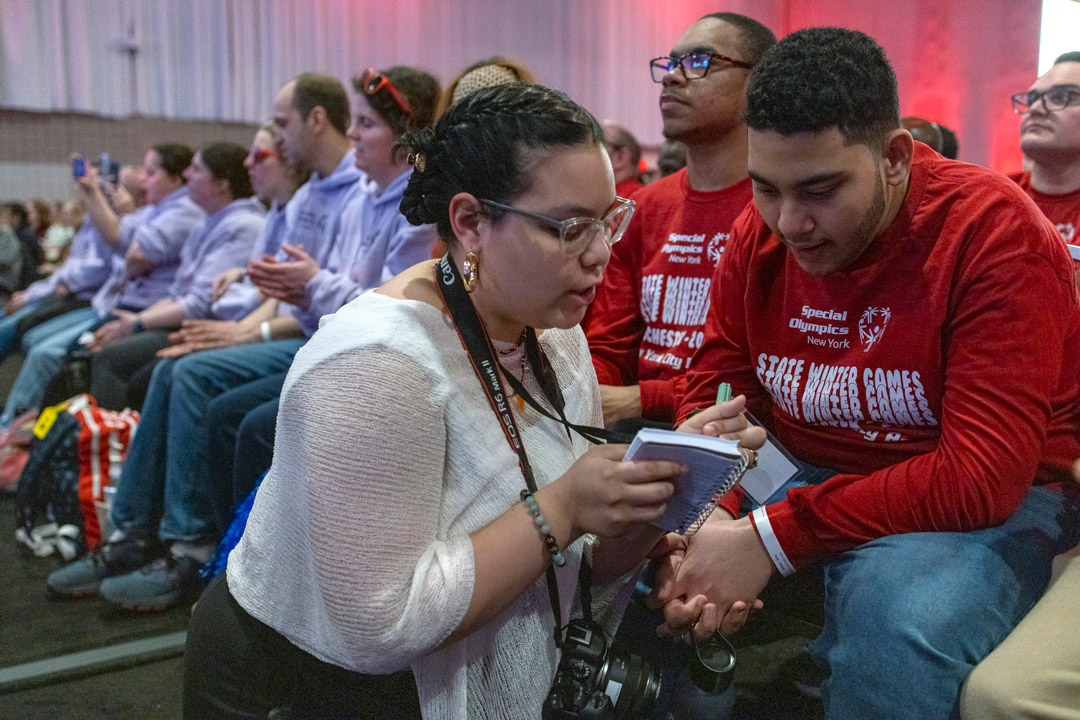
RIT photo student Naiyelis Ortiz-Torres gathers information for her caption from a New York City-based athlete at the opening ceremonies of the 2026 Special Olympics New York Winter Games.
Athletes and attendees alike say the excitement of the Special Olympics New York State Winter Games is contagious. A team of photographers from RIT leaned into that energy and happily captured every moment of it.
Genevieve Gutierrez
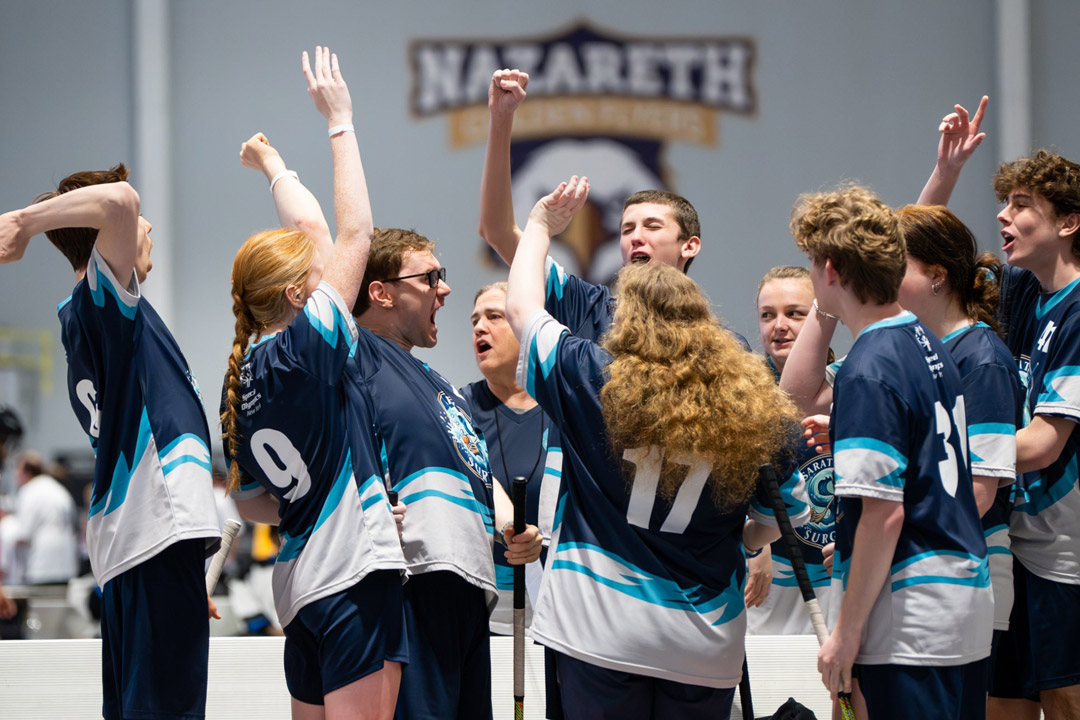
The Saratoga Surge from the Capital Region celebrate during floorball competition at Nazareth Golisano Training Center in Rochester, N.Y., on Feb. 21.
Nearly 60 RIT students and 20 alumni and faculty members helped document the 2026 Winter Games as part of an ongoing collaboration with Special Olympics New York. This is the sixth year RIT photographers have covered the winter games, and the team published hundreds of photos on RIT’s Special Olympics website and on the Special Olympics New York social media pages to celebrate the athletes.
“I think the value of this work is twofold. For one, it’s hands-on work that very much mirrors any professional experience. If you look at the International Winter Olympics that just occurred, we have a similar workflow to what professional organizations are using in the field,” said Associate Professor Jenn Poggi, who coordinates the event coverage in partnership with Associate Professor Josh Meltzer. “It’s also an opportunity to build bonds between students, faculty, and alumni.”
The community building aspect was particularly appealing for Samuel Fox, a first-year photojournalism major who helped cover the 2025 Winter Games as a high school student.
RIT’s School of Photographic Arts and Sciences was Fox’s top choice when applying to college. When Poggi, director of the photojournalism program, invited him to help cover the event before he officially enrolled, he made the trek to Rochester from his home in Bethlehem, Pa.
Returning to cover the games again this year was an opportunity he didn’t want to miss.
“Every opportunity is something that can help build up your career and your strengths. Putting myself out there helps me gain confidence so I’m not too afraid to get up close and talk to people, and it helps me get a better sense of how to take a photo that means something and leaves an impact,” said Fox.
These hands-on, experiential learning opportunities are a hallmark of RIT’s photography programs. Giving students the chance to exercise their skills, test out new roles, and gain leadership experience is part of what drives Poggi and Meltzer to continue offering the one-credit workshop course that makes this coverage possible.
Traci Westcott/RIT
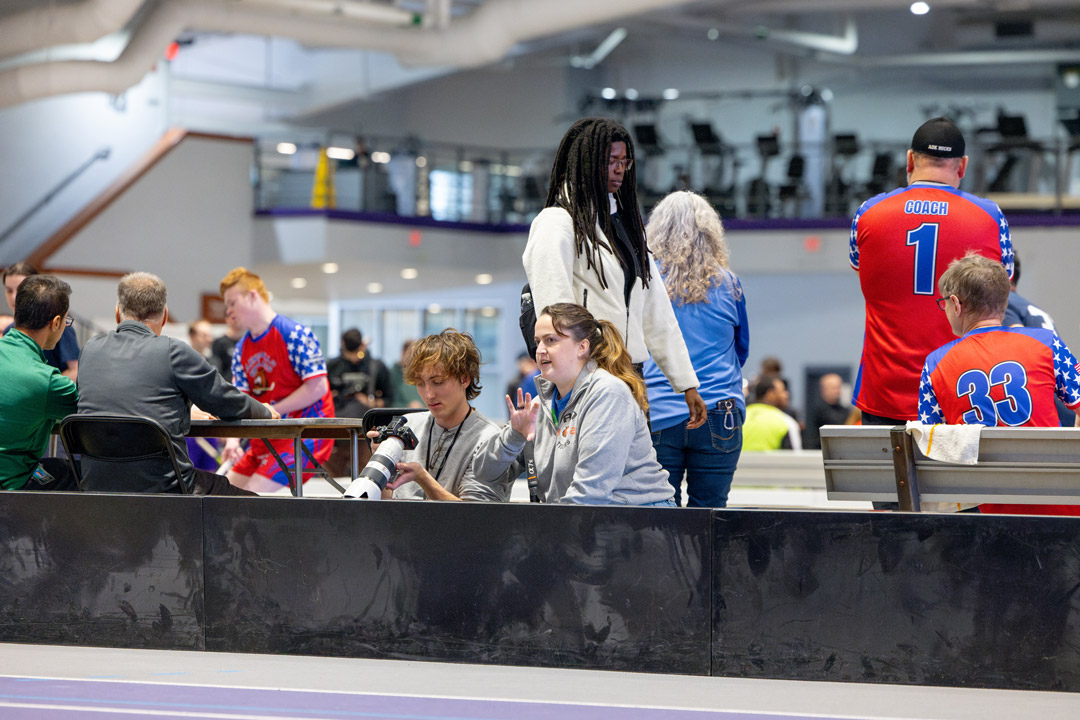
First-year photojournalism student Colin Norland, left, receives some advice from Bridget Reinsko ’20 (photojournalism), right, before a floorball competition at the at Nazareth Golisano Training Center.
“It’s a lot of work, but it’s a break from the normal routine and the students flourish in this kind of environment,” said Meltzer. “People come back every year because it’s an extremely positive experience. The students feel like they’re part of something important, and they’re able to make great pictures because it’s a place with a lot of emotion and energy.”
In addition to learning the skills needed to photograph fast-paced, high-energy scenes, Poggi said interacting with the athletes, families, and coaches can also push students to reflect on their approaches to future assignments.
“We hope the legacy we foster through this is encouraging students to consider representation in their work going forward. We want students to think about representation when they cast models or consider what kind of stories they tell, and to remember the transformational impact that representation can have,” said Poggi.
After two years of working the event, Audrey Gavagan, a third-year photojournalism and RIT Honors Program student, stepped into a lead media producer role for this year’s winter games.
In previous years Gavagan, from Mendham, N.J., supported the games as a photographer, editor, and venue producer, which perfectly prepared her for a larger leadership role.
“It’s been great having the opportunity to take on more responsibility each year, and to work with such a great organization,” said Gavagan. “It’s amazing to come and do what I love while also doing good for the community. We’re creating a far greater impact than any individual could create alone.”
Bridget (Fetsko) Reinsko ’20 (photojournalism) drove from her home in Ithaca, N.Y., to support this year’s games. Reinsko served as a student lead during RIT’s first year covering the games, and she has volunteered for four years total; twice as a student and twice as an alumna.
Mackenzie Stevenson
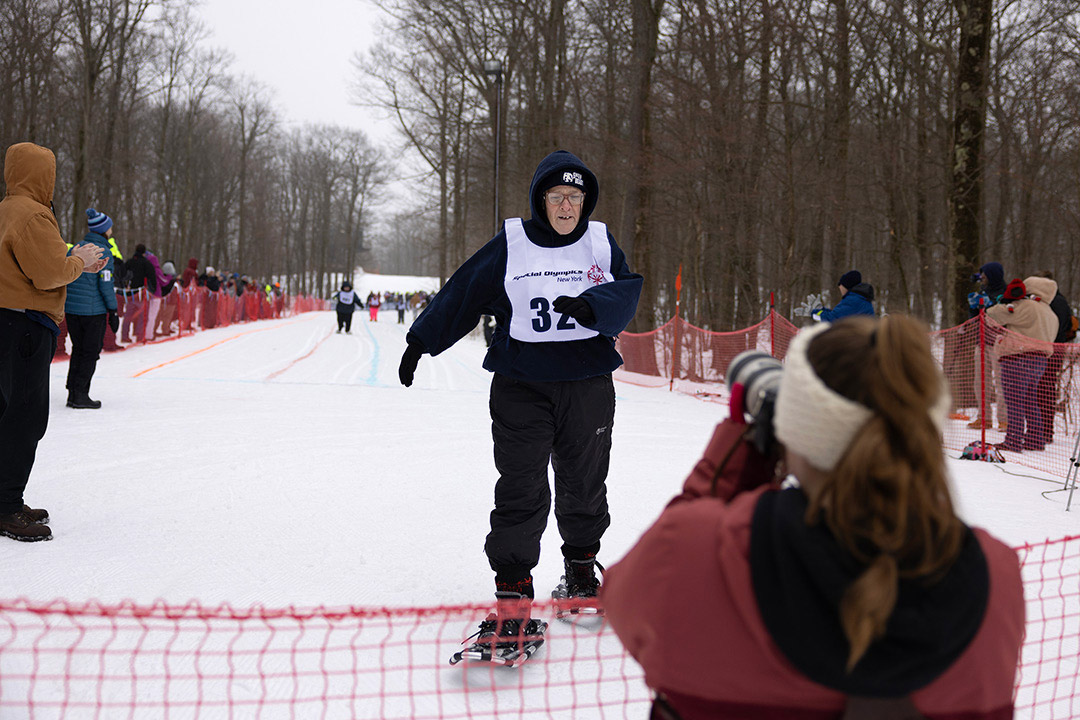
Kaila Stefanini, an advertising photography student, photographs snowshoe-athlete Elaine Lindsey crossing the finish line during a competition at the Bristol Nordic Center.
Prior to working as a new media specialist for Cornell University, Reinsko worked for Special Olympics International for two and a half years in various communications and multimedia storytelling roles. According to Reinsko, coordinating coverage for the games as a student was one of the most valuable experiences that helped prepare her for her career.
“It’s been nice to come back and watch the students come out of their shells throughout the day and gain confidence, and to see the impact their work has. The athletes and families love to see the photos afterward,” Reinsko said.
She added, “Getting to see this collaboration between RIT and Special Olympics New York from inception to now is so cool, and I’m glad to see it continuing. The work the students are doing helps build a greater understanding of Special Olympics and the work these athletes put into it.”
This coverage is made possible, in part, by support from two company sponsors. Canon donated ink and paper to the event, which allowed the digital imaging team, run by Lecturer Dan Hughes, to print more than 100 student-made photographs for athletes and families to take home. Tamron loaned additional lens options for students to use, which allowed for better coverage and gave students experience working with different types of gear.
Go to RIT’s Special Olympics website to read more about the games and see more of the photography coverage. More photos will be added to the website in the coming weeks.


