RIT researchers improve prosthetics with new materials, sensors, and bioprinting breakthroughs
Collaborative approach has the potential to improve quality of life for prosthetic users
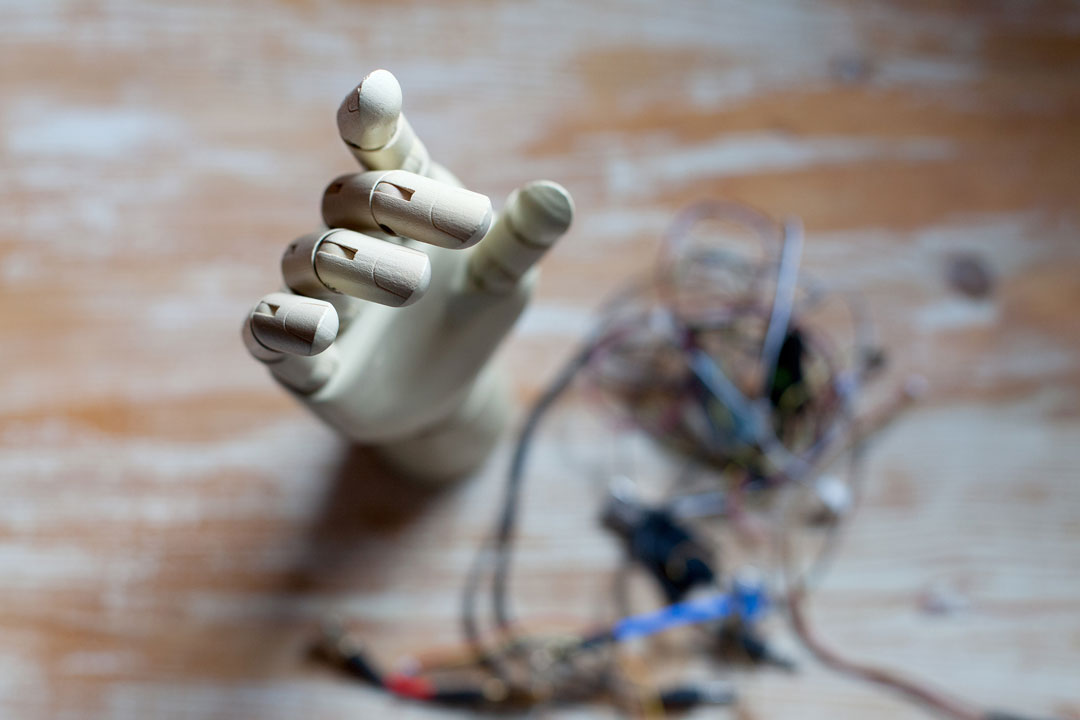
RIT faculty researchers from the Rochester and Dubai campuses collaborated to improve finger and hand prosthetics with a combination of expertise in the areas of new materials, smart sensors and bioprinting technologies.
New advances in bioprinting by Rochester Institute of Technology researchers are pointing the way to nearly human capabilities for finger prosthetics.
Fingers, complex structures made up of multiple bones and sensitive skin, are capable of intricate movements from pointing to lifting. Developing prosthetics that mimic human capabilities is being done by integrating four previously separate functions to create prosthetics that are highly sensitive, flexible and made with biocompatible materials that can be 3D printed.
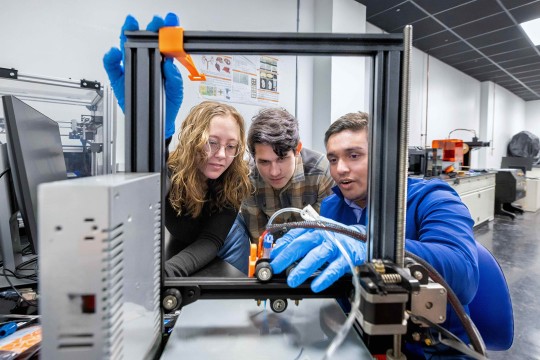
The work was done by four faculty-researchers from RIT’s U.S. and Dubai campuses with each researcher contributing their area of specialization—hybrid materials, electromechanical system development, prosthetic mechanical properties, and 3D-bioprinting techniques. The collaboration allowed development of a more complete prosthetic system than any one discipline could achieve independently, said Ahasan Habib, assistant professor of mechanical and mechatronics engineering technology in RIT’s College of Engineering Technology.
“One of the greatest needs in prosthetics is the ability to produce patient-specific devices that closely match an individual’s anatomy, mechanical properties, and functional requirements,” said Habib. “Traditional manufacturing methods often have limitations in producing complex, customized structures. Our approach has the potential to improve comfort, performance, accessibility, and ultimately the quality of life for prosthetic users.”
Habib collaborated with Krittika Goyal and Jun Han Bae, both assistant professors in RIT’s College of Engineering Technology, and Salman Pervaiz, RIT Dubai engineering professor and director of materials and advanced manufacturing research. Findings were published in the Journal of Manufacturing and Materials Processing Spring 2026 issue.
Specifically, the team found:
- Hybrid materials such as biodegradable thermoplastic and heat-resistant silicone, respectively— are substances that were optimized for flexibility, strength and biocompatibility for the prosthetic structure;
- Advanced 3D-print methodologies incorporated the hybrid materials and improved extrusion and printing performance as well as provided options for customizable products;
- “Smart” sensors were created using the new materials to create a better sense of touch using piezoelectric principles—the ability of some materials to generate electrical properties—allowing the device to recognize tactile stimulation;
- Mechanical properties were integrated in the prosthetic toward more natural usage.
Future of prosthetics
More than 185,000 amputations take place yearly in the U.S. and more than 1 million limb amputations take place globally every year, according to ProMedical East and the Amputee Coalition. With the rise in demand for prosthetic limbs, there is an equal demand for prosthetics that are both functional and cost effective.
Different research groups have explored additive manufacturing and sensor technologies individually. Other challenges include limited mechanical durability, poor compatibility with an individual’s limb and the device, and variable 3D-print quality.
The RIT project bridged these gaps for a customizable, affordable design prototype that can be further developed toward commercialization. They also detailed a comprehensive development process from material selection to 3D-print functions to ensure that materials retained tactile abilities and strength.
“As we talk about the future of prosthetics, there are two components that need to be involved. The first was to bring together multi-material printing, so it's not like the whole prosthetic should be printed with one material. The second was to make it smart, so it can be used not only for gripping but other functions,” said Pervaiz. “Capability-wise, we are there. We all have very good capabilities in each of our labs. I also think that we all share the same DNA as an RIT family of researchers.”
RIT’s research enterprise is focused on advancing knowledge, solving complex global challenges, and making a meaningful impact across disciplines. This past year, RIT received $105 million for faculty and student research, which includes total funding, National Science Foundation awards, and CAREER Award submissions.