RIT students bring their programming skills to the performing arts stage
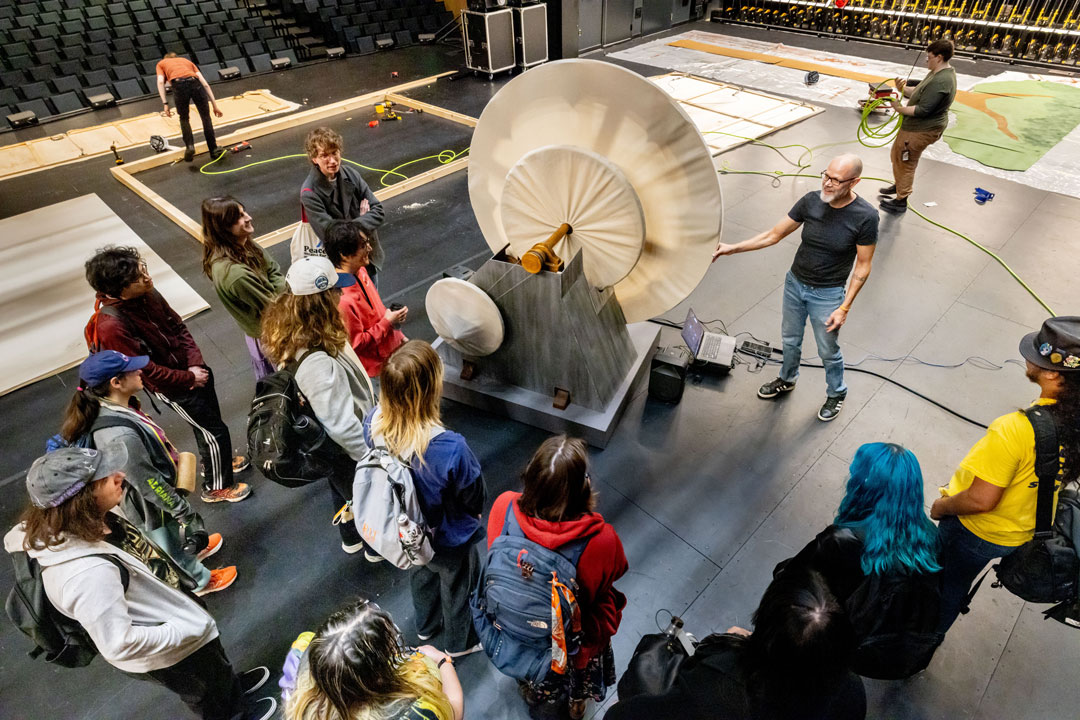
Scott Hamilton/RIT
An upcoming musical, ‘Sunday in the Park with George,’ will feature a prop programmed by RIT students that uses kinetic movement to generate a mechanical soundscape. The soundscape will complement a musical score performed by the RIT musicians in the pit orchestra.
Rochester Institute of Technology’s Creative Code for Music course encourages students to explore the intersection between technology and the arts. One manifestation of that exploration involves showcasing their programming skills during a musical theater performance.
Students in the course were tasked with programming an interactive prop called a Chromolume that will be featured in RIT’s production of Sunday in the Park with George—the first musical that will be performed in the new RIT Performing Arts Center since the venue’s gala opening in April 2026.
Sunday in the Park with George is an award-winning musical by Stephen Sondheim and James Lapine. The show is inspired by Georges Seurat’s painting, “A Sunday Afternoon on the Island of La Grande Jatte,” and explores the intersection between art and technology, as well as themes around the true cost of making art and the value that artists leave behind after their death.
Get your show tickets
Sunday in the Park with George opens at 7:30 p.m., on Thursday, Nov. 12, in the RIT Performing Arts Center. This production will be the first musical performed in the center since it opened in April 2026.
“One of the things that drew me to this piece for the RIT community is that intersection and interplay between art, technology, and science,” said Christopher Ryan, assistant professor of musical theatre in RIT’s School of Performing Arts and director of the production. “We have a vibrant community of young artists on campus, all of whom are studying other disciplines, many of which are technological and scientific.”
Collaborating with Associate Professor Paul Leary’s Creative Code for Music course was a perfect opportunity for Ryan and others involved with the performance to engage with that community.
The Chromolume prop is a key narrative element of the musical. One of the show’s main characters, George, is an artist who creates interactive sculptural installations using light, sound, and lasers. The Chromolume installation is unveiled in act two, where it is displayed alongside the Georges Seurat painting.
To bring the Chromolume to life, Leary asked his students to work in groups to create a mechanical soundscape for the prop wheel that is connected to its kinetic motion. By utilizing an Arduino, sensors, and a program called Max 9, students programmed sound effects that are triggered by and respond to the wheel’s G-force when it spins. As it slows down or speeds up, the sensor tracks the G-force data and transforms the sound effects in real time, creating a mechanical soundscape.
Leary explained that students enrolled in the course come from a variety of different majors and have varying levels of experience with both programming and musical composition. According to Leary, this mix of skills and interests provided a healthy blend of perspectives when completing this project as well as other course materials.
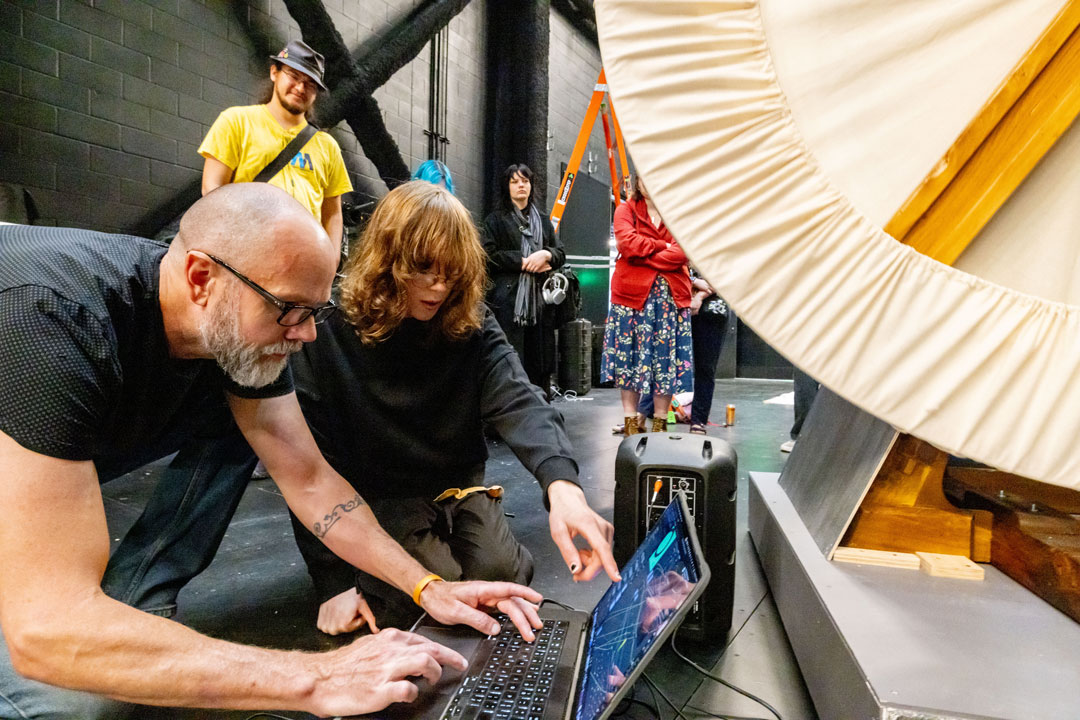
Scott Hamilton/RIT
Before the final show rehearsals, Leary and his students took to the RIT Performing Arts Center Stage to test run their mechanical soundscapes.
STEM students use their skills to support the arts
Creative Code for Music offers students a unique opportunity to study and work at the intersection of programming and music. Noah Shin, a fourth-year computer science major from Williamstown, Mass., couldn’t pass up a chance to experience that fusion of disciplines.
“As a programmer and a computer science major, I think something a lot of us can relate to is feeling like we’re getting sort of pushed out of our own space by artificial intelligence. So, for me, it's been really interesting to find an aspect of creating code that is wholly untouchably human,” said Shin.
Shin and his groupmates took an alternative approach to designing their soundscape. Rather than focusing on the painting or specific details of the play, Shin’s group leaned into the theme of 1980’s technology.
“I'm excited to see it in full context with the pit orchestra and see what the performers do with it on stage,” said Shin. “There's such a huge difference between having something go exactly how you envision it in class and seeing it in motion during the actual show. That is the beauty of performance art like this in general.”
Creative students experiment with programming
Gavin King, a fourth-year individualized program student from Penfield, N.Y., comes from a more creative background. They are a Performing Arts Scholar and a self-described “theater geek.”
Performing Arts Scholarship Program
Rochester Institute of Technology’s School of Performing Arts offers students of all majors opportunities to participate in music ensembles, theater and dance productions, and hands-on performing arts experiences both in and out of the classroom. The Performing Arts Scholarship Program bolsters participation by providing eligible students with financial support and additional opportunities to engage with RIT’s performing arts community.
“Sunday in the Park with George has been one of my favorite musicals for years now and having this opportunity to contribute to this production in this very new way feels just like home to me,” said King. “I’ve loved being able to work on something that I have a personal connection to while also learning some new technological skills along the way.”
When designing and programming their group’s mechanical soundscape, King explained that they tried to imbue the spirit of the musical into the project by utilizing samples of distorted paintbrush strokes.
The experience of using technical skills to bring a stage performance to life opened King’s eyes to the true synthesis between STEM fields and the arts.
“I find that when I’m writing music, I think about it mathematically in a lot of ways. It’s almost formulaic in the way that it makes sense for one sound to follow another. As we were writing the code and programming this project, it felt like a lot of those same principles of music were being applied. It felt really hand in hand,” said King.
Creative Code for Music is offered by the College of Liberal Arts, which prepares students for career success in a technology-driven world by developing skills in critical thinking, problem-solving, communication, and ethical leadership. Through the study of the humanities and social sciences, students learn to analyze complex issues, navigate emerging technologies like artificial intelligence, and apply human-centered perspectives to real-world challenges.