Biomedical Engineering Master's Capstone: VentriloFlex
Spasticity is a debilitating condition involving involuntary muscle flexion affecting over 12 million people worldwide. The most common and effective treatment for this condition currently requires multiple clinicians. RIT Master's students worked to develop VentriloFlex, a lightweight, mechanical brace designed to hug the outside of a patient's arm, enabling a single clinician to incrementally open and adjust the elbow angle.
Spasticity is a debilitating condition involving involuntary muscle flexion caused by nerve damage from diseases like multiple sclerosis, cerebral palsy, or strokes, affecting over 12 million people worldwide. The most common and effective treatment for this condition is Botox injections, which help relax the targeted muscles. However, administering this therapy currently requires multiple clinicians to physically pry open the patient's tightly flexed arms to reach the injection site. Recognizing this challenge, market analysis identified a pressing need for an assistive device that allows a single rehabilitation specialist to safely and efficiently access the patient's arm muscles.
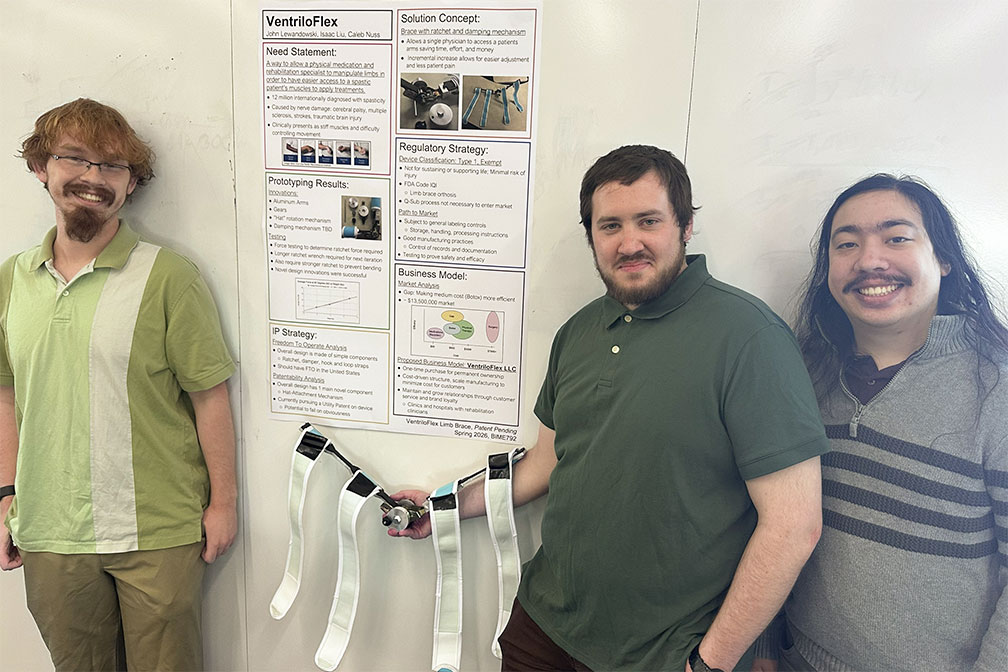
To address this need, a Biomedical Engineering MS Capstone team - John Lewandowski, Isaac Liu, and Caleb Nuss - worked to develop VentriloFlex, a lightweight, mechanical brace designed to hug the outside of a patient's arm, enabling a single clinician to incrementally open and adjust the elbow angle. The brace utilizes a modified ratchet system for controlled opening and intends to incorporate a damping mechanism, or dashpot, to ensure a slow, safe release of the arm back to its resting position without injuring the patient. The team built functional prototypes using aluminum for the structural arms and a modified ratchet for the internal mechanism. To help clinicians overcome the intense force of a spastic bicep, they designed a novel "hat rotation device" that allows a standard ratchet wrench to interface with the brace's internal gears. Initial prototype testing revealed structural weaknesses in the commercial ratchet systems that were adapted, so future iterations will focused on redesigning the ratchet-arm interface and re-engineering the ratchet release mechanism.
In order to move forward with their vision, the team established VentriloFlex LLC and filed a provisional utility patent, with plans to move forward with the design work through the assistance of an RIT multidisciplinary senior design team before filing a full utility patent and exploring commercialization/regulatory clearance.
More Featured Profiles and Work