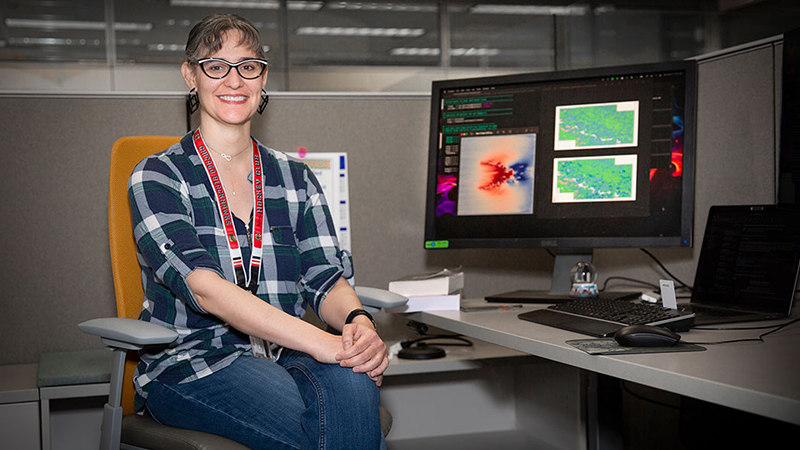
Harnessing Applied Statistics to Shape Defense Analytics
RIT alum Kimberly Roye ’09 applies her Applied Statistics MS to safeguard critical defense data. From analytics to anomaly detection, she leads work that supports decision-making at the highest levels.

When Kimberly Roye ’09 first heard about RIT’s Applied Statistics MS program, she was already working as a statistician at the U.S. Census Bureau. “After researching the curriculum and confirming that the program’s structure would allow me to complete the degree remotely from Maryland, I chose to enroll,” she says. RIT quickly stood out, not only for offering an online pathway that fit her life, but for the university’s strong academic reputation. “There were other online programs available, but none offering the prestige and rigor that RIT provided.”
Today, Kimberly is a Senior Data Scientist at Tecolote Research, Inc., where she supports the U.S. Air Force and the Office of the Secretary of Defense through high-impact data analytics. Her role has evolved far beyond traditional statistics. “I transitioned from a purely statistical role to one that integrates coding, applied mathematics, and systems-level thinking,” she explains. She now leads an Anomaly Detection program focused on data quality in a major Department of Defense enterprise database. Using R and SQL, she designs and implements rules that ensure critical operational data flows correctly and identifies anomalies before they affect decision-making.
“It is work that allows me to meaningfully contribute to the integrity and accuracy of data used at the highest levels of government,” she says.
Kimberly credits RIT with shaping not just her technical expertise, but also the mindset she brings to complex problems. “The program taught me to be a self-starter, to persist when solutions are not obvious, and to ask thoughtful questions.” One experience in particular stands out from her studies: preparing for her oral presentation. “It was one of the most daunting experiences at that point in my professional life,” she recalls. Yet that challenge became foundational. “That moment prepared me to confidently brief high-ranking military and civilian leadership on cost and analytical findings years later.”
Looking back, she says the combination of analytical training and professional skills she gained at RIT continues to influence her daily work.
For students considering the Applied Statistics program, or thinking about a career grounded in data, Kimberly offers heartfelt advice: never stop learning. “Embrace discomfort; growth rarely happens in places of ease in my experience,” she says. She encourages students to supplement their statistical training with data science or programming courses, write technical papers, and present whenever possible. “Teaching or explaining a topic to others forces you to master it at a deeper level.”
Above all, Kimberly emphasizes the importance of finding joy in your field. “As you pursue experiences that push your limits, you may discover strengths and passions you did not realize you had.”
More Featured Profiles and Work

Mary Pryor