How an RIT Psychology Degree Led Andrea Krzyzaniak '04 to a Career in Trauma Research
A research experience at RIT changed her career path—and ultimately led to directing research at a Level 1 trauma center in San Diego
When Andrea Krzyzaniak '04 (psychology) arrived at RIT, neuroscience was still an emerging field — and RIT offered one of the few psychology programs in the country with a biological focus. Two decades later, she directs research for the Trauma and Acute Care Surgery Department at Scripps Mercy Hospital San Diego, a Level 1 trauma center. And RIT now offers a degree program in neuroscience.
Krzyzaniak, who was also pre-med at RIT, joined Scripps Mercy in 2021. Her department provides the academic research support required to maintain the hospital's Level 1 trauma designation. It also partners with Naval Medical Center San Diego to support military general surgery residents, providing them the chance to complete a rotation through the trauma center and a dedicated research year with her team. Additionally, it collaborates with regional hospitals, including a stand alone pediatric center.
Her work spans identifying research projects, working with trauma attendings and residents to assess feasibility, managing Institutional Review Board (IRB) approvals and compliance, and drawing on hospital, statewide, and national databases.
A pivot sparked in an RIT lab
Krzyzaniak originally planned to pursue psychiatry, and RIT's co-op program placed her at a hospital in Florida.
"So much of what I wanted to do for patients in the long term was really going down a reactive pathway, where we were waiting for people to actively be in crisis before we could do something to intervene and help them," she said.
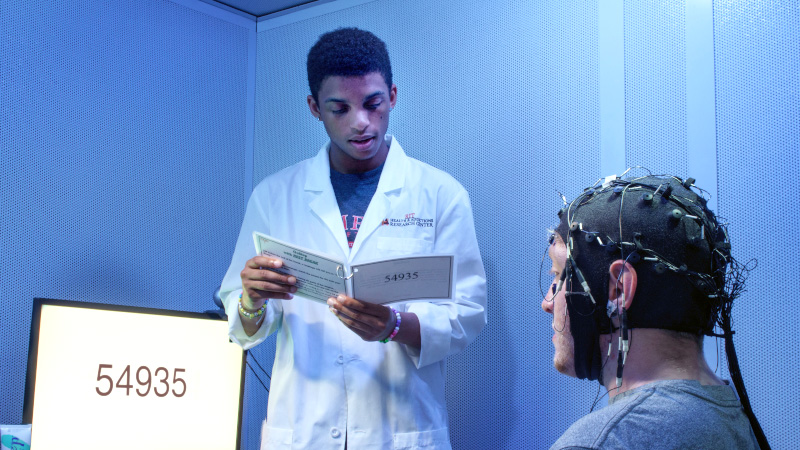
The turning point came when a professor invited her into the lab where he was conducting Electroencephalography (EEG) research related to autism.
"I just fell in love with research," she said. "That's more of a proactive way to ultimately help people and ideally solve problems more long-term."
She went on to earn her master's degree in neuroscience at San Diego State University, then built a career spanning post-traumatic stress disorder research; pediatric surgery research at Vanderbilt University while her husband, a member of the military, was stationed in Tennessee; and now trauma surgery research back in San Diego.
"The cool thing about research is that the scientific method doesn't change," she said. "It's really fun to look at all different types of research questions."
The case for liberal arts at a technology school
Ask Krzyzaniak how a liberal arts education prepared her for a career in medical research, and she doesn't hesitate.
"A big part of being able to think critically is to be able to communicate your thought process," she said. "I can have all this wonderful information, but if I'm not able to disseminate that in ways that are meaningful to other people, it doesn't end up making a difference in the long run."
She points to reading as a skill she considers inseparable from strong writing.
"In order to be a good writer, I firmly believe that you have to read," she said. "You're not going to have the vocabulary. You're not going to see the sentence structures in order to generate that yourself."
She also credits her liberal arts education with teaching her to problem solve across disciplines — "stealing like an artist," as she puts it, by applying what works in one field to another in a new way. "My experience at RIT was exceptional," she said, "so I definitely want to pay that forward."
About RIT’s bachelor’s and graduate degrees in psychology, neuroscience, and cognitive science >
About RIT nearly 20 labs and centers advances researching and discovery in psychology >
Apply to become a psychology student at RIT >
# # #
More Featured Profiles and Work
Felicia Swartzenberg