RIT engineering undergraduates collaborate with biomedical scientist to help improve healthcare therapies
Biomedical engineering Vertically Integrated Project engages students toward health research and careers
Scott Hamilton/RIT
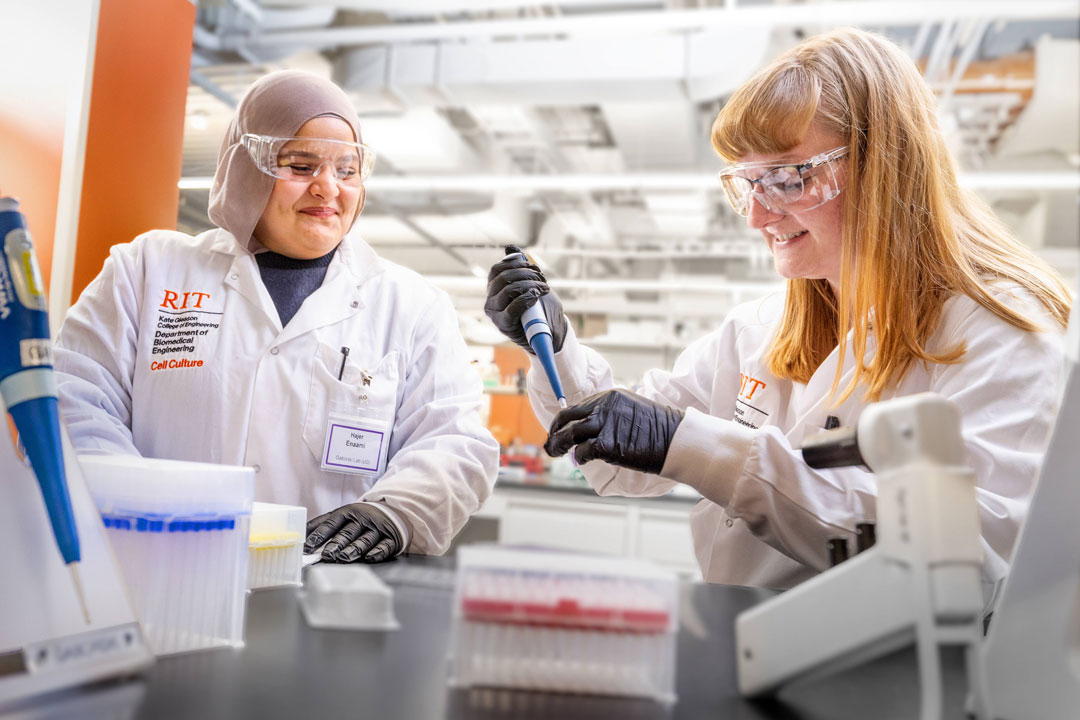
From left, students Hajer Enaami and Scarlett Jackson are experimenting with ways to separate extracellular vesicles and other nanoscale particles as a way to understand disease progression and cell behavior.
Undergraduate biomedical engineering students at Rochester Institute of Technology are collaborating with biomedical company scientists to explore how controlling cell particles can influence future diagnostic, biomanufacturing, and healthcare therapies.
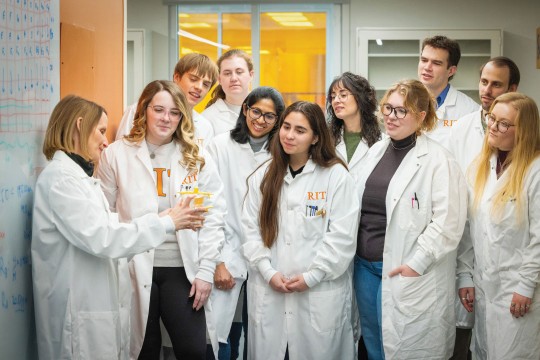
Scarlet Jackson and Hajer Enaami are helping their classmates solve some of those challenges leading two teams within the NanoBio Discovery Lab. The lab is part of RIT’s Vertically Integrated Projects (VIP) initiative, which provides broader research experiences for students. One of the initiative’s goals is to further RIT’s mission of involving students in complex research early in their academic careers. VIP creates another research opportunity for students beyond working with one faculty member and counts as an academic immersion.
Jackson and Enaami are coordinating presentations for the course that consists of 15 undergraduate students from RIT’s engineering, science, and computing colleges in the NanoBio Discovery Lab. They are leading weekly discussions of peer reviewed journal articles and managing lab experiments with Thomas Gaborski, department head of RIT’s biomedical engineering program.
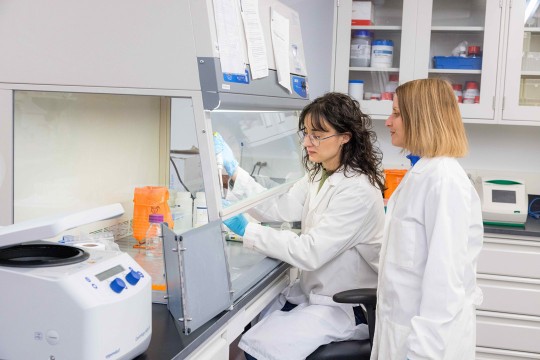
One of their projects is about isolating, purifying, and characterizing extracellular vesicles (EV) and other nanoscale particles in the lab. Gaborski is an expert in EVs and bio-separations. They also interact with Aslan Dehghani ’20 (microsystems engineering), the manager of nanoparticle technologies for Sartorius, and members of his research team to help the students develop industry-relevant skills and a research mindset. Sartorius is an international biopharmaceutical research and manufacturing company.
“I help connect the students, our work in the lab, and our partnership with Sartorius,” said Enaami.
Scott Hamilton/RIT Photography
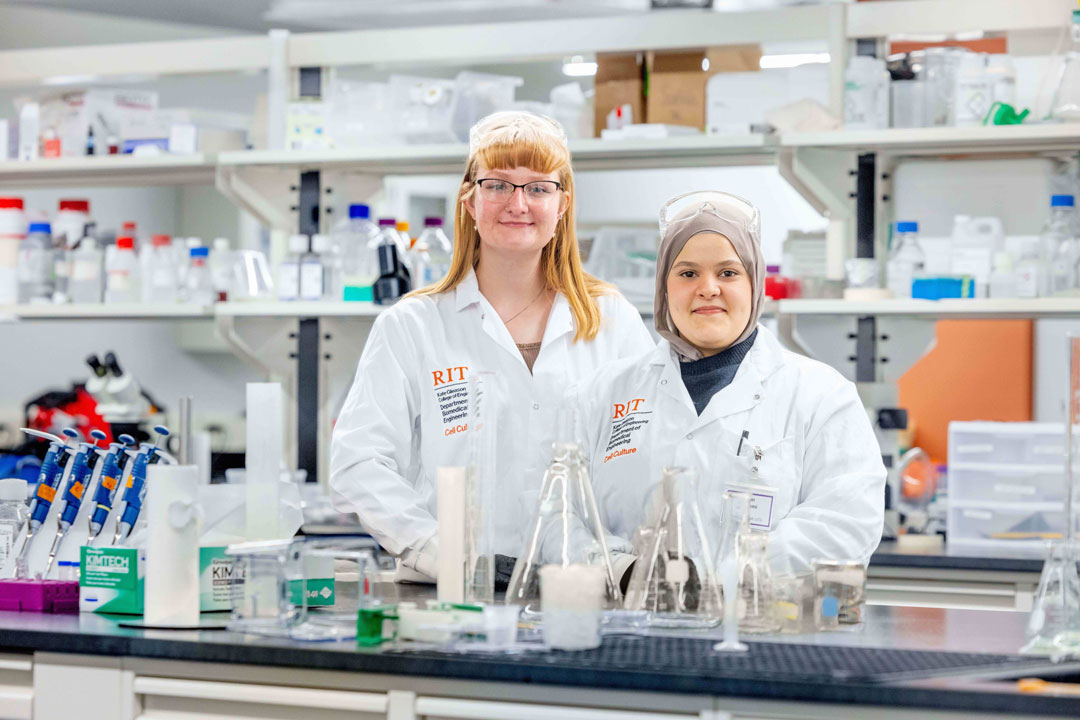
Biomedical engineering students, Scarlet Jackson, left, and Hajer Enaami are co-leading teams within the NanoBio Discovery Lab, one of RIT’s newest Vertically Integrated Projects initiative. The project provides complex, multidisciplinary research experiences for undergraduates.
EVs are nanoscale, membrane-enclosed particles released by cells. They carry proteins, lipids, and nucleic acids and play an important role in cell-to-cell communication. Understanding EV functions can determine how disease progresses or the ways they influence cell behavior to change the course of diseases. However, EVs are difficult to isolate and there are few standard methods to create reliable, well-documented, and scalable workflows to characterize the unique cells.
“This is different from a traditional course lab class. Academic research is extremely competitive,” said Jackson, a fifth-year student. She worked in the NanoBio Lab last semester investigating how antibiotic treatment influences bacterial EV production and properties, as well as how these EVs interact with host cells. “It is a big topic today, and there is a gap in the literature in trying to minimize the growth of bacteria. But that is an option that I only would have gotten through the NanoBio Discovery Lab.”
Enaami agreed. She transferred from Monroe Community College last year and quickly began to acquire the engineering and research lab skills through coursework and independent study in the lab. Enaami plans to pursue a master’s degree and is interested in a career in downstream bioprocessing and separations, with the possibility of moving into management in the future.
Both students wanted to continue the VIP course experience, and Gaborski interviewed them for the leadership positions.
“My overall goal is to be a professor,” said Jackson. “I wanted more of a leadership role and a teaching experience and found it through the lab.”
In addition to interacting with Sartorius scientists, students have access to Sartorius bioseparations consumables and technologies used in the biopharmaceutical industry. They are also mastering the meticulous experimental methods undertaken in research laboratories. The students are able to test and validate related processes as well as explore mew alternatives the company is seeking, said Gaborski.
“For some students, this is just the beginning,” Gaborski said. “They go on to National Institutes of Health and industry-funded co-op positions in our laboratory and others.”
Through this work, Jackson and Enaami are also positioning themselves for careers as professors and research scientists. Enaami would like a position as a manager in a corporate R&D lab after graduation. Jackson will complete her dual degree in biomedical engineering and public policy this May.