Accounting Bachelor of Science Degree

In RIT’s BS accounting degree, you’ll learn to determine an organization’s wealth, profitability, and liquidity as you guide short- and long-term financial business decisions.
$64.8K
Average First-Year Salary of RIT Graduates from this Accounting BS degree
#14
Best Accounting School in New York State
#59
Best Undergraduate Business Schools
2 in 5
Earn two degrees in five years with the accelerated BS/MS accounting degree
Overview for Accounting BS
Why Pursue an Accounting Bachelor’s Degree at RIT
Strong Career Paths: Network with professionals from the Big Four and regional accounting firms when you join RIT's student chapter of the Next Generation of Accountants.
Pursue Your CPA: Get started on the right path to completing specific requirements of the Certified Public Accountant (CPA) certification.
Alumni Relationships: Connect with Saunders alumni and key professionals through the Accounting Advisory Board.
Career Connections: Attend RIT’s accounting career fair to connect with representatives in finance and banking, and interview directly for open co-op and permanent employment positions.
Accelerated Bachelor’s/Master’s Available: Earn both your bachelor’s and your master’s in less time and with a cost savings, giving you a competitive advantage in your field.
Accountants are multidisciplinary professionals. They are responsible for determining an organization's overall wealth, profitability, and liquidity. Without accounting, organizations would have no foundation upon which daily and long-term business decisions could be made.
What is Accounting?
From technology and entertainment and travel and government, accounting is a key function to all businesses. It’s the collection, organization, and analysis of data that can reveal the financial state of a business. It can tell a company how well its products and services are performing, and if the products are making a profit. Financial data can help accountants make short- and long-term projections and estimate an organization’s tax liabilities. Accounting also helps an organization plan for its future. Short- and long-term profit projections can help guide an organizations’ growth and in which areas new employees will be needed. It can also help guide decision-making on which product lines to change and grow and which to downsize or eliminate. Accounting is essential to understanding which areas of your business are making money and which are not.
Explore RIT’s Accounting Degree Curriculum
RIT’s BS accounting degree covers financial and managerial accounting disciplines, while:
- Introducing you to the technology used within the profession
- Developing account management and service skills, using digital tools to communicate with, attract and retain clients.
- Exposing you to courses in the liberal arts, sciences, and management
- Leveraging our nationally ranked management information systems (MIS) major to give you the technical skills needed to design, operate, and control accounting information systems
Accounting Certifications: How to Become a CPA
The accounting bachelor’s degree starts you on the right path to completing specific requirements of the Certified Public Accountant (CPA) certification. Additional graduate work is required in order to fulfill New York State CPA exam requirements. Students who complete the 24-credit hour minimum at the bachelor’s degree level will need to complete at least nine credit-hours of graduate accounting courses in order to meet the requirements to sit for the exam. Students completing 30 undergraduate-level accounting credit hours may only need one graduate accounting course to meet NYS CPA exam eligibility rules.
While the CPA license is not required to work in the field of accounting it is highly recommended for students. Learn more about becoming a CPA, CPA requirements, the CPA Exam, and other certifications.
The BS accounting program prepares students for success, as demonstrated by CPA Exam passing rates for RIT students that are consistently above passing rates overall and for all New York state candidates.
Furthering Your Education in Accounting
RIT’s Combined Accelerated Bachelor’s/Master’s Degrees enable you to earn both a bachelor’s and a master’s degree in as little as five years, giving you a competitive advantage.
- The Accounting BS/Accounting and Analytics MS: In this accelerated dual degree, you'll combine a BS degree in accounting with an MS degree in accounting and analytics to gain a solid accounting background while enhancing your knowledge of the accounting technologies that will help you analyze an organization's data so you can gain significant insights, predict future outcomes, and ascertain risk.
- +1 MBA Early Acceptance Pathway: Successful RIT applicants who are offered admission into the accounting bachelor’s degree as an incoming first-year student may also be offered conditional early acceptance into the +1 MBA Early Acceptance Pathway. This option enables you to earn both your BS degree and an MBA in as little as five years of study. Learn how the +1 MBA Early Acceptance Pathway adds a competitive advantage to your studies.
- +1 MBA: Students who enroll in a qualifying undergraduate degree have the opportunity to add an MBA to their bachelor’s degree after their first year of study, depending on their program. Learn how the +1 MBA can accelerate your learning and position you for success.
-
Meet Us on Campus
Learn about academics, co-op and internships, financial aid, and more at one of our on-campus open houses.
October 12 | October 24 | November 14
-

Apply for Fall 2027
Early Decision I and Early Action deadlines are November 1.
-
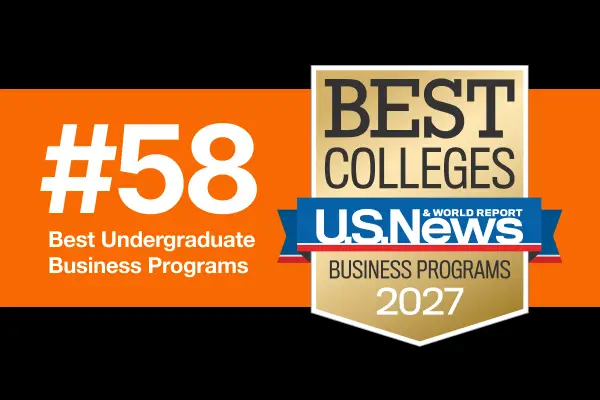
A National Leader in Business Education
RIT’s Saunders College of Business is among the best business schools in the nation for an undergraduate business degree, according to U.S. News & World Report.
Careers and Experiential Learning
Typical Job Titles
| Accountant | Auditor | Credit Card/Cashless Accountant |
| Financial Specialist | Junior Accountant | Senior Auditor |
| Tax Accountant |
Industries
Cooperative Education
What’s different about an RIT education? It’s the career experience you gain by completing cooperative education and internships with top companies in every single industry. You’ll earn more than a degree. You’ll gain real-world career experience that sets you apart. It’s exposure–early and often–to a variety of professional work environments, career paths, and industries.
Co-op takes your knowledge and turns it into know-how. Business co-ops provide hands-on experience that enables you to apply your knowledge of business, management, finance, accounting, and related fields in professional settings. You'll make valuable connections between course work and real-world applications as you build a network of professional contacts.
Students in the accounting BS are required to complete at least one cooperative education experience.
Accounting Career Fair
RIT’s Office of Career Services and Cooperative Education hosts an accounting-specific career fair that connects accounting majors with employers in finance and banking. During this day-long event, you’ll be able to network with company representatives and interview directly for open co-op and permanent employment positions.
Featured Work and Profiles
-

From Campus Leader to KPMG: Navigating the Future of Accounting
Ericka Chen ’26 "Other than my degree, I graduated with leadership experience, close friendships, and a network of professors, alumni, and peers who genuinely wanted to see me succeed. Those experiences taught me...
Read More about From Campus Leader to KPMG: Navigating the Future of Accounting -
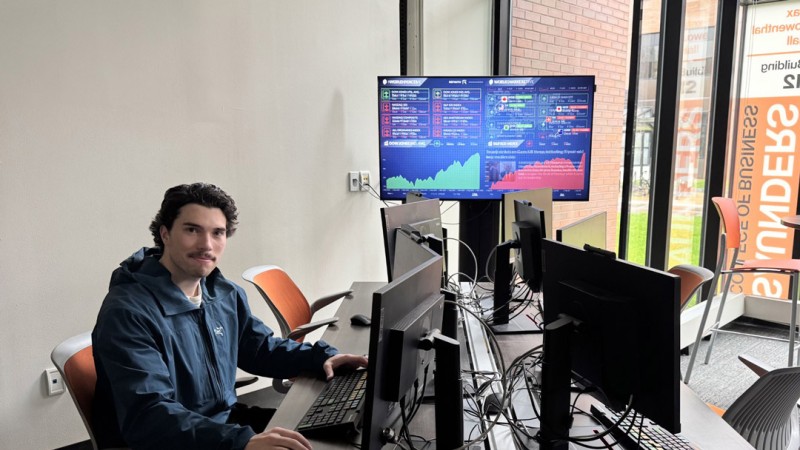
Hockey and finance set future path for Saunders graduate
Tyler Mahan ’26 Finance graduate Tyler Mahan has juggled a demanding academic and athletic career, leaving RIT with a choice between professional hockey and a career at Deloitte.
Read More about Hockey and finance set future path for Saunders graduate -

Leading with Vision at the Forefront of Global Finance
Jeannie Khaw ’95 "That breadth of experience, combined with a disciplined problem-solving approach and deep collaboration within and across teams, allowed me to guide the institution's financial operations and...
Read More about Leading with Vision at the Forefront of Global Finance -

Research Insights: Strength in numbers?
Sriniwas Mahapatro How co-CEOs can lead successfully—or not
Read More about Research Insights: Strength in numbers? -

From solving problems in courses to a network of faculty, alumni, and mentors, to a global co-op
Paphawarintr (Mind) Tienpasertkij, co-op ’21 "Saunders provides hands-on experiences that allow students to challenge themselves in order to solve business problems in the real world. Through my courses at Saunders, I have been able to...
Read More about From solving problems in courses to a network of faculty, alumni, and mentors, to a global co-op -

Enhancing Classroom Engagement and Career Success
Devren Purdie, co-op ’17 "My co-op with Wegmans was the best experience I have ever had in the workplace. Not only did it provide an exciting environment for learning, but it gave me skills that are transferable to my...
Read More about Enhancing Classroom Engagement and Career Success
Curriculum for 2026-2027 for Accounting BS
Current Students: See Curriculum Requirements
Admissions and Financial Aid
First-Year Admission
First-year applicants are expected to demonstrate a strong academic background that includes:
- 4 years of English
- 3 years of social studies and/or history
- 3 years of math is required and must include algebra, geometry, and algebra 2/trigonometry. Pre-calculus is preferred.
- 2-3 years of science
Transfer Admission
Transfer applicants should meet these minimum degree-specific requirements:
- A minimum of college algebra is required. Pre-calculus or calculus is preferred.
Financial Aid and Scholarships
100% of all incoming first-year and transfer students receive aid.
RIT’s personalized and comprehensive financial aid program includes scholarships, grants, loans, and campus employment programs. When all these are put to work, your actual cost may be much lower than the published estimated cost of attendance.
Learn more about financial aid and scholarships


Related News
-
July 20, 2026
Saunders Ranked #2 in New York State for MIS by College Factual, 2026
Saunders College of Business at RIT earned top statewide and national recognition in College Factual’s 2026 rankings, driven by world-class faculty leading the future of technology, data, and AI.
-
August 22, 2025

Traveling Tigers connects Saunders students with career opportunities
A program at Saunders College of Business is helping students gain real-world immersion into the careers they study.
-
July 9, 2025

RIT names three new members to university board
Human resources executive Jane Elliott, physician Brenda Haynes, and entrepreneur Chance Wright have been named to RIT’s Board of Trustees.
Contact

Saunders College of Business