Zoe Caggiano ’23 Found the ‘Why’ Behind Technology Through Humanities, Computing, and Design
For a career in wealth management, this RIT alumna says curiosity, communication, and a human-centered approach to technology paved the way.
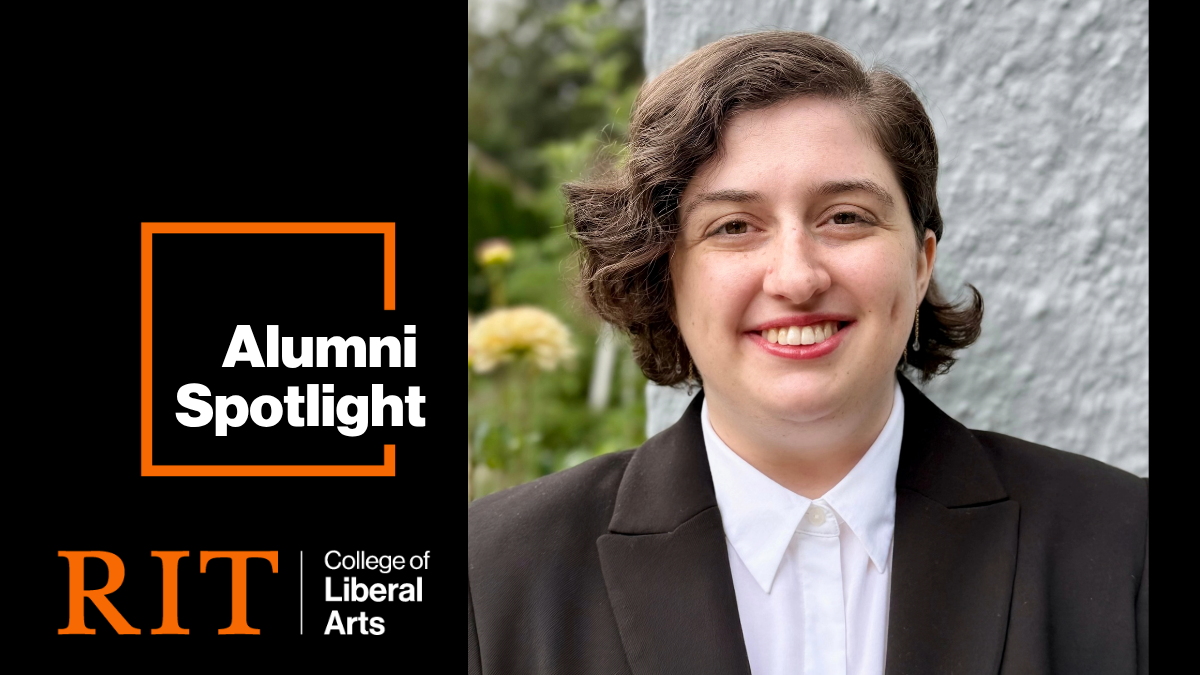
Zoe Caggiano ’23 didn’t arrive at RIT knowing she would study humanities. In fact, her path to the humanities, computing, and design (HCD) major included detours through engineering and packaging engineering before she discovered a field that brought together the things she was most curious about.
“I kind of fell into HCD,” Caggiano said. “And I just loved it so much.” What stood out was the program’s ability to examine technology through a human lens.
“The humanities aspect of technology is something that I think really sets you up for success in a way that just focusing on technology doesn’t. It gives you the ‘why’ of tech,” said Caggiano.
That emphasis on understanding people, systems, ethics, communication, and the broader context surrounding technology became increasingly valuable as Caggiano moved beyond RIT. “Communication’s the bedrock of everything,” she said. “It’s the bedrock of human understanding. If you cannot communicate with the people around you, you are at a disadvantage.”
Coursework for her HCD major encouraged her to question how and why systems operate, recognize bias, understand different perspectives, and distill complex information into what matters most. Those abilities, she said, have proven applicable far beyond the classroom.
From HCD to a Career
After graduating, Caggiano returned to her hometown of Chicago. Her early career didn’t follow a perfectly linear path, however, eventually landing a job in library makerspace let her build on one of her most meaningful experiences at RIT—working at The Construct. Originally launched as The Construct, the makerspace was a student‑driven hub for hands-on making, prototyping, and creative experimentation. It has since been incorporated into the SHED Makerspaces.
That role further developed her skills in teaching, providing service, solving problems under pressure, and working with people when tensions were high, experiences that ultimately prepared her for her current work at Morgan Stanley in wealth management.
“Wealth management is finance, but it’s relationships,” Caggiano said. “It is a communications job in a finance field.” While financial knowledge is important, she said the work also requires earning clients’ trust, understanding their needs, and communicating in ways that make complex decisions understandable. “Can I convince someone that I am the person they should trust with their future?” she said. “Because that’s what money is. It’s someone’s future.”
Liberal Arts Strengths Create Connections
For Caggiano, that is where the connection between her liberal arts education and her career becomes especially clear. Building trust requires more than knowing numbers. It requires communication, empathy, critical thinking, and what she describes as a service mindset: asking, “How can I help you?”
Caggiano also credits several people at RIT with helping shape her experience, particularly Jessica Lieberman, who was the chair of the HCD program at the time. “I don’t think I would have finished college if it weren’t for her,” Caggiano said. “She deeply cares about everyone in her department, and she wants them to succeed in the way they want to succeed.”
She also remembers faculty members whose enthusiasm encouraged her to investigate subjects she otherwise might have overlooked. One course in ancient technology led her to write a 20-page paper examining fiber lengths and spinning practices across cultures—an assignment she remembers less for the subject itself than for the curiosity it encouraged.
Her experience at The Construct reinforced that lesson as well. She credits former supervisor Michael Buffin with modeling what good leadership could look like by treating student employees as colleagues and giving them meaningful responsibility.
Advice for RIT Students
Looking back, Caggiano believes curiosity remains one of the most important things students can bring to their education.
“My best advice for anyone in college is do what you’re curious about,” she said. “Don’t try to play to what you think the market wants because the market will change.”
Instead, she encourages students to follow the subjects and questions that genuinely interest them—and to recognize that communication skills have become increasingly valuable as technology continues to reshape the workplace.
“In the age of AI and technology, human-to-human conversation and communication is more valuable than ever,” Caggiano said. “It’s something that will never fail you.”
Learn More
Your future doesn’t have to fit into a single box, and your major shouldn’t either. That’s the idea behind Humanities, Computing, and Design (HCD)—a uniquely RIT interdisciplinary major for students who want the freedom to explore multiple interests and multiple ways of solving problems.
HCD draws from RIT’s strengths in computing, creative design, and the humanities, giving you the opportunity to build a highly customizable education around what you want to do next develop expertise in your choice of career paths.
- Read more about the Humanities, Computing, and Design (HCD) major
- Read about potential careers that start with an HCD degree
- Read about how to change your major to a College of Liberal Arts program like HCD
- Future RIT students, find out how to apply