Physics Master of Science Degree

Overview for Physics MS
STEM-OPT Visa Eligible: The STEM Optional Practical Training (OPT) program allows full-time, on-campus international students on an F-1 student visa to stay and work in the U.S. for up to three years after graduation.
Advance your knowledge in core areas of physics, including electrodynamics, quantum, classical mechanics, and statistical physics.
Gain research and technical skills while tailoring the program to your personal career interests.
Develop professional skills in leadership, managing research teams, promoting innovation or sustainable technologies, entrepreneurship and intellectual property, and more.
RIT’s Physics MS: Explore Advanced Physics Your Way
A physics master’s prepares you for a variety of professional opportunities. Whether your interests are in quantum mechanics or studying the entire universe with general relativity, you can gain the research and technical skills needed to achieve your career goals.
Students in RIT’s physics MS program are trained in the core areas of physics and can choose sub-areas of physics that align with their interests and career aspirations. Sub-areas may include: atomic, molecular, and optical physics; computational physics; lasers; modern and quantum optics; nanoscale physics; physics education research; radiation, scattering, and spectroscopy; relativity and gravitation; solid-state, materials, and device physics; and soft matter and biological physics.
At RIT you don’t just study these areas, you work directly with faculty conducting research. The School of Physics and Astronomy conducts millions of dollars in research annually in experimental, theoretical, applied, and computational physics. Gain hands-on experience and put your knowledge into practice with access to our labs and equipment and as part of our strategic research centers.
You will also develop professional skills in organization and leadership, managing research teams, promoting innovation or sustainable technologies, entrepreneurship and intellectual property, finance and accounting, data science, scientific visualization, electronics, STEM pedagogy and education research, public policy, and communication. The RIT physics master's program offers robust, advanced training in a flexible format that allows you to meet your personal career goals.
Research Centers
Students and faculty researchers collaborate in our strategic research centers:
- Center for Computational Relativity and Gravitation
- Center for Detectors
- Future Photon Initiative
- Laboratory for Multiwavelength Astrophysics
Labs and Equipment
Students in the physics MS have access to an extensive range of equipment and labs:
- Atomic-Scale Microscopy Laboratory
- Granular Materials Laboratory
- Iontronics and Nanoelectronics Laboratory
- Laboratory for Complex and Biological
- Fluid Studies
- Laboratory for Experimental Cosmology
- Laser Light Scattering Equipment
- Materials Laboratory
- Nanopower Research Laboratories
- Quantum Optics/Imaging Laboratory
- RIT Observatory
- Supercomputer Clusters
- X-Ray and Surface Science Laboratory
Careers in Physics
Nationally, graduates of the program are in demand across all economic sectors, spanning a wide variety of exciting opportunities within the private sector (especially in engineering and computer/information technology), in government labs and agencies, and in education at both the university and secondary levels.
-
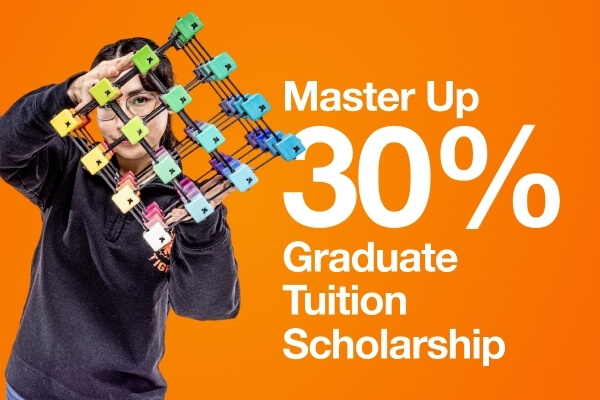
Affordable Now. Valuable for Life.
Earn your master’s degree without the full price tag. With Master Up you can receive a 30% tuition scholarship for an RIT master’s degree.
-

Don't Delay Your Ambitions Until the Fall
This program offers a spring start, which means you can jumpstart your graduate journey and begin your studies this January.
-
Discover how graduate study at RIT can help further your career objectives.
Virtual Admissions Webinars | Recordings available
Virtual Academic Sessions | October 20 - October 29
On-Campus Open House | November 20
Careers and Cooperative Education
Typical Job Titles
| Optical/Photonics Scientist | Instrumentation and Device Engineer | Quantum Research and Development Scientist |
| Radiation and Detector Physicist | Computational Physicist |
Cooperative Education
What makes an RIT science and math education exceptional? It’s the ability to complete science and math co-ops and gain real-world experience that sets you apart. Co-ops in the College of Science include cooperative education and internship experiences in industry and health care settings, as well as research in an academic, industry, or national lab. These are not only possible at RIT, but are passionately encouraged.
What makes an RIT education exceptional? It’s the ability to complete relevant, hands-on career experience. At the graduate level, and paired with an advanced degree, cooperative education and internships give you the unparalleled credentials that truly set you apart. Learn more about graduate co-op and how it provides you with the career experience employers look for in their next top hires.
Featured Work and Profiles
-

RIT Physics MS: Exploring Different Interests for Ph.D. Research
The physics MS degree helped Vijay Sundaram ‘21 explore different fields of interest. Now he’s a Ph.D. student in the Microsystems Engineering program using Integrated Photonics for Quantum...
Read More about RIT Physics MS: Exploring Different Interests for Ph.D. Research -

Physics MS Program: Research From Day One
The opportunity to research from day one was a deciding factor for Aasim Jan ‘21 to enroll in the physics MS program at RIT.
Read More about Physics MS Program: Research From Day One
Curriculum for 2026-2027 for Physics MS
Current Students: See Curriculum Requirements
Students are also interested in
Admissions and Financial Aid
This program is available on-campus only.
| Offered | Admit Term(s) | Application Deadline | STEM-OPT Visa Eligible |
|---|---|---|---|
| Full‑time | Fall; Spring may be considered | Fall - February 15 priority deadline, rolling thereafter; Spring - rolling | Yes |
| Part‑time | Fall; Spring may be considered | Rolling | No |
Full-time study is 9+ semester credit hours. Part-time study is 1‑8 semester credit hours. International students requiring a visa to study at the RIT Rochester campus must study full‑time.
Application Details
To be considered for admission to the Physics MS program, candidates must fulfill the following requirements:
- Complete an online graduate application.
- Submit copies of official transcript(s) (in English) of all previously completed undergraduate and graduate course work, including any transfer credit earned.
- Hold a baccalaureate degree (or US equivalent) from an accredited university or college in physics, applied physics, or a closely-related discipline within the physical/mathematical sciences or engineering fields. A minimum cumulative GPA of 3.0 (or equivalent) is recommended.
- Submit a current resume or curriculum vitae.
- Submit a personal statement of educational objectives.
- Submit two letters of recommendation.
- Entrance exam requirements: GRE optional but recommended
- Submit English language test scores (TOEFL, IELTS, PTE Academic, etc.), if required. Details are below.
English Language Test Scores
International applicants whose native language is not English must submit one of the following official English language test scores. Some international applicants may be considered for an English test requirement waiver.
Duolingo (DET): 140
IELTS: 7.5
LanguageCert Academic: 84
PTE Academic: 76
TOEFL: 100/5.5
International students below the minimum requirement may be considered for conditional admission. Deaf and hard-of-hearing test takers with significant hearing loss do not need to take the listening and speaking sections for the TOEFL and IELTS. Each program requires balanced sub-scores when determining an applicant’s need for additional English language courses.
How to Apply Start or Manage Your Application
Cost and Financial Aid
An RIT graduate degree is an investment with lifelong returns. Graduate tuition varies by degree, the number of credits taken per semester, and delivery method. View the general cost of attendance or estimate the cost of your graduate degree.
A combination of sources can help fund your graduate degree. Learn how to fund your degree


Research
Exceptional Physics Research
The College of Science consistently receives research grant awards from organizations that include the National Science Foundation, National Institutes of Health, and NASA, providing graduate students with unique opportunities to conduct cutting-edge research with RIT’s world-class faculty.
Faculty in the School of Physics and Astronomy conduct research on a broad variety of topics in experimental, theoretical, applied, and computational physics–all areas in which you may pursue research and thesis work. Learn more about our physics research or explore our physics faculty areas of research. You also may explore research opportunities in related programs such as our microsystems engineering Ph.D., imaging science MS, or imaging science Ph.D.
Related News
-
April 7, 2026
RIT’s graduate programs ranked among the best by ‘U.S. News & World Report’
Seventeen graduate degree programs at Rochester Institute of Technology and the graduate schools in business and engineering are among the best in the nation, according to U.S. News & World Report’s annual rankings.
-
November 19, 2025
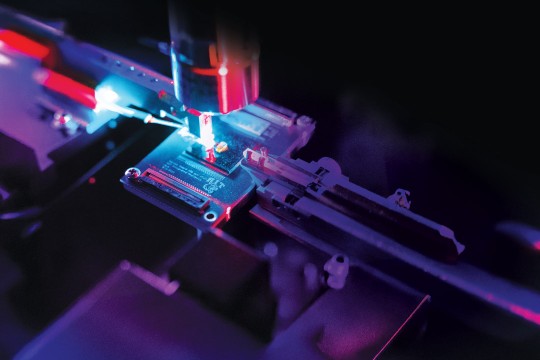
Manifesting quantum: How RIT researchers are navigating the next frontier of physics
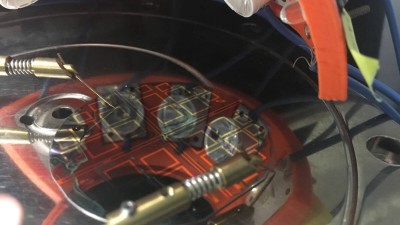
RIT researchers are zeroing in on quantum photonics, the creation, control, and detection of light. Photonics has long been a specialty of the university. RIT led the team that developed the first quantum photonic wafer, which is key to the future of mass-produced quantum communication systems.
-
May 6, 2025
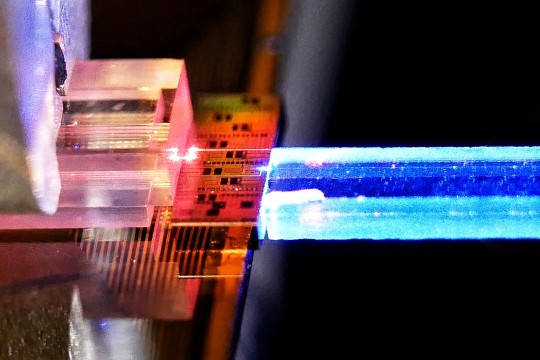
RIT and University of Rochester develop experimental quantum communications network
Researchers at RIT and University of Rochester recently connected their campuses with an experimental quantum communications network using two optical fibers. The Rochester Quantum Network (RoQNET) uses single photons to transmit information about 11 miles along fiber-optic lines at room temperature using optical wavelengths.
