RIT key partner in $15 million award to establish a national laser technology hub
The NSF Engine award will be matched by $16 million in New York state support
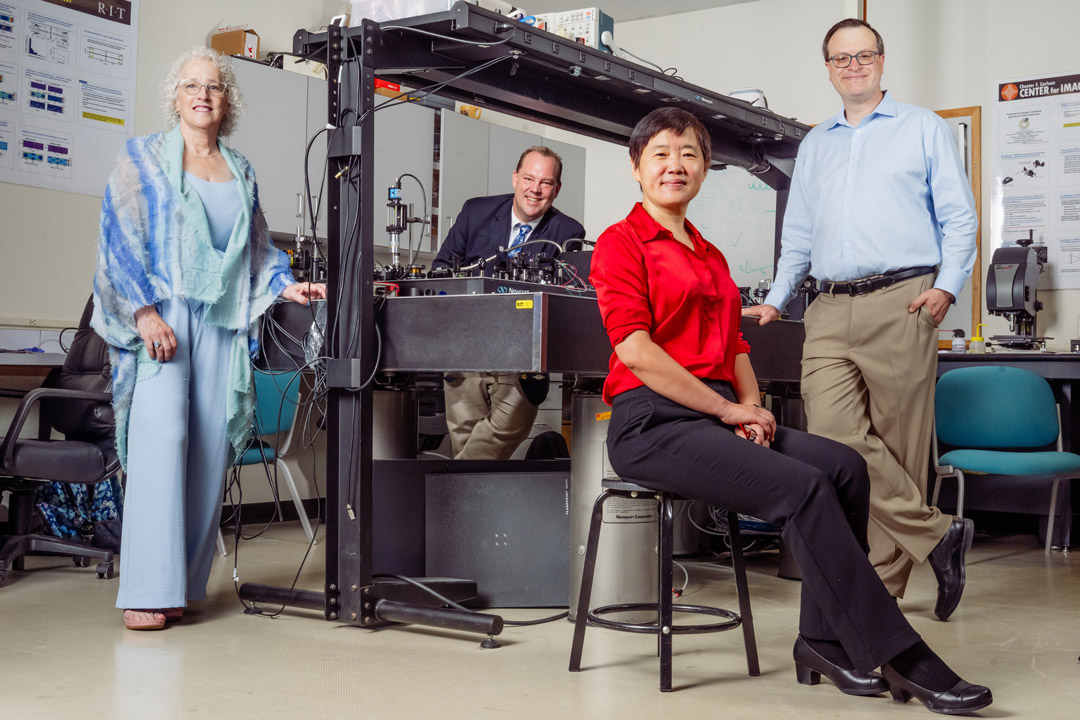
Liam Myerow/RIT
From left to right, RIT researchers Linda Bryant, Seth Hubbard, Jie Qiao, and Stefan Preble are part of the NSF Engine STELLAR group that brings $15 million in federal funding to the Rochester region to bolster a national laser technology hub.
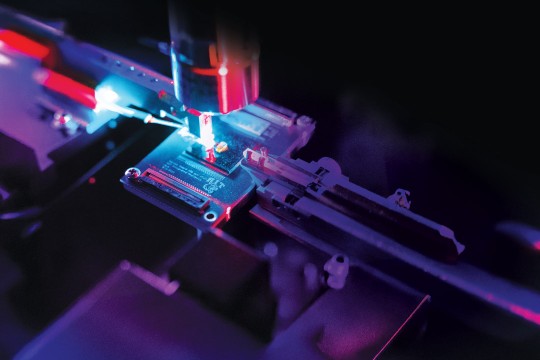
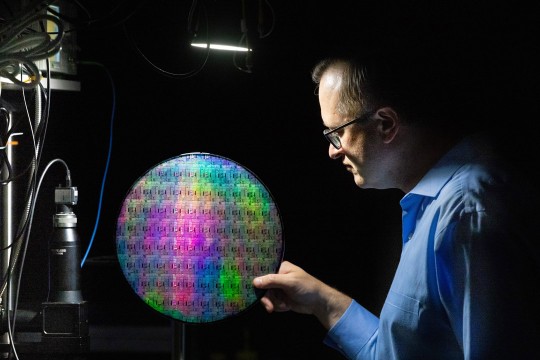
The National Science Foundation (NSF) will award $15 million over the next two years to the Rochester/Finger Lakes region of New York to establish a national hub for laser science and development. RIT is a key partner in the initiative.
The award, matched by $16 million in New York state support over the next six years, will establish an internationally competitive technology and innovation cluster in the region focused on laser technologies, education, company creation, manufacturing, and workforce development.
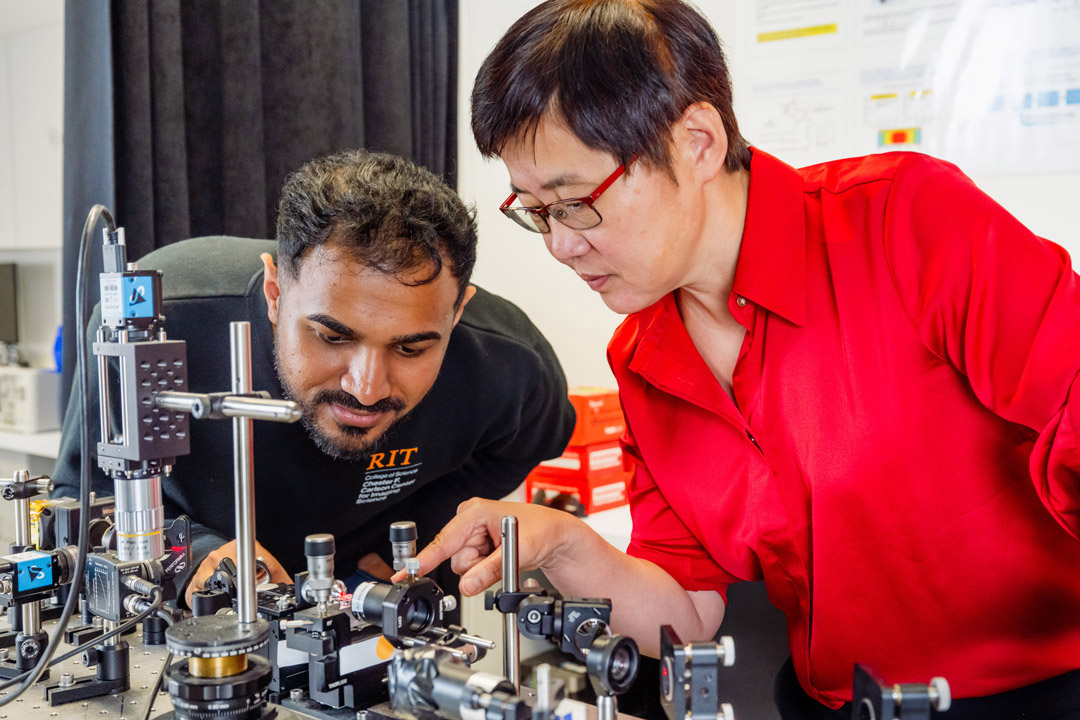
Liam Myerow/RIT
A goal of the NSF Engine STELLAR program is to educate and build a stronger workforce in laser technologies. Students, like RIT imaging science Ph.D. student Muhammad Akif Qadeer, left, receive hands-on learning on ultrafast laser enabled optical fabrication and integrated photonics in Professor Jie Qiao’s Advanced Optical Fabrication, Instrumentation, and Metrology Laboratory.
An estimated $16 trillion global marketplace depends on lasers for everything from smartphones to national defense but is increasingly based overseas. The STELLAR (Science, Technology and Engineering for Laser and Laser Applications Research) project will bolster laser production domestically.
Along with RIT, the project’s key partners include the Institute of Optics and Laboratory for Laser Energetics at the University of Rochester, the project lead; Monroe Community College, NextCorps Luminate, Greater Rochester Enterprise, AmeriCOM, and New York state. In addition, more than 90 organizations including industry, higher education, startups, state and local government, venture capitals, and not-for-profits have offered collaboration and support of the initiative.
“Laser technology powers everything from advanced manufacturing and communications to national security and healthcare,” said RIT President Bill Sanders. “This award positions the Rochester region to build on its legacy of innovation while strengthening America's competitiveness in one of the world's most important technologies. RIT is honored to join our partners in creating a national hub for laser research, education, entrepreneurship, and workforce development. Together, we are expanding opportunities for students, advancing discoveries that matter, and helping ensure that the emerging technologies shaping the future are developed right here.”
Faculty-researchers involved in the initiative from RIT are Stefan Preble, the Bausch and Lomb Professor in Microsystems Engineering; Linda Bryant, director of the National Technical Institute for the Deaf’s (NTID) Learning Consortium which includes NTID Online Initiatives and NTID Center for Workforce Development; Seth Hubbard, head of the School of Physics and Astronomy; and Jie Qiao, associate professor in the Chester F. Carlson Center for Imaging Science.
Preble is on the STELLAR leadership team as a co-principal investigator. He is an expert in photonic integrated circuits. Bryant brings her experience to help bolster the education facet of the project. Hubbard is also a faculty member in the microsystems engineering Ph.D. program and is a lead researcher in the growth, fabrication, and characterization of photovoltaic devices. Qiao leads the Advanced Optical Fabrication, Instrumentation, and Metrology Laboratory at RIT.
“Through STELLAR, we will drive the next era of innovation in laser technologies and their applications,” said Preble. “By leveraging Rochester’s and RIT’s leadership in optics, photonics, imaging, semiconductor, and microelectronic research and education, and working closely with our partners, we will advance transformative laser-enabled technologies and develop the skilled workforce needed to maintain our region’s position as a global leader.
A national investment rooted in Rochester’s strengths
The Rochester and Finger Lakes region is already home to more than 150 optics, photonics, imaging, and laser supply-chain companies, as well as institutions and facilities that are national leaders in the field. These include:
- URochester’s Institute of Optics, the nation’s premier program for education and research in optics, photonics, imaging, and laser science, founded nearly 100 years ago, and URochester’s Laboratory for Laser Energetics, site of Nobel-prize winning research and home to the largest—and among the most powerful—lasers in academia.
- RIT’s Chester F. Carlson Center for Imaging Science, which created the nation’s first imaging science program, and the Semiconductor Nanofabrication Laboratory, which houses a class 1000 cleanroom facility with a complete equipment set for the fabrication of semiconductor, laser, and photonic devices. RIT is also home to the nation’s first BS and MS degree programs in microelectronic engineering, and the nation’s first Ph.D. program in microsystems engineering.
- Monroe Community College, home to the nation's first community college optical systems technology program and a national leader in helping establish optics programs at other community colleges, including SUNY Corning Community College.
- Companies and organizations such as L3Harris, Corning, Optimax Systems, Inc., TOPTICA Photonics, Inc., and AIM Photonics that manufacture high-precision optics in aerospace, defense, and semiconductor industries.
Laser products are essential in a wide range of fields, including manufacturing, communications, inspection, environment sensing, defense, and security systems. While the laser was first theorized and demonstrated by American scientists and engineers, STELLAR’s organizers say the U.S. risks falling behind China and Europe in the critical technology without serious, sustained attention.
Liam Myerow/RIT
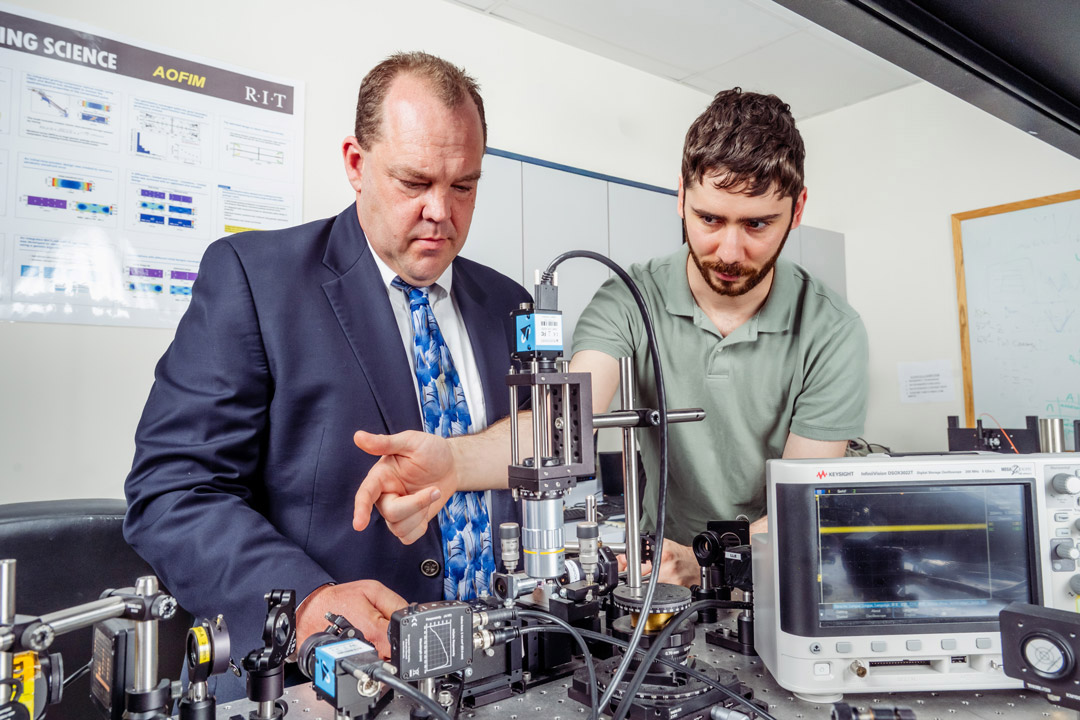
RIT’s Head of the School of Physics and Astronomy Seth Hubbard, left, is a program faculty member in both the materials science master’s degree program and the microsystems engineering Ph.D. program. As a member of the NanoPower Research Laboratory at RIT, his breakthrough interdisciplinary research helps scholars like imaging science Ph.D. student Derek Oliwa, right, prepare for the future workforce.
The manufacturing and packaging of lasers are increasingly being carried out overseas. At the same time, there’s a shortage of skilled workers in the optics and photonics industry, according to SPIE, the international society for optics and photonics. Through the NSF Engines program, STELLAR’s leaders aim to bring New York laser research, development, and manufacturing to a scale that can compete globally.
“NSF Engines investments in critical technologies and future industries will transform America’s innovation infrastructure for decades to come," said Brian Stone, performing the duties of the NSF director. “The NSF STELLAR Engine will strengthen U.S. competitiveness in global markets by advancing lasers and laser application research for manufacturing, defense, communication and healthcare.
Project leaders began formally planning STELLAR in 2023, when NSF awarded a $1 million Regional Innovation Engines Development Award grant. The project was ultimately selected from a process that began with nearly 300 letters of intent.
The Rochester/Finger Lakes coalition is one of the newest 12 U.S. teams across 20 states to receive NSF Regional Innovation Engines (NSF Engines) funding
The NSF Engines program is intended to build and scale new innovation clusters that accelerate the development of critical technologies and grow regional economies nationwide. The initiative has the potential to eventually receive up to $160 million over the next decade.
“This is a tremendous moment for the University of Rochester, our region, and the American public,” said URochester President Sarah Mangelsdorf. “Through this rigorous proposal process, our regional leaders have demonstrated that we have the talent and the teamwork needed to reposition our nation at the forefront of laser research, development, and manufacturing.
““We are grateful to the National Science Foundation for recognizing this special ecosystem of innovation in Greater Rochester,” said Sanders. “In addition, we thank our congressional delegation and the state of New York. This includes Senator Schumer, Senator Gillibrand, Representative Morelle, Representative Langworthy, Representative Tenney, and Governor Hochul for sharing in this vision and incredible support.”
Government leaders voice their support
US Senator Charles Schumer:
“With this whopping $15 million National Science Foundation award, the future is bright for research, development, and manufacturing of cutting-edge laser technology in Rochester, the Finger Lakes, and Southern Tier – led by the University of Rochester. I created the NSF Regional Innovation Engines program in my CHIPS & Science Law with Upstate NY’s world-renowned universities, world-class workforce, and innovation ecosystem in mind. The Rochester-Finger Lakes region has a proud history of excellence and innovation in optics, photonics, imaging, and lasers and will lead the charge to increase the domestic laser research and manufacturing so critical to America’s global competitive advantage. I will continue to be laser-focused on delivering new federal investment to advance this cutting-edge work.”
US Senator Kirsten Gillibrand:
“The University of Rochester is a deserving recipient of this award, and I couldn’t be more proud to see the STELLAR Engine recognized in the NSF Regional Innovation Engines competition. The Rochester-Finger Lakes region has long been a hub of optical technology and advanced manufacturing, and this award—up to $160 million over the next decade—builds on that proud legacy. Laser technologies are critical to both manufacturing and national defense, and STELLAR strengthens the Buffalo-Rochester-Syracuse Tech Hub designation I was proud to fight for.”
Congressman Joe Morelle:
“Rochester has always been a place where big ideas become real-world breakthroughs, and today’s announcement is another exciting chapter in that story. This investment will help create good-paying jobs, grow our local economy, and give more students and workers the opportunity to build careers right here in our community. I was proud to help secure funding for the NSF Engines program that made investments like this possible, and I congratulate the University of Rochester, the National Science Foundation, Governor Hochul, and all our partners for coming together to cement Rochester's place as a global leader in laser technology.”
Congresswoman Claudia Tenney:
“The National Science Foundation’s selection of STELLAR is tremendous news for the Finger Lakes and all of Upstate New York. Earlier this year, I wrote to NSF in support of this proposal because I knew our region had the talent, research institutions, and industry partnerships to lead in laser and photonics innovation. This investment will strengthen advanced manufacturing, expand workforce development, and create new opportunities for businesses and workers across our region. Congratulations to the University of Rochester, NextCorps, and the entire STELLAR partnership on this well-deserved achievement.”
Congressman Nick Langworthy:
“This is outstanding news for the University of Rochester and our entire region. I was proud to strongly support the University’s application because I knew this investment would build on their world-class leadership in optics and laser technology while creating new opportunities for innovation, manufacturing, workforce development, and good-paying jobs. The STELLAR Engine will help strengthen America’s technological edge, bolster our national security, and ensure this region remains at the forefront of the next generation of advanced manufacturing. Congratulations to President Mangelsdorf, Dr. Tom Brown, and the entire coalition of partners who worked tirelessly to make this vision a reality.”
NextCorps President James Senall:
“True innovation in laser and optics technologies requires an intentional ecosystem in order to thrive. NextCorps is eager to help founders commercialize these breakthrough laser technologies and bring them to market. By building this regional capacity, we are ensuring that brilliant scientific ideas are successfully transitioned into powerful commercial solutions and transformative economic impact.”
Monroe Community College President DeAnna R. Burt-Nanna:
“Monroe Community College is proud to join our partners in launching the NSF STELLAR Engine and in strengthening Rochester’s legacy as a global leader in optics, photonics, and laser technologies. As the home of the nation’s first community college optical systems technology program, MCC understands that breakthrough innovation depends on a highly skilled workforce. This NSF investment will expand opportunities for students, strengthen career pathways, and help ensure that employers across our region and nation have the talented technicians needed to drive the next generation of discovery, manufacturing, and economic growth.”
Greater Rochester Enterprise President and CEO Matt Hurlbutt:
“The Greater Rochester, NY region is the ideal place for the United States National Science Foundation to invest in a laser hub. Rochester is the home of leading research universities, talent development, and outstanding optics, photonics, imaging, and laser companies that lead global innovation. The NSF STELLAR Engine will spur research and development and enhance the United States’ ability to lead next generation technologies that support critical industries and solve global challenges. Greater Rochester Enterprise is committed to supporting the STELLAR effort by increasing collaboration among key stakeholders to attract more private investment and job creation across the entire region.”