RIT science professor wins award for excellence in teaching
Christina Goudreau Collison earns 2026 James Norris Flack Award for Outstanding Teaching in Chemistry recognizing goal to make chemistry accessible to all students
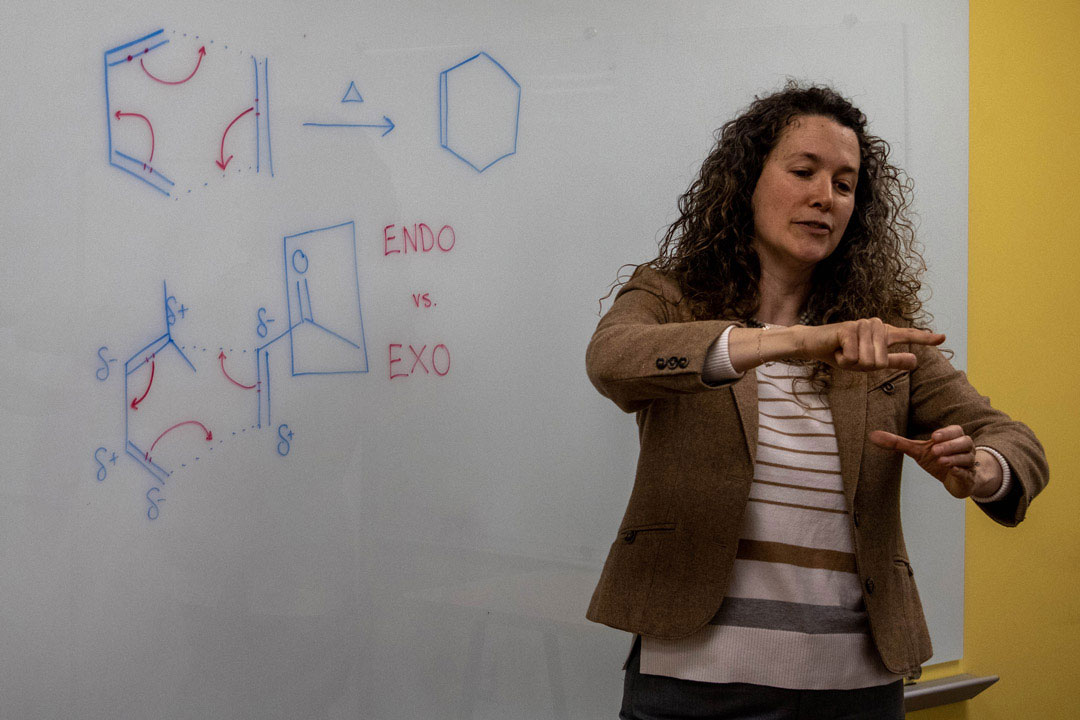
Ryan Colburn ‘26
Tina Goudreau Collison has incorporated sign language into chemistry education, among other initiatives, to help all students learn and understand complex topics. Her efforts have resulted in awards for teaching.
Rochester Institute of Technology (RIT) Professor Christina Goudreau Collison’s long-term plan entering college was to study science and go to medical school. But as she became aware of different opportunities, her path shifted.
Micaela Nelson ‘20
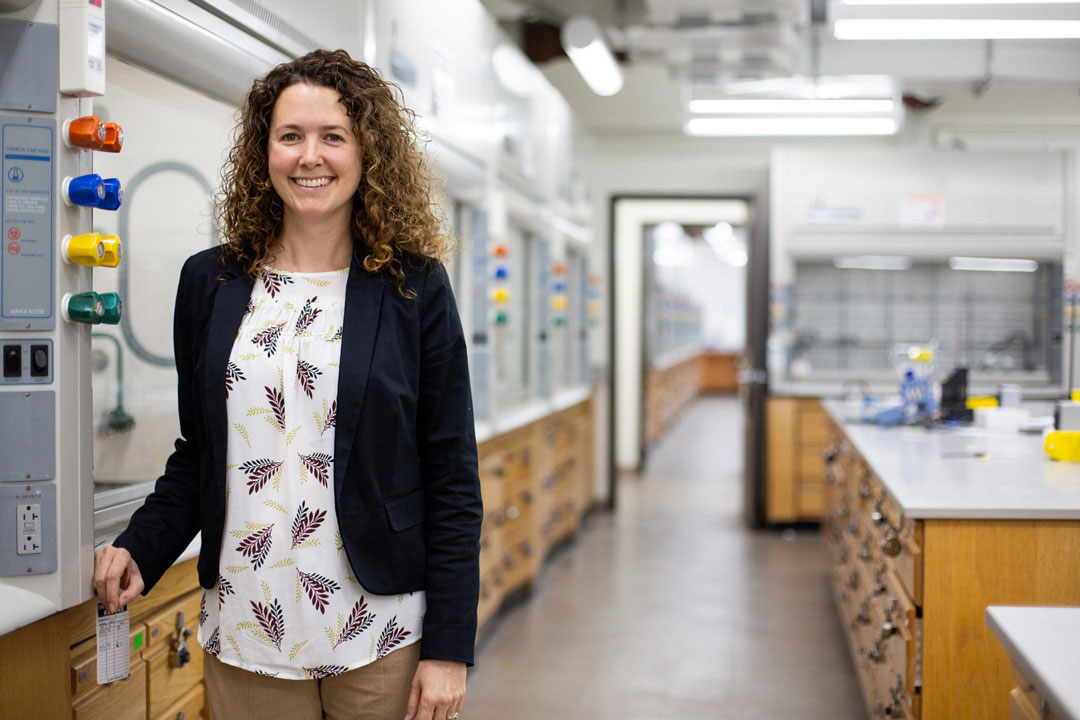
Goudreau Collison is shown in her lab on RIT’s campus. She has focused her career on chemistry education, including creating reformed experimental activities in the lab.
She feels fortunate for taking the steps that landed her where she is now, a leader in chemistry education within RIT’s School of Chemistry and Materials Science. Her efforts in providing a better education for students have been noticed. She was named the recipient of the 2026 James Flack Norris Award for Outstanding Achievement in the Teaching of Chemistry by the Northeastern Section of the American Chemical Society (NESACS). She also earned the 2026 Centennial Award for Excellence in Undergraduate Teaching from Iota Sigma Pi, the National Honor Society for Women in Chemistry.
“I never thought I would ever write a textbook for organic labs. I never thought I would start learning sign language and study the impacts on teaching organic chemistry,” said Goudreau Collison. “Those were unexpected products, like many a lab experiment. It’s the surprise discovery, the one you didn’t plan for, that ends up being the most successful.”
As a first-generation college student years ago, Goudreau Collison had only ever identified scientists as doctors, so she chose the pre-med route. She enjoyed her organic chemistry class and began doing research, shifting her attention away from medical school. Eventually, she realized she wanted to teach at the university level, which led her to pursue a Ph.D. in organic synthesis.
Goudreau Collison was hired in 2003 at RIT, where she continues to evolve the methods to meet the needs of students. About a decade into her career, she rewrote a lab with colleague Jeremy Cody to make it more student-guided, teaching concepts using an engaging, scaffolded approach. That led to the publication of a paper that received a lot of positive feedback from professors from other institutions asking for more.
That experience introduced her to the field of chemistry education and set her down the path to co-write a textbook and to receive grants from the National Science Foundation to redesign how to teach organic chemistry.
“I couldn’t have planned for the research projects I’m working on now,” she said. “You start with one set of goals, but if you are paying attention, you may find that pivoting toward a new goal will be more impactful. I feel lucky that I was paying attention.”
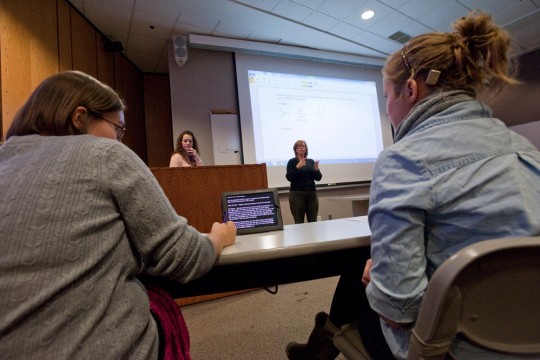
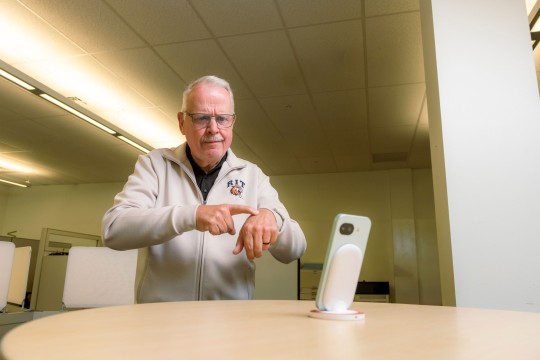
Goundreau Collison launched Reformed Experimental Activities (REActivities) in 2017 and then started noticing another area where she could help students. Her National Technical Institute for the Deaf College of Science support faculty member, Jennifer Swartzenberg, alerted her that there were gaps to the STEM language in ASL. From that awareness, the Sign Language Incorporation in Chemistry Education (SLICE) project was born.
The NESACS Norris Award, which honors the memory of former Massachusetts Institute of Technology professor James Flack Norris, recognizes dedicated teachers of chemistry at any level whose efforts have had a wide-ranging effect on chemistry education. Goudreau Collison has continued to evolve in her career to make sure the needs of students are met, and learning is made more accessible and inclusive for all.
The SLICE team was awarded the Royal Society of Chemistry’s Inclusion and Diversity Prize in 2022 and a NSF grant in 2023. Goudreau Collison was a recipient of RIT’s Eisenhart Award for Outstanding Teaching in 2013.
“I really love teaching at RIT,” said Goudreau Collison. “It’s kind of incredible to get an award for something you love to do. This was a huge surprise, and I am really honored to be recognized.”
RIT’s College of Science promotes novel ways of thinking and implementation in a rapidly changing world, providing scholars with hands-on experience and multidisciplinary research. Faculty and staff mentor students to become the next generation of problem solvers to expand and explore the frontiers of science and mathematics.