RIT students win Microsoft hackathon with AI-powered shopping solution
Students work with industry clients to improve trust in agentic e-commerce at NYC competition
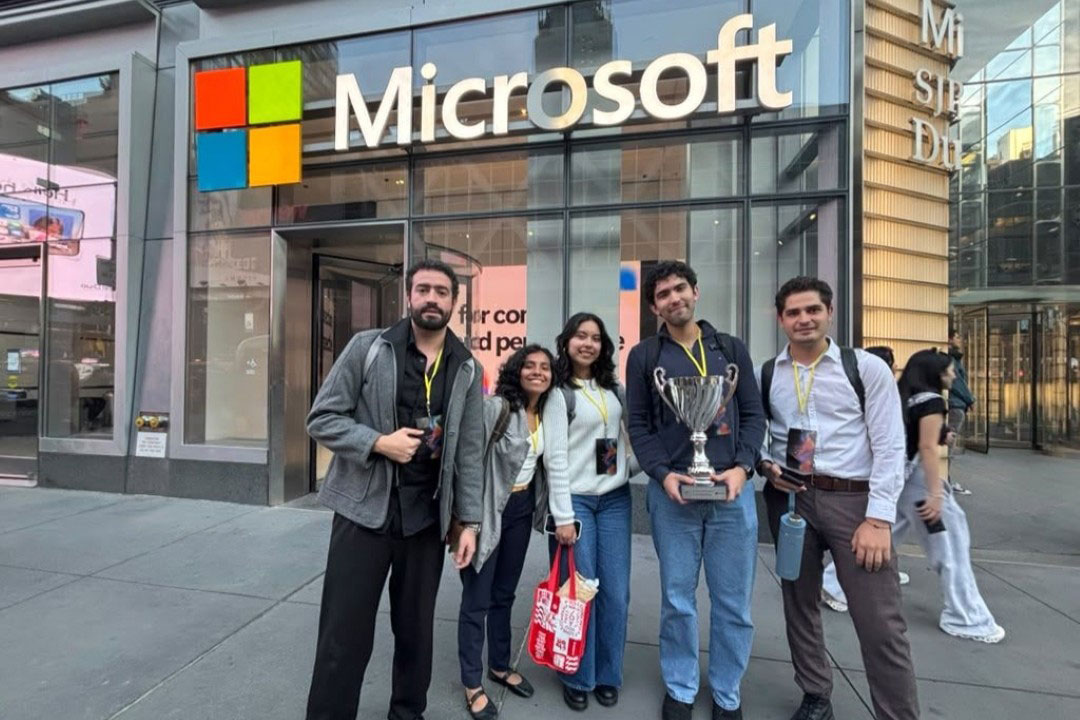
A team of computing and engineering RIT students went to Microsoft’s Times Square headquarters in New York City for the LEAD ASPIRE hackathon. RIT won the competition, which tasked the team to take on a real business challenge and pitch a solution to the clients. The student team included Gesem Mejia, left, Carla Lopez, Denise Reyes Lujan, Cristian Morataya, and Emilio Garcia Rabell.
Five Rochester Institute of Technology students won first place at a Microsoft hackathon in New York City after developing a strategy to help AI agents make better shopping decisions.
The competition, called LEAD Aspire 2026, asks students to step into the role of a Microsoft Cloud and AI Specialist for a day and work alongside professionals from Microsoft, Mastercard, EY, and GitHub. Out of more than 1,000 applications, the RIT team was selected as one of 17 finalists to take a real business challenge from the very first conversation all the way to a working solution.
The team, calling themselves Los Tigres de RIT, included:
- Denise Reyes Lujan, a fifth-year computer science student from New Rochelle, N.Y.;
- Gesem Mejia, an electrical and computer engineering Ph.D. student from Mexico;
- Carla Lopez, a fifth-year software engineering student from Peru;
- Cristian Morataya, a fifth-year computer engineering student from Chicago;
- Emilio Garcia Rabell, a fifth-year computer engineering student from Mexico.
“The goal was to understand client needs, develop a strategy, create a solution using Microsoft’s AI technologies, and pitch its value all within an eight-hour-day,” said Reyes Lujan.
The group of friends initially missed the application deadline. Rather than give up, Reyes Lujan contacted an organizer directly, through LinkedIn, who said that they really admired her team’s initiative.
To make the trip to New York City, the team received funding support from RIT’s Golisano College of Computing and Information Sciences, Kate Gleason College of Engineering, and Student Government.
Once at Microsoft’s Times Square office, the students met with Mastercard representatives to learn about the company’s challenges and identify an opportunity. The industry leaders asked students to consider how to build consumer trust in agentic e-commerce, an emerging area of online shopping that uses AI agents to make shopping fast and convenient.
After researching Mastercard’s existing initiatives, the team decided its strongest approach was to add value to what the company already has. However, Reyes Lujan said they weren’t sure if the team’s idea was innovative enough, so they consulted with one of the product managers.
“She mentioned that the best ideas for their company are things that they can easily implement—or fit in with—what they currently have,” Reyes Lujan said. “I think this was something the really helped us stand out.”
Align Buddy is the solution
The RIT team developed Align Buddy, an AI-powered tool that double checks purchases to ensure that AI agents are making decisions that consumers actually want.
Align Buddy is designed to complement Mastercard’s existing Agent Pay and Verifiable Intent initiatives. Rather than simply using binary classification to determine whether a transaction was being initiated by an agent, Align Buddy uses a complete AI model to develop a more complete picture of individual customer preferences using previous transactions and preferences. It then evaluates potential purchases to determine whether they fit the customer’s expectations.
For example, if a customer consistently books nonstop flights, Align Buddy could flag a proposed itinerary that has multiple layovers. And Align Buddy would evaluate this before the payment is made, helping reduce returns and increase customer satisfaction.
The students said that RIT’s required co-op, internship, and capstone team projects helped distinguish the team at the competition, providing them with relevant experiences working with customers and building solutions that businesses can adopt.
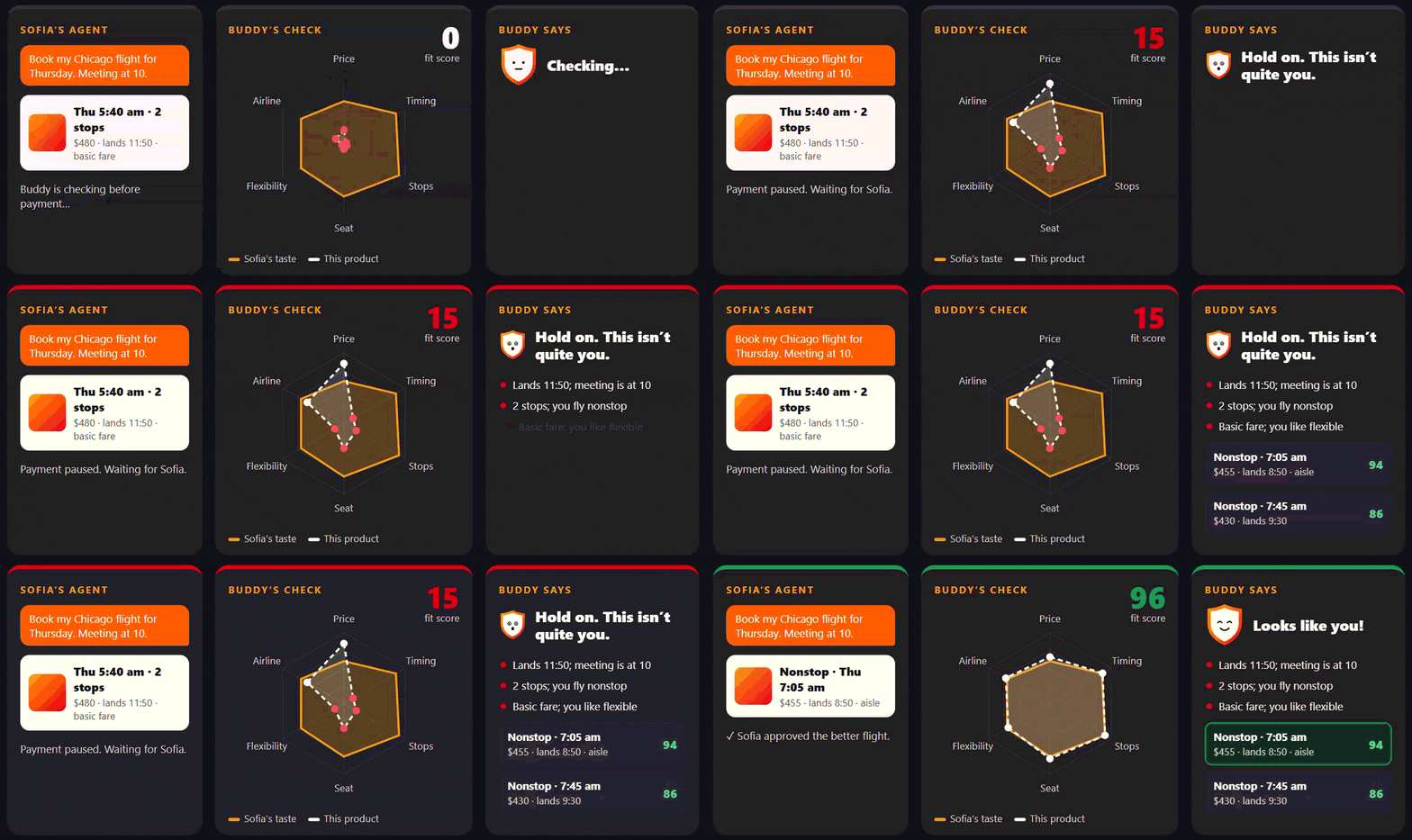
Is this what the customer wanted? Did the AI agent pick the best item? Is this really the customer? To make sure AI agents get it right, Align Buddy, made by a team of RIT students, asks these questions before a purchase is made.
The team earned a trophy and headphones with the win. However, the students said that it was clear from the beginning that the most valuable prize was networking and building connections with professionals from Microsoft, Mastercard, EY, and GitHub.
“When we received the trophy, everyone gave us their LinkedIn information and said, ‘If you ever wanted to work at our company, you guys are exactly what we want,’” Mejia said. “They said, ‘We want people who know how to interpret data, build models, and solve these types of problems.’”
Several of the RIT team members met through, and have been involved with, RIT’s chapter of the Society of Hispanic Professional Engineers.