Science and Math News
-
February 7, 2023
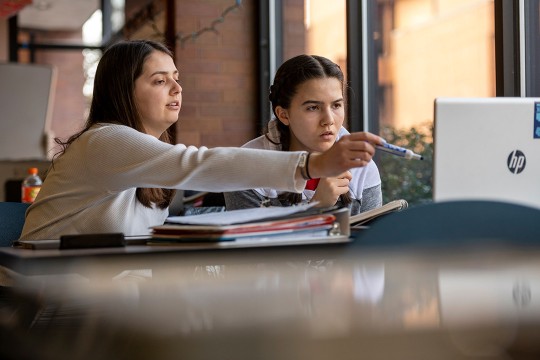
Academic Success Center: A place to boost grades, and confidence
One of the first lessons students learn at college is that studying and completing their homework is probably a lot different than it was in high school. That’s why free walk-in study areas were created decades ago at RIT, where students can do their homework and be helped by trained student peers.
-
February 1, 2023
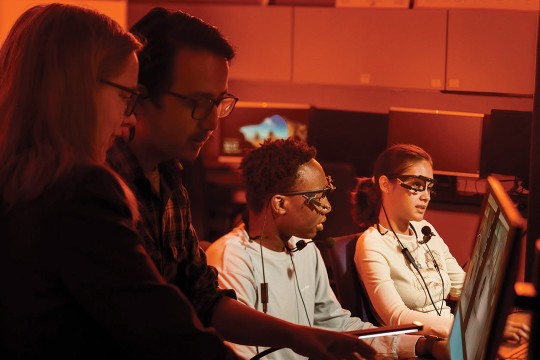
Doctoral offerings keep growing
RIT is growing its Ph.D. offerings, adding one new program in the fall of 2023 and two in 2024. This fall, Saunders College of Business will offer a Ph.D. in business administration. In 2024, the College of Liberal Arts will introduce a new doctoral degree in cognitive science and the College of Science will launch a Ph.D. in physics.
-
January 27, 2023
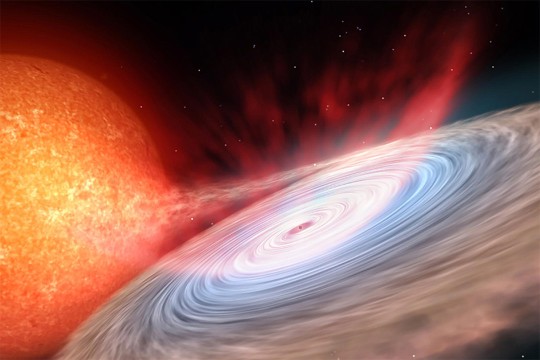
RIT scientists reach a milestone in the search for continuous gravitational waves
Scientists on the hunt for a previously undetected type of gravitational waves believe they are getting close and have refined techniques to use in upcoming observational runs. Researchers from the LIGO-Virgo-KAGRA Collaboration outlined the most sensitive search to date for continuous gravitational waves from a promising source in a paper recently published in the Astrophysical Journal Letters.
-
January 19, 2023

RIT’s Wegmans School of Health and Nutrition offers new MS degree in dietetics and nutrition
RIT is offering a new master’s degree in dietetics and nutrition to prepare graduates to become registered dietitian nutritionists with a deep understanding of food as medicine. The two-year graduate program will start in the fall and enrollment is open now.
-
January 18, 2023
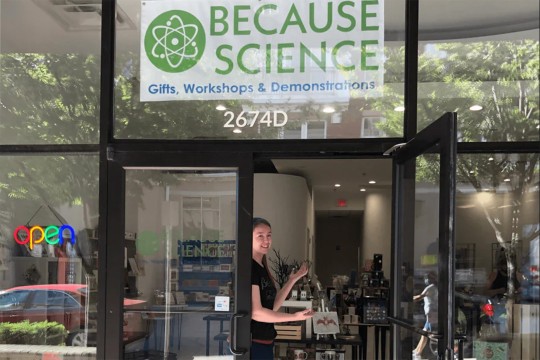
Because Science: How a new DC shop is blending science with art
WUSA-TV features Amanda Preske ’09 (chemistry), founder of Circuit Breaker Labs and Because Science.
-
January 16, 2023

RIT scientists help rediscover earliest known star map using multispectral imaging
Scientists uncovered what they believe to be the first astronomical map. The discovery, outlined in recent studies published in the Journal for the History of Astronomy and the Classical Quarterly, was made in part thanks to multispectral imaging conducted by researchers at Rochester Institute of Technology’s Chester F. Carlson Center for Imaging Science.
-
January 12, 2023

RIT’s Golisano Institute for Sustainability forms partnership agreement with Wells College
A partnership agreement between RIT’s Golisano Institute for Sustainability and Wells College will enable students from the Aurora, N.Y., school to enroll in RIT’s sustainable systems MS degree program.
-
January 9, 2023

Building an esports community
Hundreds of millions of people around the globe are engaging in electronic sports, called esports. It’s a billion dollar industry, where fans watch as their favorite professional and amateur players take each other on in some of the most popular video games. Since starting an esports club in 2016, RIT has become one of the nation’s largest and best collegiate esports programs.
-
January 9, 2023

Staying busy between semesters
During the 15 weeks between spring and fall semester, RIT students are finding ways to embrace new challenges. Some are taking the stage and performing. Others are winning club championships. For many, summer is a time to get work experience and participate in research projects, traveling abroad, and helping others while pursuing their passions.
-
January 9, 2023

Pursuing the promise of Title IX
Fifty years ago, Title IX set the stage for change. But the reason why RIT now has more women faculty, administrators, coaches, and exemplary students is that women acted. Prior generations of women invested their careers to make RIT a better version of itself, including winning two transformative grants from the National Science Foundation focused on gender equity.
-
January 9, 2023

James Webb Space Telescope study reveals wide diversity of galaxies in the early universe
New data from the James Webb Space Telescope (JWST) have revealed that the structures of galaxies in the early universe were much more diverse and mature than previously known. RIT Associate Professor Jeyhan Kartaltepe said that JWST’s ability to see faint high redshift galaxies in sharper detail than Hubble allowed the team of researchers to resolve more features and see a wide mix of galaxies.
-
December 21, 2022
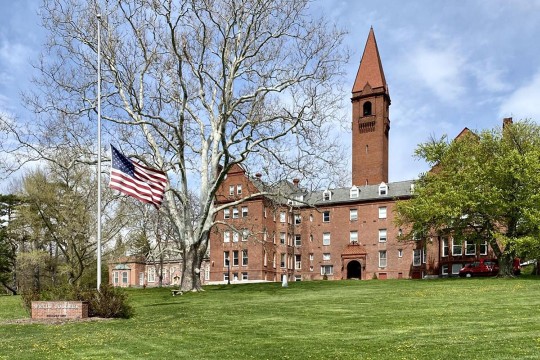
Wells partners with RIT on sustainability program
The Auburn Citizen features a partnership between Wells College and RIT's Golisano Institute for Sustainability.